At UN General Assembly, US Delegation Walks Out as Iranian President Speaks: Tensions Peak
Baca dalam 60 detik
- Delegasi Amerika Serikat meninggalkan ruang sidang Majelis Umum PBB ketika Presiden Iran Masoud Pezeshkian menyampaikan pidato yang mengecam keras pernyataan Donald Trump sehari sebelumnya.
- Pezeshkian menegaskan Iran adalah korban terorisme, bukan pelaku, dan menuduh AS serta Israel menggunakan senjata yang menewaskan anak-anak dalam serangan ke sebuah sekolah.
- Aksi walkout ini memperdalam isolasi diplomatik AS di forum multilateral dan berpotensi mempersulit upaya mediasi internasional, termasuk bagi Indonesia yang aktif mendorong perdamaian.
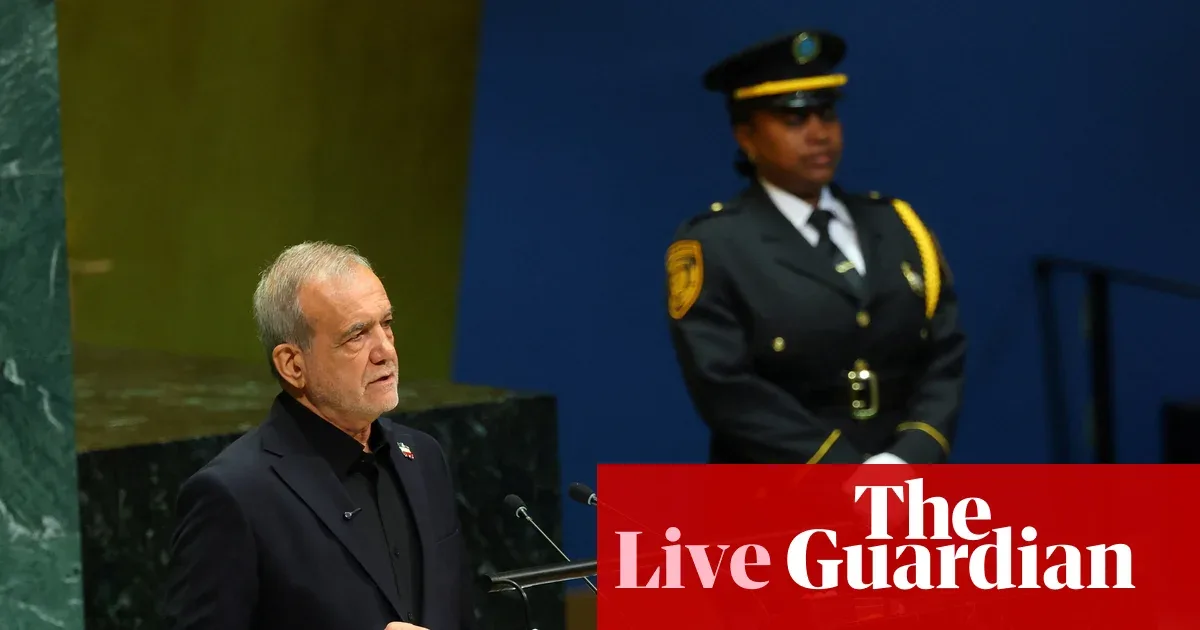
The United States delegation conspicuously left the hall of the UN General Assembly on Tuesday (23/9/2026) as Iranian President Masoud Pezeshkian took the podium and launched a counterattack against President Donald Trump's remarks a day earlier. The walkout became the most dramatic moment of the high-level debate session in New York, marking an escalation of rhetoric between Washington and Tehran on the most prestigious multilateral stage.
Pezeshkian, speaking in an emotional tone, responded to Trump's accusation that Iran is a terrorist state. "The US President called us terrorists. We are in fact victims of terrorism," he said, as quoted from The Guardian's live report. He then accused the United States of bombing a school and causing children to die from weapons used by the US and Israel. The statement sparked tension in the chamber, and several delegations appeared uneasy.
In his speech, Pezeshkian stressed that Iran does not bow its head and does respond, but never attacks civilian populations. "We only defend ourselves – we are not terrorists," he said. But as he continued his oration, the US delegation led by its Ambassador to the UN chose to walk out of the room. The move was not merely a symbolic protest; it underscored how fragile the diplomatic path is between the two countries that have for years been locked in nuclear tensions and proxy conflicts in the Middle East.
For Indonesia, the dynamics at the UN are not merely a geopolitical spectacle. As the country with the largest Muslim population and a tradition of independent and active diplomacy, Jakarta has a direct interest in Middle East stability. A heated US-Iran conflict could disrupt global energy supplies, given that Iran is one of the main oil producers. A rise in crude oil prices would affect energy subsidies and domestic inflation, ultimately burdening the state budget and people's purchasing power.
In addition, Indonesia often serves as a bridge for dialogue between the Islamic world and the West. Rising tensions at the UN could narrow Indonesia's room to maneuver in promoting a two-state solution for Palestine and encouraging regional peace. Indonesia's Foreign Minister, present in New York, is scheduled to hold a series of bilateral meetings, including with Gulf states, to discuss the impact of this escalation. Indonesia's position of non-alignment yet criticism of violations of international law will be tested.
"The walkout by the US delegation shows that the diplomatic path is narrowing. This is a signal that both sides are not yet ready for substantive dialogue," said an international relations analyst from the University of Indonesia, who asked not to be named because he was not authorized to speak to the media.
Some observers assess that the US protest could trigger similar responses from allied countries, potentially isolating Iran further. However, Tehran could instead use this moment to strengthen its narrative as a victim of aggression and draw sympathy from non-aligned countries. In the long term, this tension could hamper efforts to revive the long-stalled 2015 nuclear deal (JCPOA).
The question is, will the UN forum remain an effective space for dialogue, or will it instead turn into a stage for a contest of influence that further widens the gap between major powers? For Indonesia, the choice to remain consistent with the principle of independent and active diplomacy and to push for a peaceful settlement will be a true test of diplomacy.