Constitutional Court Gives Two-Year Deadline, Bakamla Institutional Structure Must Be Overhauled
Baca dalam 60 detik
- Mahkamah Konstitusi memerintahkan DPR dan pemerintah merevisi UU Kelautan untuk mendesain ulang Bakamla dalam dua tahun.
- Jika tidak dipenuhi, kewenangan penegakan hukum Bakamla dinyatakan inkonstitusional dan kehilangan kekuatan mengikat.
- Putusan ini membuka jalan penataan ulang tata kelola keamanan laut nasional yang selama ini dinilai tumpang tindih.
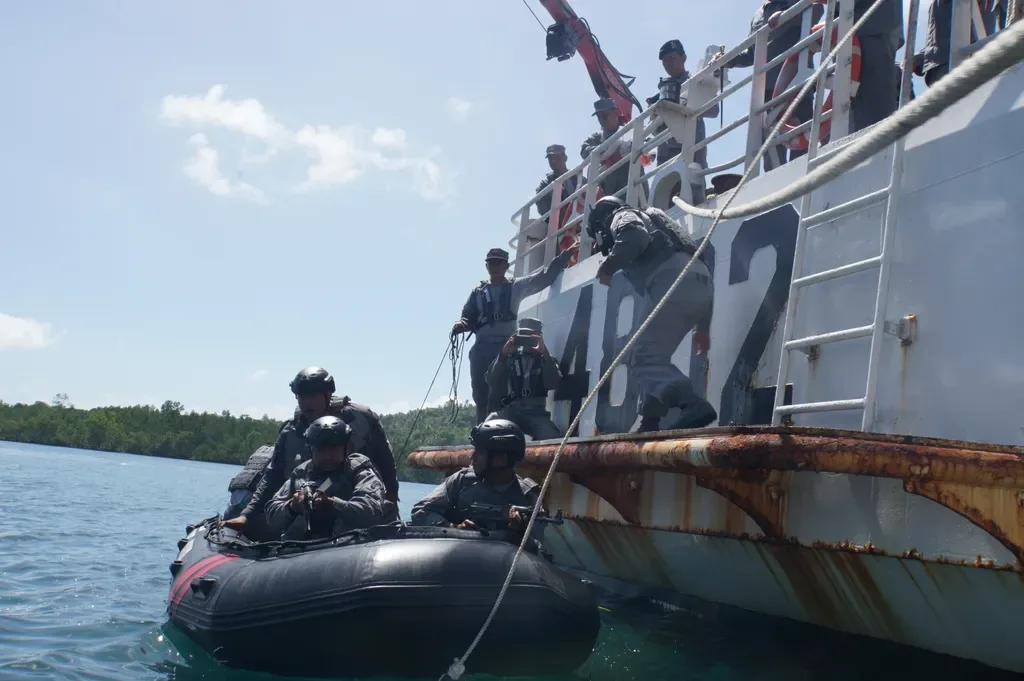
The Constitutional Court (MK) has ordered the House of Representatives (DPR) and the government to overhaul the institutional structure of the Maritime Security Agency (Bakamla) within a maximum of two years. The order is contained in a ruling on the judicial review of Law No. 32 of 2014 on Maritime Affairs, which declared several articles conditionally unconstitutional. If no follow-up is taken, Bakamla's law enforcement authority will automatically lose its constitutional basis and no longer be legally binding.
The non-ministerial government agency has so far carried out patrol, surveillance, and enforcement functions in Indonesian jurisdictional waters. However, the MK deemed the legal construction underpinning it no longer adequate. The requested redesign covers the nature, duties, functions, and authority attached to Bakamla. This means lawmakers cannot simply patch up articles; they must comprehensively reformulate the institutional architecture.
The decision is a blow to the status quo of national maritime governance. For years, overlapping authority among Bakamla, the Indonesian Navy, Polairud, and the Ministry of Marine Affairs and Fisheries has been in the spotlight. Various maritime operations often involve more than one institution with different legal bases. The MK appears to want to ensure there is no longer any ambiguity of authority that leads to weak law enforcement in Indonesian waters.
For Indonesia as an archipelagic state, the implications of this ruling are far-reaching. Bakamla is at the forefront of safeguarding maritime territory, including countering illegal fishing, smuggling, and violations of sovereignty. Without a solid legal basis, every enforcement action risks being challenged in court. Maritime criminals could also exploit this gap to weaken Indonesia's position in strategic waters such as Natuna, the Malacca Strait, and the Arafura Sea.
"The MK asks lawmakers to redesign Bakamla's institutional structure, particularly regarding its nature, duties, functions, and authority," the core of the ruling's reasoning states.
The DPR and the government now bear the political burden of formulating a revision that not only meets constitutional demands but also strengthens Bakamla's position vis-à-vis other law enforcement institutions. One option that has emerged is to clarify Bakamla's position as a maritime law enforcement agency under its own law, rather than merely part of the Maritime Law. However, this option could trigger a tug-of-war over authority with already established institutions.
Maritime law observers argue the MK ruling should be a momentum for consolidation, not merely a legislative formality. They warn that the overhaul must be accompanied by strengthening human resources, fleet, and budget. Without that, changing the law would only produce authority on paper with no real impact in the field. The government is also urged to involve academics and civil society organizations so the revision process does not get trapped in sectoral interests.
With the two-year deadline, the public will watch whether the DPR and the government are serious about fixing Bakamla's institutional structure or instead stall until the deadline. If they fail, the biggest risk is not only the loss of law enforcement authority but the weakening of Indonesia's sovereignty at sea, which is increasingly contested. Will this ruling become a turning point for maritime security governance, or merely a neglected historical footnote?