Jatigede Reservoir Shrinks, Dead Village at the Bottom of the Lake Reappears
Baca dalam 60 detik
- Surutnya Waduk Jatigede di Sumedang mengungkap kembali bangunan permukiman lama yang selama ini tenggelam di dasar danau.
- Fenomena ini menandai tekanan kekeringan yang kian berat di Jawa Barat dan mengancam pasokan air irigasi serta pembangkit listrik.
- Pemerintah daerah dituntut mempercepat mitigasi kekeringan sebelum musim hujan datang dan konflik air meluas.
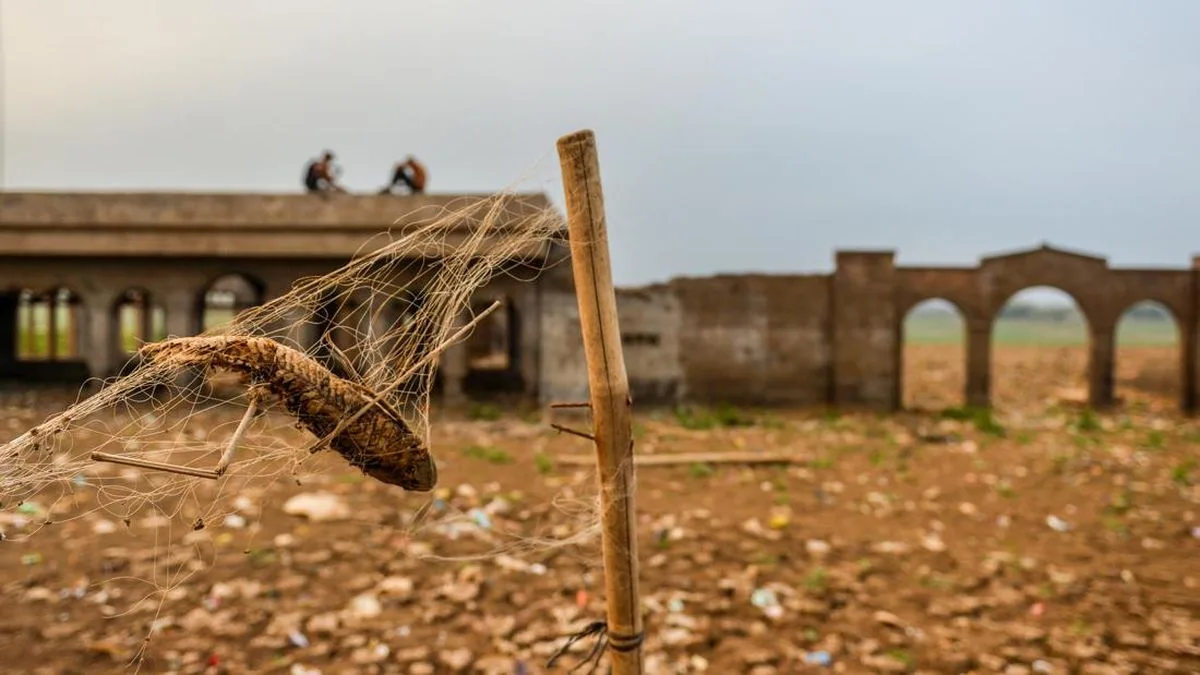
The water of Jatigede Reservoir in Sumedang Regency, West Java, has shrunk sharply during the dry season, exposing the remains of settlements that had been submerged for years. A mosque building, a playground, and even a sunken boat that had vanished at the bottom of the lake are now visible at several points along the shore, including in Cipaku Village and Sukamenak Village, Darmaraja District.
The reappearance of the old village is not merely a rare sight. It signals that the water volume in one of West Java's largest reservoirs is under serious pressure. Jatigede has long supported irrigation for hundreds of thousands of hectares of rice fields in Pantura and Cirebon, while also serving as a raw water source and a hydroelectric power plant. When the water level drops, that entire supply chain is disrupted.
According to residents' observations and documentation by the West Java Regional Disaster Management Agency (BPBD), areas usually covered by water have turned into land passable by two-wheeled vehicles. Children were seen playing among the exposed mosque buildings, while fishing nets snagged on the remains of building structures. The scene shows how quickly the reservoir's shoreline has shifted toward the center.
For downstream farmers, this condition is an alarm. Planting schedules that depend on irrigation supply from Jatigede could be delayed if the water discharge continues to decline. The provincial government and the River Basin Authority (BBWS) are being pressed to recalculate water allocation so that household, agricultural, and power plant needs remain met in balance.
"The receding reservoir shows that climate pressure is no longer a matter of long-term prediction, but a daily operational issue that must be responded to quickly," said a local official monitoring conditions at Jatigede, as quoted from a field report.
This phenomenon is not the first. During the 2023 and 2024 dry seasons, several reservoirs in West Java and Central Java also experienced significant water level drops. The recurring pattern strengthens the suspicion that the dry season cycle on Java Island is becoming drier and longer, in line with regional climate change projections.
On the policy side, questions arise over whether the management of a multipurpose reservoir like Jatigede already has adequate emergency protocols. So far, coordination among regency, provincial, and ministry governments has often overlapped, especially when deciding water allocation priorities amid a crisis.
If the dry season continues, the risk of interregional water conflict could rise. Sumedang, Indramayu, and Cirebon regencies, which all depend on Jatigede, could clash over water quotas. On the other hand, inland fishermen who rely on the reservoir for their livelihood also lose their source of income when water volume shrinks drastically.
The central government, through the Ministry of Public Works and Housing, needs to accelerate the modernization of a sensor-based water discharge monitoring system, so that allocation decisions can be made based on real-time data rather than seasonal estimates. That step would also help the Meteorology, Climatology, and Geophysics Agency (BMKG) compile more precise drought early warnings.
Just as important, the reappearance of the old village at the bottom of Jatigede carries a social dimension that is rarely discussed. Thousands of families were relocated when the reservoir was built in the 2000s. Now, as the remains of their homes and mosque become visible again, the collective memory of that sacrifice also resurfaces.
The question is whether the state will interpret the reappearance of the village merely as a visual phenomenon, or as a call to redesign the national water resilience strategy before the next crisis arrives sooner than expected?