Home Ministry Oversees TB Elimination Down to Regions, Wiyagus Highlights Health Budget and Minimum Service Standards
Baca dalam 60 detik
- Wamendagri Akhmad Wiyagus menegaskan komitmen pusat mengawal eliminasi tuberkulosis sampai ke pemerintah daerah.
- Kemendagri mendampingi Kemenkes mengintegrasikan skrining TBC dengan program Cek Kesehatan Gratis.
- Kota Mojokerto menjadi contoh dengan alokasi anggaran kesehatan di atas 20 persen APBD, tetapi pemenuhan SPM masih jadi pekerjaan rumah.
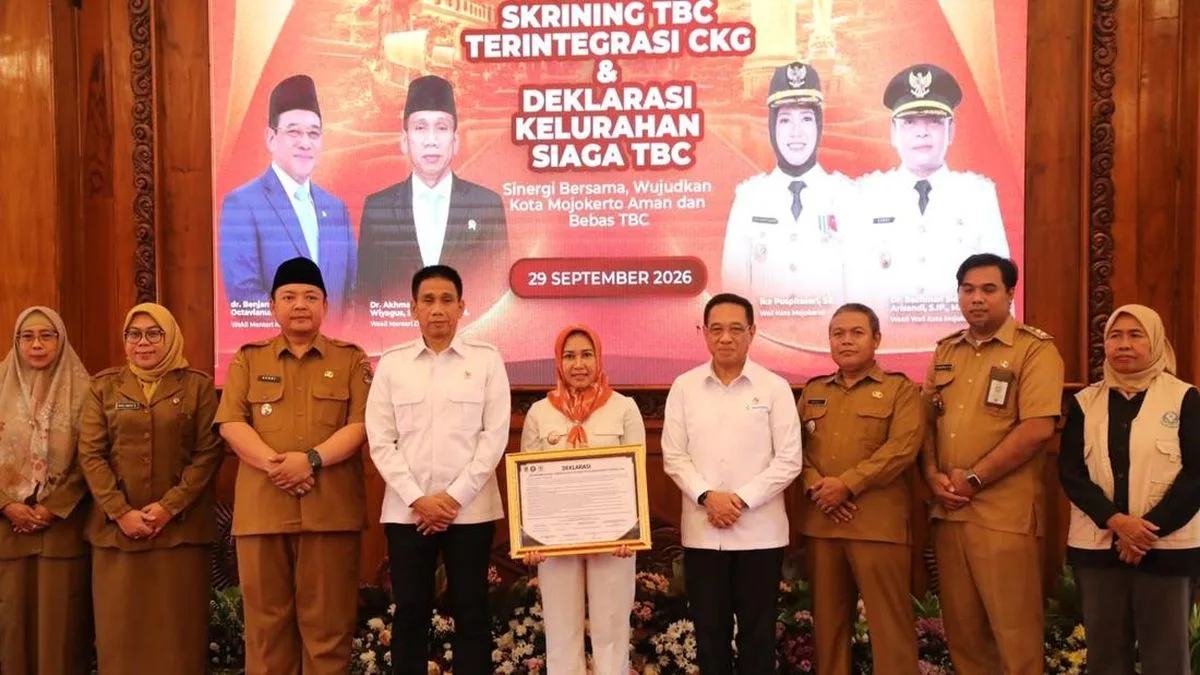
Deputy Minister of Home Affairs Akhmad Wiyagus stressed that the Ministry of Home Affairs will oversee tuberculosis elimination efforts down to local governments. The statement was made at the Interactive Dialogue and Declaration of TB-Ready Villages at Pendopo Sabha Mandala Madya, Mojokerto City Hall, East Java, Tuesday (29/9).
According to Wiyagus, the success of the national TB control program cannot rely solely on central government policy. Local governments hold a key role because health is a mandatory government affair that directly intersects with basic services. "Strengthening the role of local governments is key so that the national TB control program does not stop at policy, but can be realized in concrete steps in the community," he said.
Wiyagus added that the Home Ministry is assisting the Ministry of Health in integrating TB screening with the Free Health Check (CKG) program. He assessed that this integration shows the Home Ministry's seriousness in fully supporting the Health Ministry's program. "The CKG and TB elimination and control are on the same level, the same, that is why they are integrated," Wiyagus said.
Wiyagus reminded that local government involvement has a legal basis in Law Number 23 of 2014 on Regional Government. The regulation governs the division of affairs between the central and regional governments, including the obligation of regions to prioritize health. "Each local government is legally required to prioritize this health issue, as set out in planning documents, both the RPJMD as a derivative of the RPJMN, then the RKPD, the strategic plans of regional apparatus organizations, up to the APBD," he explained.
He cited Mojokerto City, which allocates more than 20 percent of its APBD to health. According to Wiyagus, the size of that allocation is in line with the city's achievement of winning an award for access to health services in the Java and Bali region. "It means it is not a lie, that what is budgeted is in line with its purpose, the outcome of which is achievement," he said.
Nevertheless, Wiyagus assessed that strengthening health services, including TB control, still needs to be carried out sustainably. He highlighted the importance of fulfilling the Minimum Service Standards (SPM), especially by increasing the capacity of personnel to find TB cases, integrate data, and ensure that indicated patients receive treatment. "SPM achievement is determined by the capacity of the personnel handling this in a collaborative manner, to find cases, integrate data, then treat them once found, do not let them be left alone," he stressed.
The meeting was also attended by Deputy Minister of Health Benjamin Paulus Octavianus, Mojokerto Mayor Ika Puspitasari, heads of departments within the Mojokerto City Government, subdistrict heads across Mojokerto City, and a number of related officials. The presence of cross-ministerial and local government representatives shows that TB control cannot run on its own.
From a policy perspective, integrating TB screening into the CKG has the potential to expand the reach of case detection at the community level. However, the main challenge remains regional capacity: whether the allocated budget is truly converted into services that reach vulnerable groups, including those who have long struggled to access health facilities. Mojokerto City can serve as a policy laboratory, but replication to other regions requires planning and budgeting discipline that is not uniform.
Going forward, the question is no longer about commitment on paper, but how quickly regions can fulfill health SPM and close the TB detection gap. If the CKG integration runs effectively, the TB elimination target can be more measurable. Conversely, without strengthening personnel and data, the declaration of TB-ready villages will only stop as a ceremony.