Indonesia Offers Just Transition Model at UN Climate Summit, Jumhur: Growth and Environment Must Go Hand in Hand
Baca dalam 60 detik
- Menteri Lingkungan Hidup Moh. Jumhur Hidayat menegaskan komitmen iklim Indonesia di Climate Summit 2026, New York, dengan menekankan keseimbangan antara pertumbuhan ekonomi dan perlindungan lingkungan.
- Indonesia memaparkan strategi lintas sektor: pengurangan emisi metana, dekarbonisasi industri, energi surya, B50, dan kendaraan listrik, serta adaptasi pesisir melalui Giant Sea Wall.
- Menjelang COP31, Indonesia mendorong pembiayaan iklim yang adil dan akses loss and damage, sambil menegaskan multilateralisme harus menghasilkan perlindungan nyata bagi negara rentan.
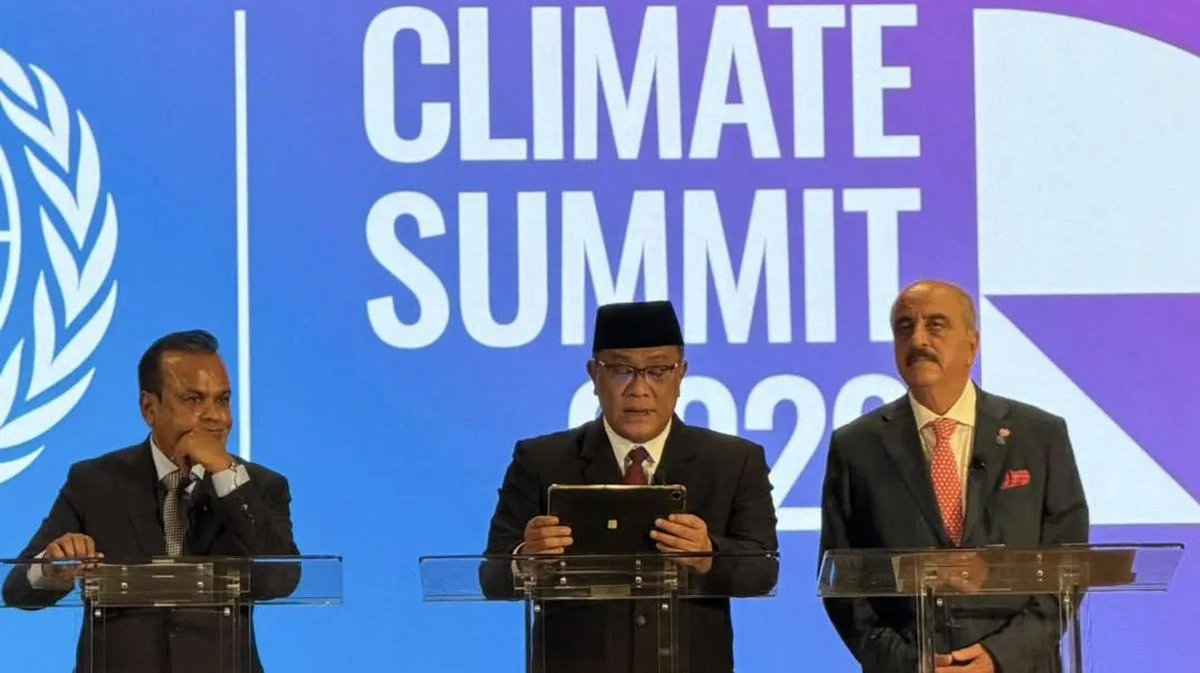
Minister of Environment/Head of the Environmental Control Agency (BPLH) Moh. Jumhur Hidayat stressed that Indonesia is not only talking about climate targets, but has translated them into cross-sector actions that unite economic growth, energy resilience, poverty alleviation, and environmental protection. The message was delivered at the Interactive Leaders Dialogue at the Climate Summit 2026 on Climate Action and the Just Transition, part of the 81st UN General Assembly session in New York, Wednesday (23/9/2026).
The forum, opened by UN Secretary-General António Guterres, was attended by a number of heads of state and government, including President of Türkiye Recep Tayyip Erdoğan, Australian Prime Minister Anthony Albanese, European Commission President Ursula von der Leyen, President of Palau Surangel Whipps Jr., and Barbados Prime Minister Mia Mottley. The meeting served as a stage for countries to demonstrate concrete commitments ahead of COP31 in Antalya, Türkiye, with three main focuses: accelerating emissions reduction, affordable financing for developing countries, and strengthening adaptation and climate resilience.
In his speech, Jumhur emphasized that the Paris Agreement remains the compass, but the room to keep the temperature rise below 1.5 degrees Celsius is narrowing. "Our task is to bridge global commitments into real results, guided by fairness and the principle of common but differentiated responsibilities in accordance with respective capabilities," he said. He added that Indonesia's development paradigm is clear: growth and environmental protection must advance together.
Indonesia outlined a number of concrete actions: emissions reduction from waste and methane, industrial decarbonization, development of low-carbon industry, responsible implementation of carbon capture, utilisation and storage (CCUS), large-scale solar energy development, and the use of B50 fuel to strengthen energy resilience. The development of electric vehicles is also part of the low-carbon industrial transformation and strengthening domestic value addition.
"The transition must be just, orderly, country-led, and people-centered. Success is not measured only by technology or investment value, but also by energy affordability, decent work, local value addition, protection of vulnerable groups, and tangible environmental benefits," Jumhur stressed.
Beyond the main session, Indonesia held three Solution Dialogues addressing climate financing, adaptation financing in the era of overshoot, and methane reduction. In the financing dialogue, Indonesia emphasized that funds must follow the needs of NDC implementation and the National Adaptation Plan (NAP), from program preparation, technology, capacity building, implementation, transparency, to learning. Grants and highly concessional financing remain crucial for risk data, early warning systems, ecosystem protection, local government capacity, and community action. Indonesia also pushed for loss and damage support that is timely, adequate, and easily accessible.
Methane reduction is an example of climate action with a direct impact on society. Improved waste and wastewater management, circular economy, data, measurement, reporting and verification (MRV), technology, and local government capacity can lower emissions while improving air quality, health, and public services. As an archipelagic country, Indonesia emphasizes that adaptation must go hand in hand with mitigation. Besides the Giant Sea Wall, protection and restoration of mangroves and coastal ecosystems are priorities to safeguard communities, livelihoods, and coastal regional development.
For Indonesia, the climate agenda is not an add-on issue. Decisions on energy, industry, investment, waste, financing, and coastal areas will determine food security, health, jobs, environmental quality, and the ability of communities to face increasing climate risks. Domestically, policies such as B50 and the development of electric vehicles are expected to reduce dependence on fossil fuel imports, although financing challenges and infrastructure readiness still loom. The government needs to ensure the transition does not burden vulnerable groups and instead creates green jobs.
Ahead of COP31, Indonesia is pushing for credible progress in the implementation and enhancement of the New Collective Quantified Goal on Climate Finance. Jumhur stressed that multilateralism must produce real protection and development opportunities, especially for countries most vulnerable to the climate crisis. "Indonesia is ready to deepen partnerships that turn climate ambition into real development opportunities and resilience for all," he said. The question is, will these promises materialize into concrete policies felt all the way to coastal villages and industrial areas?