Boat Crash Test in Tennessee Yields G-Force Data, Could Change How Marine Accidents Are Investigated
Baca dalam 60 detik
- Hefring Marine memasang sistem IMAS pada dua kapal yang ditabrakkan secara terkendali di Knoxville, Tennessee, menghasilkan data percepatan hingga 10,9 G.
- Data tersebut memungkinkan rekonstruksi pergerakan kapal sebelum, selama, dan setelah benturan, melampaui bukti video biasa.
- Teknologi ini masih terbatas untuk klien komersial dan pemerintah, namun berpotensi mempercepat investigasi kecelakaan laut di masa depan.
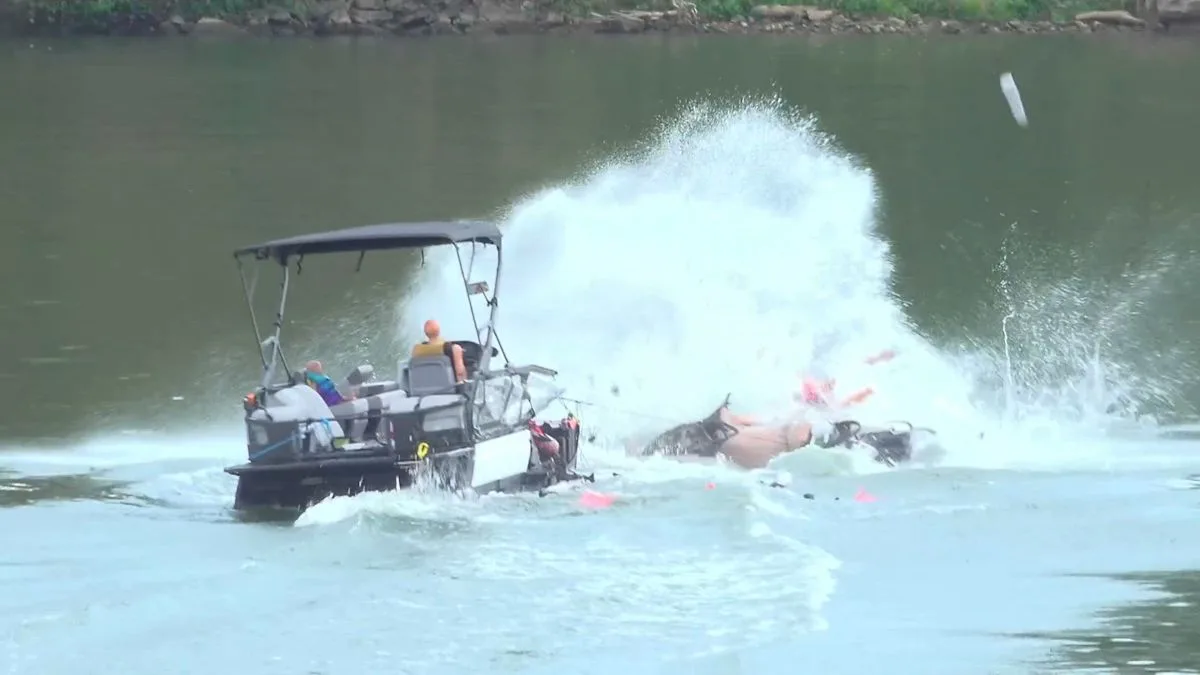
A deliberate boat collision demonstration in Knoxville, Tennessee, last week did more than provide dramatic footage of two boats crashing into each other. More than that, the controlled incident produced telemetry data recording the behavior of both vessels before, during, and after the impact — a breakthrough that could change how investigators reconstruct real-world maritime accidents.
Hefring Marine, a maritime technology company from Iceland, installed its Intelligent Marine Assistance System (IMAS) on both vessels involved in the demonstration, held as part of the annual conference of the National Association of State Boating Law Administrators (NASBLA) in Knoxville. The system recorded the movement, speed, and shocks that occurred during the simulated collision.
Philip Miller, Hefring's head of business development for the United States, said the Sea-Doo used was traveling slightly above 40 mph before the impact. At the point of collision, a dummy on the Sea-Doo recorded acceleration of 10.9 G, while another sensor on the same vessel recorded 9 G. The pontoon boat recorded 5.8 G. These figures add a new dimension to understanding accident dynamics that cameras do not capture.
Miller said this data provides another way to examine what happened during the collision, beyond what is visible in video. "From an investigative standpoint, what you can do is reconstruct the scene," he said. IMAS itself uses an inertial measurement unit (IMU) to detect changes in a vessel's motion. Miller likened it to a smartphone that knows when it has been dropped. "When I drop my iPhone, it knows I dropped it to a certain degree. We have a similar IMU," he explained.
When the system detects a significant change in motion, it records the spike and attaches a timestamp to the event. This allows investigators to see how the vessel was operated leading up to the impact, including its speed and direction. "We can tell whether the boat accelerated quickly or turned sharply," Miller said. However, the technology does not by itself determine the cause of an accident. Investigators still need other evidence to determine whether factors such as mechanical failure, alcohol, or operator experience contributed.
Hefring has previously supplied data to investigators, including after an incident in Iceland. Miller said investigators can review the data shortly after an event and use it to understand what happened before and during the impact. The company has also worked with maritime operators and government organizations that use IMAS technology. Currently, Hefring mainly serves commercial and government customers, including agencies and law enforcement, rather than the average recreational boat owner. Broader use among recreational users would require additional development as well as interest from government agencies and the maritime industry.
"From my perspective, that silence ... we need to address boating, whether with a Sea-Doo or a pontoon boat, more seriously," said Philip Miller.
For the Tennessee demonstration, Hefring submitted an accident report generated from the collected data to officials. Miller said the report was produced in less than 24 hours and is now under review. Hefring also markets IMAS as a decision-support system intended to help operators avoid dangerous situations before a collision occurs. The system can provide real-time guidance based on vessel speed, motion, and surrounding conditions.
However, Miller emphasized that the controlled collision itself had a different purpose: to create a realistic accident that could be studied afterward. NASBLA has previously held simulated boat collisions several times as part of efforts to improve incident reporting, evidence collection, and maritime accident investigation training. Their annual conference brings together recreational boating safety professionals from various states and other involved parties.
For Indonesia, this development offers a valuable lesson. As an archipelago with heavy maritime traffic, including tourist waters such as Bali, Labuan Bajo, and Raja Ampat, Indonesia faces a not-insignificant risk of boat accidents. Data from the KNKT shows that maritime accident investigations in the country are often hampered by limited evidence, especially due to the scarcity of data recorders such as black boxes. IMAS technology could serve as a reference for regulators such as the Ministry of Transportation and Basarnas to encourage the installation of similar devices on passenger ships, tourist boats, and modern fishing fleets. If adopted, Indonesian investigators could speed up analysis of accident causes, improve operator accountability, and ultimately save more lives.
Going forward, the question is no longer whether vessel data recorder technology will become standard, but how quickly regulators in various countries — including Indonesia — will mandate it. Without policy momentum, innovations such as IMAS will remain exclusive tools for large commercial operators, while accidents at sea remain difficult puzzles to solve.