Four Hours of Prabowo Absorbing Expert Input: A New Strategy to Control Forest and Peat Fires
Baca dalam 60 detik
- Presiden Prabowo Subianto menggelar rapat tertutup selama empat jam bersama akademisi dan BRIN untuk membahas pengelolaan gambut serta penanggulangan karhutla.
- Diskusi menyoroti tiga fokus: penanganan darurat, konservasi ekosistem gambut, dan pemilihan varietas tanaman yang adaptif.
- Pemerintah berencana memperkuat Satgas Darat dan menerapkan teknik pengeboran dangkal untuk pemadaman api di lahan gambut.
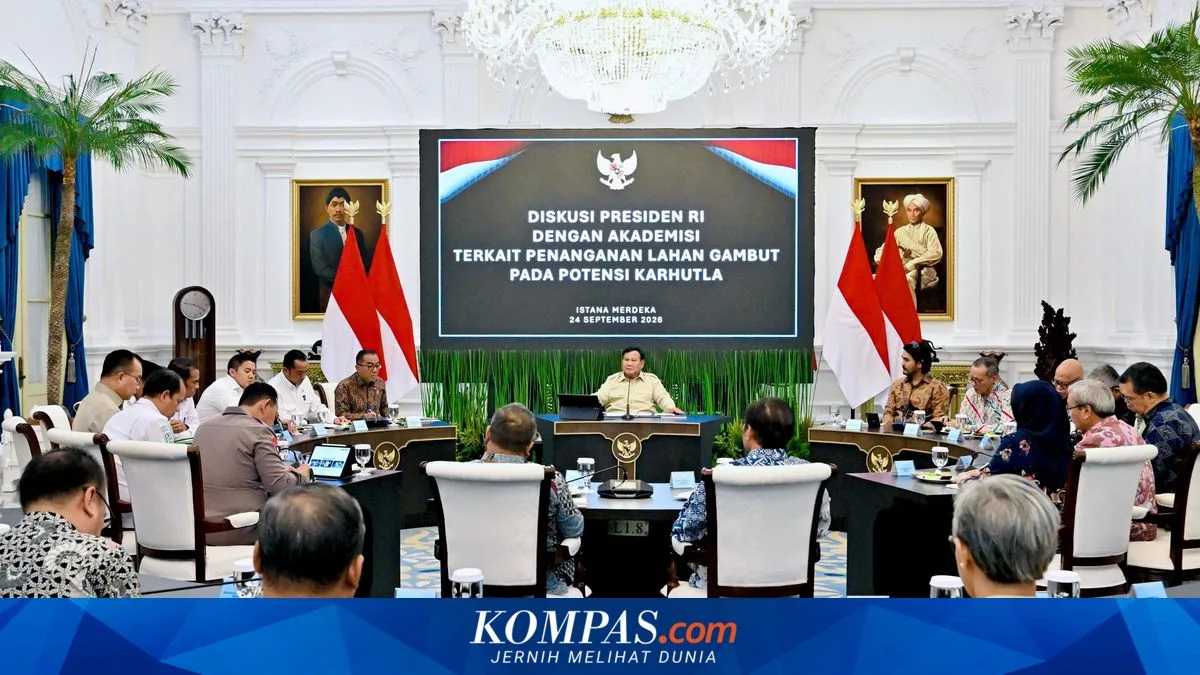
Indonesian President Prabowo Subianto spent four hours on Thursday (24/9/2026) listening to experts' views on peat ecosystem management and the handling of forest and land fires (karhutla). The meeting, held at the Merdeka Palace in Jakarta, was attended by academics from various universities as well as representatives of the National Research and Innovation Agency (BRIN).
According to the head of the Meteorology, Climatology, and Geophysics Agency (BMKG), Teuku Faisal Fathani, the discussion touched on three crucial areas. First, the optimal steps once fire has already burned land. Second, how to both utilize and protect peat ecosystems. Third, the selection of plant species and varieties suitable for cultivation in peat areas.
“We received a great deal of input from experts, both from universities and from BRIN,” Faisal said after the meeting. He added that the government wants to ensure the handling of forest and land fires is no longer reactive, but based on solid scientific study.
On emergency response, the experts recommended strengthening the Ground Task Force (Satgas Darat) deployed directly to fire hotspots. One technique discussed was shallow drilling to reach a water source, then pumping that water with portable pumps to extinguish fire within a radius of about 200 meters from the drill point. This approach was deemed more effective for peat terrain that heavy equipment struggles to reach.
Faisal also stressed the importance of the role of surrounding communities. Community fire-awareness groups will be strengthened to help with suppression as well as prevent new hotspots from emerging in their areas. “Community strength is key,” he added.
On prevention, the experts highlighted the importance of maintaining peat moisture. The land surface must remain covered by vegetation so it does not undergo excessive evaporation that dries out peat and makes it flammable. “We are working to keep the peat water table from dropping more than 40 centimeters below the ground surface,” Faisal explained. If peat is more saturated, fire risk can be suppressed.
In addition, weather modification operations remain a mainstay instrument when cloud conditions allow. The government will also maintain water reservoirs beneath peatland to preserve natural moisture.
“First, if it has already burned, what should be done. Second, how to utilize and protect the peat ecosystem. Third, which plants and varieties are suitable for peat areas,” Faisal said, summarizing the discussion.
For Indonesia, this step is not merely a seasonal response. Forest and land fires have long been a scourge that harms the economy, health, and diplomatic relations. By involving experts and BRIN, the government is seeking to build a more measurable long-term strategy. Investors and businesses in the plantation, forestry, and energy sectors need to watch the direction of this policy because it will affect land governance, environmental compliance, and operational costs.
Going forward, the effectiveness of this plan depends on implementation in the field. Are the Ground Task Force and shallow drilling techniques enough to suppress the escalation of forest and land fires? And to what extent can cross-sector collaboration—from BMKG, BRIN, to indigenous communities—be realized? The public awaits proof, not just a four-hour discussion.