Jasa Raharja Gives IRSMS Awards to Regional Police, Pushes for Faster Accident Data
Baca dalam 60 detik
- Jasa Raharja bersama Korlantas Polri menganugerahkan IRSMS Award kepada jajaran kepolisian yang dinilai unggul dalam pelaporan data kecelakaan lalu lintas sepanjang 2025.
- Penghargaan dibagi ke dalam lima kategori wilayah, dengan Polda Jawa Barat dan Polda Maluku keluar sebagai yang terbaik di kelompoknya masing-masing.
- Perbaikan tata kelola data kecelakaan disebut menjadi kunci percepatan santunan korban sekaligus fondasi kebijakan keselamatan jalan yang lebih presisi.
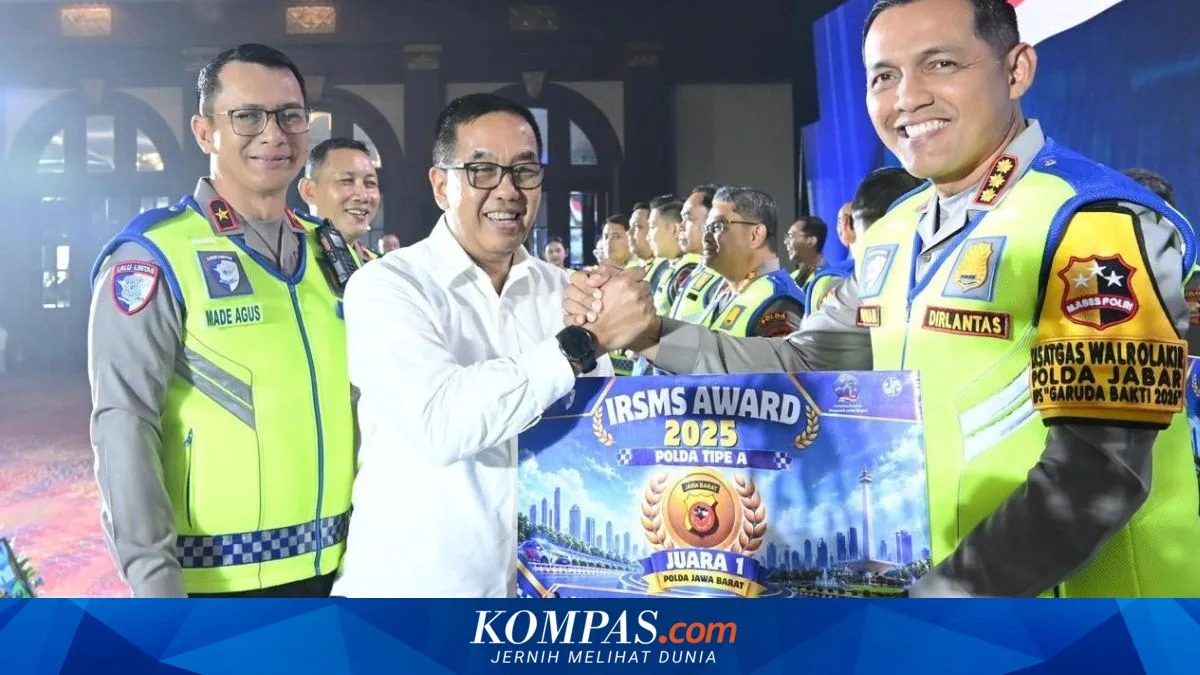
PT Jasa Raharja (Persero), together with the Indonesian National Police's Traffic Corps (Korlantas), presented the Integrated Road Safety Management System (IRSMS) Award to a number of police units deemed the most disciplined in managing and reporting traffic accident data. The recognition was part of the series of events for the 71st Bhayangkara Traffic Day thanksgiving, held at the Birawa Assembly Hall, Hotel Bidakara, South Jakarta, on Friday (25/9/2026).
This year's IRSMS Award assessment refers to the performance of police units throughout 2025. Five categories were contested: Type A Regional Police, Type B Regional Police, Metro/City/Large City Police, Type A District Police, and Type B District Police. Of the five categories, the West Java Regional Police, Maluku Regional Police, Cirebon City Police, Madiun District Police, and West Halmahera District Police each took the top position.
For Jasa Raharja, the speed and accuracy of accident information is not merely an administrative matter. Data that arrives quickly allows the state-owned company to speed up the compensation process for victims. Jasa Raharja President Director Muhammad Awaluddin stressed that the speed and accuracy of accident information is crucial for the company in providing services to victims. He therefore expressed appreciation to the police units that continue to support the management and reporting of accident data through IRSMS.
According to Awaluddin, the synergy between Jasa Raharja and the police does not stop at speeding up victim services. The collaboration is also part of efforts to build a better traffic safety database. A well-organized database will make it easier to map accident-prone points, evaluate traffic engineering policies, and design more measurable prevention programs.
The speed and accuracy of accident information is crucial for us in providing services to victims. We therefore express our appreciation to the police units that continue to support the management and reporting of accident data through IRSMS.
The event was attended by a number of senior officials, including National Police Chief General Listyo Sigit Prabowo, Korlantas Polri Chief Inspector General Wibowo, Coordinating Minister for Political and Security Affairs Djamari Chaniago, Transportation Minister Dudy Purwagandhi, BPK RI Member I Nyoman Adhi Suryadnyana, and Jasa Raharja Operations Director Ariyandi. The presence of officials from across ministries and agencies signals that the road safety issue is no longer solely the domain of the police, but a shared agenda touching the financial, transportation, and state audit sectors.
For readers in Indonesia, especially businesses and investors, improved accident data governance could help reduce the social and economic costs of traffic accidents. Accurate data allows insurance companies, logistics operators, and transportation service providers to calculate risk more precisely. In addition, faster compensation from Jasa Raharja helps maintain the purchasing power of victims' families, which has often been hampered by protracted claims processes.
On the other hand, awards like this still leave critical questions. Does reporting performance correlate with a decline in accident rates in those regions? Or is the IRSMS Award merely an administrative incentive that has yet to address the root causes, such as poor road infrastructure and weak enforcement of driving rules? The public will certainly wait to see whether the regions that won awards this year also record a decline in traffic fatalities in the following period.
Going forward, integrating IRSMS with other systems—such as hospital data, BPJS Kesehatan, and police digital platforms—could be the next test. If successful, Indonesia has a chance to build a road safety ecosystem that is not only reactive to accidents but also able to anticipate risks before victims fall.