Data Refutes It: Bitcoin Remains Indifferent to Surging Bond Yields
Baca dalam 60 detik
- Korelasi 90 hari antara return harian Bitcoin dan pergerakan yield US Treasury hanya -0,18, nyaris nol.
- Kenaikan yield global lebih dipicu data ekonomi AS yang kuat ketimbang kekhawatiran fiskal, tetapi negara berutang tinggi justru terimbas lebih dalam.
- Bagi investor Indonesia, sifat non-korelatif Bitcoin menawarkan peluang diversifikasi portofolio, namun volatilitas jangka pendek tetap perlu diwaspadai.
Bitcoin has once again proven that it is not an asset that moves in step with the rhythm of the global bond market. Amid a surge in government bond yields worldwide, historical data shows that this cryptocurrency has almost no statistical relationship with yield movements, especially over the long term.
On Wednesday (24/9), the yield on the 10-year US Treasury jumped 15 basis points to its highest level since 2007, breaking through 5.13%, and dragged yields in other countries higher. The familiar narrative resurfaced: high yields raise the opportunity cost of holding non-yielding assets such as Bitcoin and gold, potentially diverting funds into bonds. However, that logic is not supported by correlation data.
A CoinDesk analysis shows the 90-day correlation between Bitcoin's daily returns and changes in the 10-year US Treasury yield is only about -0.18. That figure is very close to zero, meaning there is almost no relationship at all. Longer time windows are consistent as well: the 180-day correlation stands at -0.06, while the one-year correlation is just -0.03. Bitcoin also shows no significant correlation with the yields of other countries.
Lacie Zhang, head of research at Bitget Wallet, sees this non-correlated nature as a genuine portfolio advantage. "Bitcoin's near-zero correlation with US Treasury yields shows BTC is not traded merely as a duration or interest rate asset," she told CoinDesk. According to her, the latest data even shows the 90-day correlation briefly moving closer to zero, reinforcing the diversification thesis.
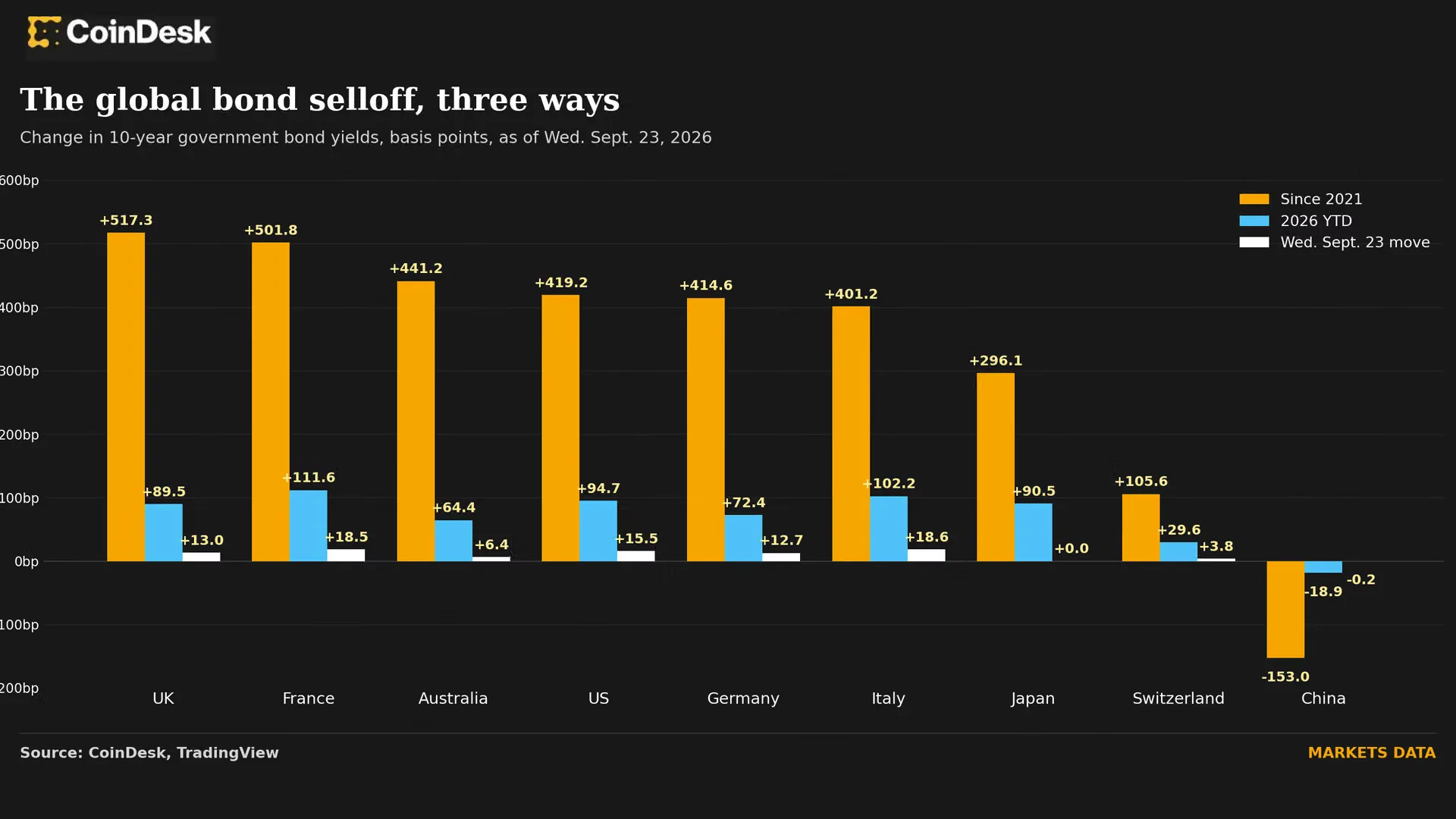
Bitcoin's long-term performance strengthens that argument. Since 2021, its price has soared 191% and reached a peak of $126,000 last October. That achievement came precisely as 10-year yields in the UK and France surged more than 500 basis points, while the US, Australia, Germany, and Italy rose above 400 basis points. Japanese and Swiss yields rose 296 and 105 basis points respectively, while China's actually fell due to deflation.
Even so, the absence of correlation does not automatically shield Bitcoin from short-term pressure. A surge in volatility in the bond market, especially US Treasuries, which are the backbone of the global financial system, can tighten liquidity conditions, raise credit costs, and trigger broad risk aversion. The MOVE Index, which tracks expectations for Treasury turbulence, jumped 21% to 95 points on Wednesday, the highest since early April. This explains Bitcoin's correction from $87,200 to $83,500 on the same day, though the market may simply have been looking for a reason to take profits after the sharp rally beforehand.
Wednesday's yield rise was driven by US economic data, not fiscal concerns. The S&P Global flash US Composite PMI rose to 58.4 in September, the highest since July 2021, from 56.0 in August. Business activity grew at the fastest pace in more than five years, accompanied by mounting inflation pressure. The data reinforced expectations that the Fed needs to continue raising interest rates after a 25 basis point hike in September. Both 10-year and 2-year yields jumped.
Interestingly, however, French yields rose even higher than US yields that day, even though the trigger was US data. UK yields also rose by nearly as much. According to Robin Brooks, a Senior Fellow at the Brookings Institution and former chief economist at the IIF, the same happened in Italy and Greece. "What happened today is strong data for the US, and then fiscally vulnerable places got burned too," Brooks wrote in his Substack.
This phenomenon is nothing new. Markets have long punished countries with high fiscal debt. Japan leads with a debt-to-GDP ratio above 200% at the end of 2025, followed by the US at 123.8%, France at 115%, the UK at 102%, and China at 100%. Switzerland is the exception, with federal debt at only 16% of GDP, making the Swiss franc (CHF) increasingly sought after as a safe-haven currency replacing the Japanese yen.
For Indonesian investors, this dynamic offers an important perspective. Amid global uncertainty and the potential for further Fed rate hikes, crypto assets such as Bitcoin can be a diversification alternative because of their low correlation with bonds. However, it should be noted that the domestic crypto market remains vulnerable to global sentiment and short-term volatility. Regulations being prepared by Indonesian authorities, including the role of OJK, will determine the extent to which retail investors can take advantage of this non-correlated character without being exposed to excessive risk.
Going forward, the question is no longer whether Bitcoin cares about bond yields, but how long the market will continue to ignore the old narrative that has already been refuted by data. If Treasury volatility continues, short-term corrections may occur, but over the long horizon, Bitcoin appears to stay on its own track.