Survey: 78% of Consumers Reject Humanoid Robots, but Attitudes Shift After Direct Interaction
Baca dalam 60 detik
- Survei terhadap 1.000 responden di AS dan Inggris menunjukkan 78% menolak robot humanoid, dengan Net Promoter Score -68.
- Pengalaman langsung mengubah sikap secara drastis: 88% dari mereka yang pernah berinteraksi menyatakan positif, dengan minat beli hampir tiga kali lipat.
- Meski dianggap tak terhindarkan dalam satu dekade, adopsi massal tetap bergantung pada paparan publik dan kepercayaan, bukan sekadar pemasaran.
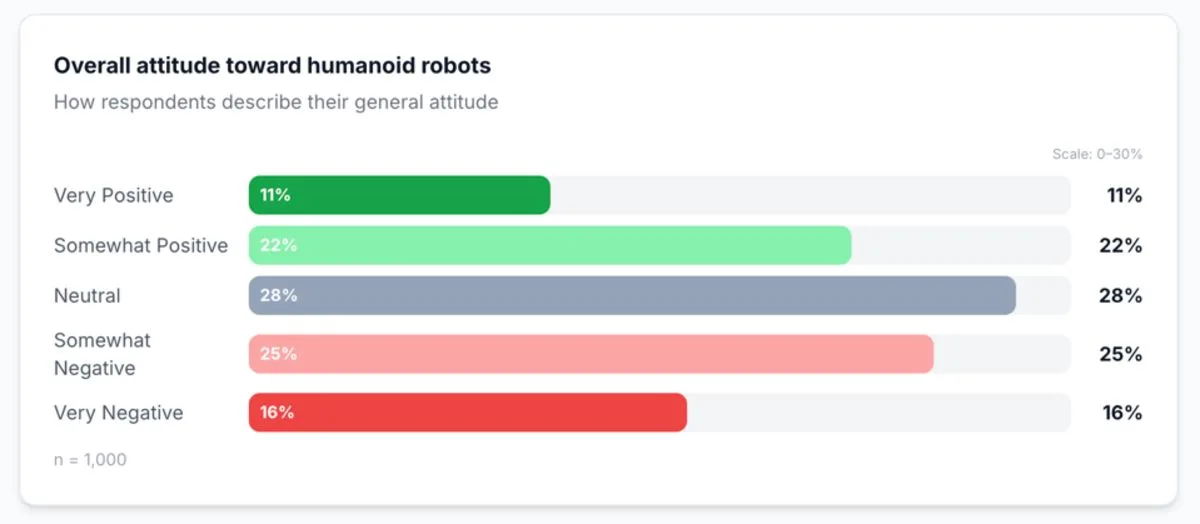
Only 11% of respondents expressed a strongly positive attitude toward humanoid robots, according to a recent survey of 1,000 adults in the United States and the United Kingdom. That figure puts the humanoid robot industry in a difficult position: it has raised tens of billions of dollars, yet most prospective users reject the technology.
The survey, conducted through the HumanoidMegaHub platform—which tracks 380 manufacturers and 861 robot models—found that the Net Promoter Score (NPS) for humanoid robots stands at -68. A total of 78% of respondents fell into the detractor category, while only 10% were willing to recommend them. Overall, 40% of respondents felt negative, 33% positive, and 27% neutral. Average purchase intent was just 36 out of 100, and among those who had never used a robot, the figure dropped to 28.
Interestingly, attitudes reversed dramatically once someone had direct experience. Among the 7% of respondents who regularly interact with humanoid robots, 88% reported a positive experience, and their purchase intent was nearly three times higher than those who had never been in contact with one. The findings confirm that the main barrier is not price, but trust.
"What stands out to me is that cost isn't what's holding people back ... trust is what's holding them back," said Tony Robinson, CEO of Next Events & Conferences, a partner in the survey project. "That's a solvable problem, but the solution emerges in public spaces, on retail floors, in hospitality, and in live demonstrations."
The survey also found wide gender and age gaps. Men were far warmer toward humanoid robots: 43% positive versus 24% of women, with purchase intent at 45 versus 29. Women were nearly twice as likely to hold negative views (47% vs 31%). Meanwhile, younger generations aged 18–34 recorded 43% positive and a purchase intent of 42, while the 55-and-over group showed only 19% positive and a purchase intent of 24. UK respondents were slightly more receptive (39% positive) than those in the US (28%).
Despite their hesitation, the public believes humanoid robots will arrive soon. The median respondent expected humanoid robots to become a common sight within 10 years, and 42% expected it within 5 years. Only 4% thought it would take 50 years or more. Yet on every perception metric, respondents leaned skeptical: on a 1–5 scale, robots scored 2.8 between threatening and beneficial, 2.7 between unsafe and safe, and 2.6 between unnecessary and essential.
Use-case preferences were relatively clear: dangerous work ranked at the top, followed by entertainment and personal assistance. Elderly care also made the list, relevant for families with older members or those who want to age at home. Meanwhile, Dar Sleeper, head of product and design at 1X—one of the few people who has lived with an advanced humanoid robot—said the normalization process takes only a few minutes. "People don't appreciate how adaptable humans are. We're very adaptive," he said.
For Indonesia, this humanoid robot wave offers both opportunity and challenge. In labor-intensive manufacturing and logistics sectors, robot adoption can boost productivity but also raises concerns about worker displacement. The government and industry players need to prepare labor regulations, safety standards, and retraining programs. On the other hand, the tourism and hospitality sectors could serve as an early showcase—places where tourists and the public see robots at work, in line with the survey's prescription that public exposure builds trust.
Going forward, humanoid robot manufacturers face a test: can they move robots from factories into public spaces before the wave of skepticism hardens? If this exposure data holds, the winners will not be those who advertise most aggressively, but those bold enough to put their robots in front of consumers—in malls, hospitals, hotels, and on the streets. The question is, how quickly can that trust be built in a market like Indonesia, which has different demographic and cultural characteristics?