KAIST Robot Dog Completes 42 Km Marathon, 25 Km of Battery Left
Baca dalam 60 detik
- RAIBO2, robot berkaki empat dari KAIST, menuntaskan maraton penuh dalam 4 jam 19 menit dengan satu kali pengisian daya.
- Efisiensi energi menjadi fokus utama: konsumsi daya setara 0,25 biaya transportasi, lebih rendah dari manusia (0,37).
- Teknologi ini membuka peluang operasi jarak jauh di medan sulit, namun versi komersial masih menanti uji ketahanan lingkungan.
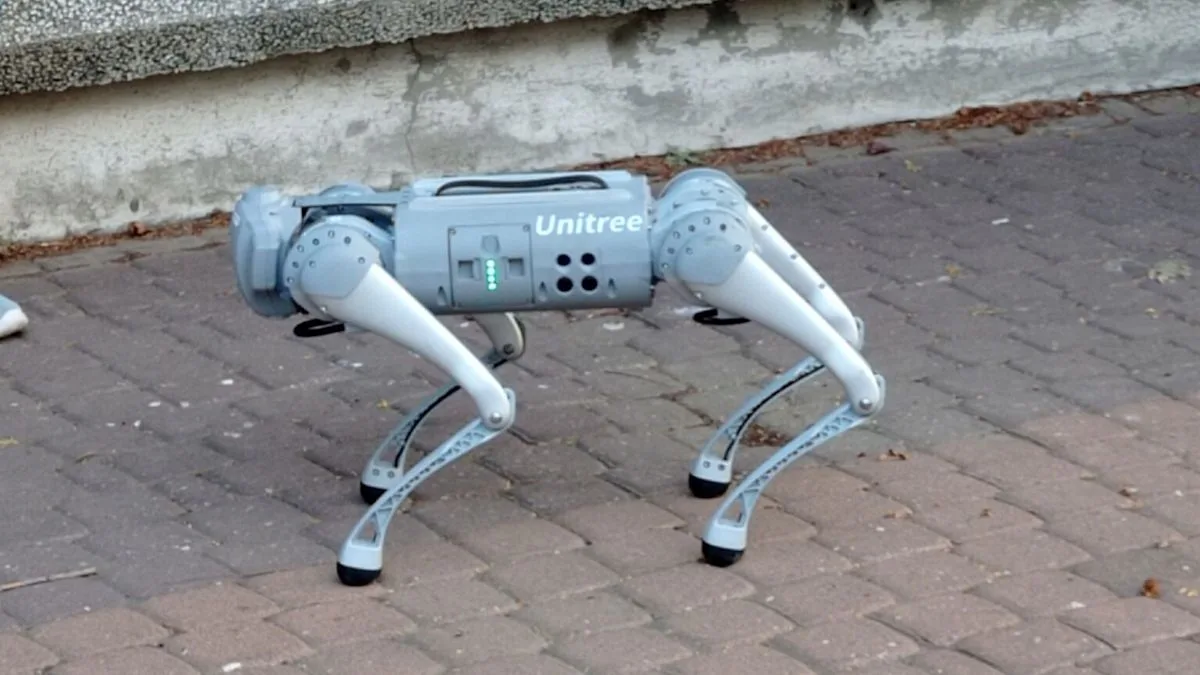
A four-legged robot managed to complete a 42.195-kilometer marathon without stopping to recharge its battery, and still had significant power reserves when it crossed the finish line. RAIBO2, a robot developed by the Korea Advanced Institute of Science and Technology (KAIST), recorded a time of 4 hours, 19 minutes, and 52 seconds on a single charge, according to a study published in the journal Nature on 23 September.
The trial took place in November 2024 at the Sangju Dried Persimmon Marathon, South Korea, but the research team only published their findings recently. Along the course, RAIBO2 consumed about 1,280 watt-hours, leaving enough energy to continue for roughly 65 kilometers based on theoretical calculations. This figure far exceeds the capability of existing four-legged robots, which on average can only cover a third of that distance per charge.
What makes this achievement stand out is not just the distance, but the energy efficiency achieved. The KAIST team did not take a shortcut by increasing battery capacity, but instead redesigned energy-hungry components. They used lightweight leg mechanisms, integrated motor-driver circuits, and joints designed to transfer force efficiently. The motion controller was trained with reinforcement learning in the RaiSim simulation environment, exposing the system to various terrains and movement patterns before being tested on hardware.
The marathon course RAIBO2 traversed was not a flat indoor terrain. The route included two 50-meter inclines, at around kilometers 14 and 28 respectively, as well as slippery and challenging surfaces. These conditions provided a tougher test than an indoor track at a testing facility. The robot also ran alongside human participants, making it the first public demonstration of a four-legged robot in an official marathon event.
From a technical standpoint, four-legged robots are naturally energy-hungry because they must constantly support their own body weight. Every foot strike causes energy loss due to impact and slip. This challenge is what makes long-distance operation difficult, even when a robot is mechanically capable of walking or running for a long time. RAIBO2 addresses this by recovering some energy when going downhill: its joints allow the motors to function as generators, returning energy used during ascent to the battery.
"The whole-system approach we applied allowed this robot to achieve more than three times the range of existing four-legged robots," said a representative of the KAIST research team, as quoted from the study publication.
The efficiency metric used is total cost of transport (COT), which combines energy use, distance, and robot weight. RAIBO2 recorded a COT of 0.25 during the marathon, lower than the human benchmark of 0.37. This means that to move a certain load over a certain distance, this robot requires less energy than a human. This achievement is an important indicator that four-legged robotics is getting closer to biological efficiency.
Nevertheless, RAIBO2 is not yet ready for all terrains. The KAIST team says its long-term target is long-duration use in environments such as mountains and disaster areas. Their startup partner, RAION ROBOTICS Inc., is developing a commercial product based on this technology. However, the commercial version will have to meet much stricter durability standards: water, dust, extreme temperature, shock, vibration, and electromagnetic compatibility resistance. In addition, performance must be consistent across all production units, not just a single prototype.
For Indonesia, the development of four-legged robotics like this could potentially be relevant for search and rescue missions in remote areas, forest monitoring, or even logistics in difficult terrain. However, adoption of this technology still awaits the readiness of supporting infrastructure and regulation. The big question: will these robots soon become everyday work tools in critical sectors, or will it take another decade to reach commercial maturity?