Three Japanese Chinooks Over Mempawah's Skies: Forest Fire Aid or Defense Equipment Soft Selling?
Baca dalam 60 detik
- Jepang mengerahkan kapal JS Kunisaki dan tiga helikopter CH-47 Chinook untuk mendukung operasi water bombing karhutla di Kalimantan Barat.
- Kerja sama ini merupakan implementasi Defence Cooperation Arrangement (DCA) yang diteken Mei 2026, sekaligus ajang unjuk kemampuan alutsista Jepang di kawasan.
- Operasi akan digeser ke Kabupaten Ketapang, sementara pengamat menilai bantuan ini memperkuat diplomasi pertahanan Indonesia yang bebas aktif.
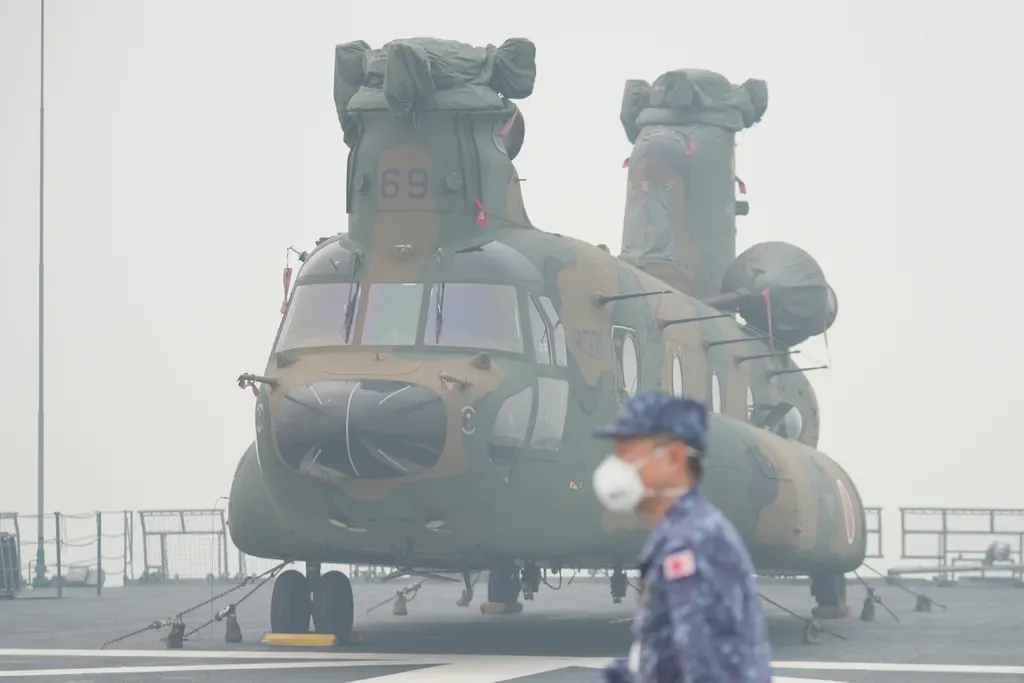
The tank landing ship of the Japanese Maritime Self-Defense Force, JS Kunisaki, has been docked at Kijing Terminal, Mempawah, West Kalimantan, since Thursday (10/9/2026). The ship carries three CH-47 Chinook helicopters deployed to support aerial operations to extinguish forest and land fires (karhutla). The presence of the Japanese fleet in Kalimantan waters is not merely a humanitarian mission, but a marker of the entry into force of the Defence Cooperation Arrangement (DCA) signed by both countries on 4 May 2026.
Defense Minister Sjafrie Sjamsoeddin inspected JS Kunisaki directly on Tuesday (15/9/2026). During the visit, he held talks with several senior Japanese officers, including Joint Force Commander Colonel Nakahara Syunzi and CH-47 Squadron Commander Lieutenant Colonel Wakatsuki. Sjafrie also held a video call with Japanese Defense Minister Shinjiro Koizumi, who then gave instructions to his troops in the field.
"I express my thanks and appreciation to Japanese Defense Minister Shinjiro Koizumi for the rapid response in providing CH-47 helicopter assistance equipped with firefighting capabilities," Sjafrie said in a written statement.
International Relations lecturer at Paramadina University, Anton Aliabbas, assesses Japan's assistance as a form of defense diplomacy in the low politics category. According to him, the move carries low political risk, but its strategic reach is broad because it involves the military assets of both countries. "This has a fairly broad strategic reach given the military involvement of both countries," he said.
Anton added that the presence of Japanese military personnel occurred at Indonesia's request, not as a unilateral initiative. This, he said, actually reaffirms the free and active sovereignty principle upheld by Jakarta. He also highlighted another dimension: Japan wants to showcase its defense industry capabilities. "Although this is humanitarian assistance, it is also a form of soft selling of Japan's defense equipment capacity in the region," Anton said.
In the regional context, Japan carried out similar assistance in 2013 when it sent troops to the Philippines after Typhoon Haiyan. For the TNI, this cooperation serves as a venue for joint exercises in water bombing techniques, while also strengthening institutional memory among the armed services. Field coordination involves three safety officers from the Army, Navy, and Air Force placed on each helicopter, while operational supervision and flight clearance are in the hands of the TNI, with flight missions coordinated with BNPB.
For Indonesia, the presence of Japanese Chinooks demonstrates the diversification of defense partners amid Asia-Pacific geopolitical tensions. This cooperation not only brings physical assistance, but also the transfer of technical knowledge and operating standards that can enrich the TNI's disaster response capabilities. On the other hand, Japan gains a stage to demonstrate the reliability of its defense equipment, which could potentially open market opportunities in the ASEAN region.
After operating in Mempawah, the task force will shift its area of operations to Ketapang Regency, West Kalimantan, which is considered more optimal for CH-47 flights. This move indicates that the operation will continue in the near future, as fire hotspots in several areas have yet to be extinguished. Sjafrie stressed that the main priority is protecting the public and accelerating firefighting efforts. "The most important thing is how all available capabilities can be used to protect the public, accelerate firefighting, and reduce the impact of forest and land fires," he said.
Going forward, the public will be waiting to see whether the Indonesia–Japan DCA truly becomes the foundation of an equal defense partnership, or merely an instrument of symbolic diplomacy. The effectiveness of the operation in Ketapang will be the first test: how much foreign assistance can accelerate the handling of forest and land fires that often hit Kalimantan every dry season. If successful, it is not impossible that this cooperation model could be replicated for other disasters in the future.