Mahfud MD: Without Law, Democracy Could Collapse Before Golden Indonesia 2045
Baca dalam 60 detik
- Mantan Ketua MK Mahfud MD menilai penegakan hukum adalah prasyarat mutlak agar demokrasi tidak berujung anarki dan cita-cita Indonesia Emas 2045 tetap terjangkau.
- Dengan pendapatan per kapita baru sekitar US$4.900, Indonesia masih di bawah ambang US$5.500 yang menurut kajian Azyumardi Azra dan Boediono dibutuhkan untuk demokrasi yang stabil.
- Mahfud mendorong kaderisasi pemimpin yang benar-benar memahami demokrasi, tetapi pergantian kekuasaan harus tetap melalui jalur konstitusional.
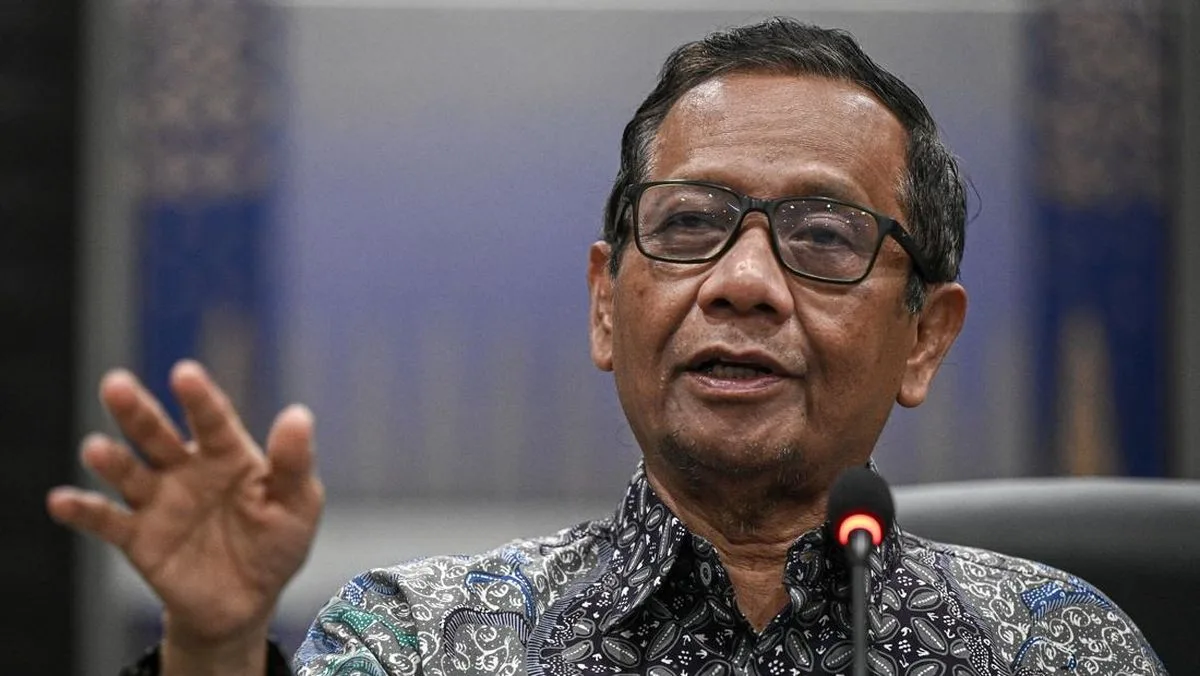
Former Constitutional Court Chief Justice Mahfud MD said Indonesia's democracy can only survive if it is underpinned by consistent law enforcement. Without that, he predicted the goal of Golden Indonesia 2045 will never be achieved because the nation risks losing its bearings first. Mahfud made the statement in the Soetandyo Lecture at the Faculty of Social and Political Sciences, Universitas Airlangga, Surabaya, on Thursday (29/10).
Mahfud recalled Prabowo Subianto's 2018 speech, in which he predicted Indonesia could fall apart by 2030 due to massive corruption. At the time, Prabowo said the country was moving toward a kleptocracy, a term he used to describe a government controlled by thieves. Now that Prabowo is president, that old warning is worth testing: has the threat truly been tamed, or has it merely changed form?
For Mahfud, the answer lies in the quality of governance. He demanded that five requirements of good governance be met at once: transparency, accountability, legal responsibility, and independence from intervention by political forces and other parties. If those pillars stand, he is confident that by 2045 extreme poverty will no longer be an Indonesian problem. What remains will be only relative poverty, with a minimum income standard that is far more decent for every citizen.
Mahfud does not turn a blind eye to the paradoxical nature of democracy. On one hand, Indonesia needs integration to remain intact amid its diversity of ethnicities, races, and religions. On the other, that diversity can only be managed healthily through democratic mechanisms. He considers democracy not an ideal system, but still the best compared with monarchy, aristocracy, or oligarchy. In the cycle he describes, monarchy often gives rise to aristocracy, which then deteriorates into oligarchy, namely the arbitrary rule of a handful of capital owners.
Oligarchy, according to Mahfud, can only be countered by a democracy that gives people room to supervise and ensure the circulation of power runs. But freedom without rules ends in anarchy. That is why he places nomocracy, or the sovereignty of law, as the guardian that keeps democracy from overstepping its bounds. "Democracy is not ideal. But it remains the best of all the bad options," he said.
"If democracy is not guarded by law, we may not even reach Golden Indonesia before it falls apart." — Mahfud MD
What makes Mahfud's warning more urgent is the matter of numbers. He referred to Boediono's study when he was still a professor at UGM and Azyumardi Azra's thinking that democracy only grows stable when a country's per capita income is at least US$5,500. Meanwhile, Indonesia's per capita income is only around US$4,900. Below that threshold, a country is highly vulnerable to slipping into authoritarianism. Mahfud then posed a critical question: how long must Indonesia wait, and will that theory hold amid today's political conditions?
He also highlighted the risk of demagogues when society is not yet economically and educationally established. Such politicians, Mahfud said, rely on empty promises without any data basis. He cited the practice of New Order politicians who promised to build bridges in areas that did not even have rivers. For Mahfud, criticism must not be diluted precisely because it is needed to fix, improve, and evaluate the government, including the one currently in power. "Right now, among our state officials who should be the nation's leaders, there are many notes that need correcting," he stressed.
The solution he offers is not an extra-constitutional change of power, but the preparation of new figures who truly embody democracy. The transition, according to Mahfud, must still go through mechanisms that are legally and constitutionally legitimate. "How do we correct it? Later, when there is a change of leadership through a constitutional process, we must prepare people who more fully embody democracy," he said. Before students, he expressed hope that the next generation would not merely be spectators, but would absorb the framework of democracy as a whole.
The question now: if the law continues to be used as a political tool and per capita income has not crossed the US$5,500 threshold, can Indonesia escape the oligarchy trap before 2045? Or will Mahfud's warning turn out to be a prophecy slowly coming true?