US Midterm Elections and the Bitcoin Rally Myth: 53.7% Average, but the Halving Cycle Matters More
Baca dalam 60 detik
- Data historis menunjukkan Bitcoin rata-rata melonjak 53,7% dalam 12 bulan pasca-midterm, sementara S&P 500 mencatat kenaikan 15,17% sejak 1950.
- Kenaikan tersebut diduga lebih dipicu siklus halving empat tahunan ketimbang faktor politik elektoral Amerika Serikat.
- Hasil midterm 2026 berpotensi mengubah lanskap regulasi kripto jika Partai Demokrat menguasai salah satu kamar Kongres.
US financial markets are bracing for the midterm elections on 3 November, and history shows that risk assets such as Bitcoin and the S&P 500 often post impressive performance afterward. However, analysts caution that the correlation is not necessarily driven by political factors.
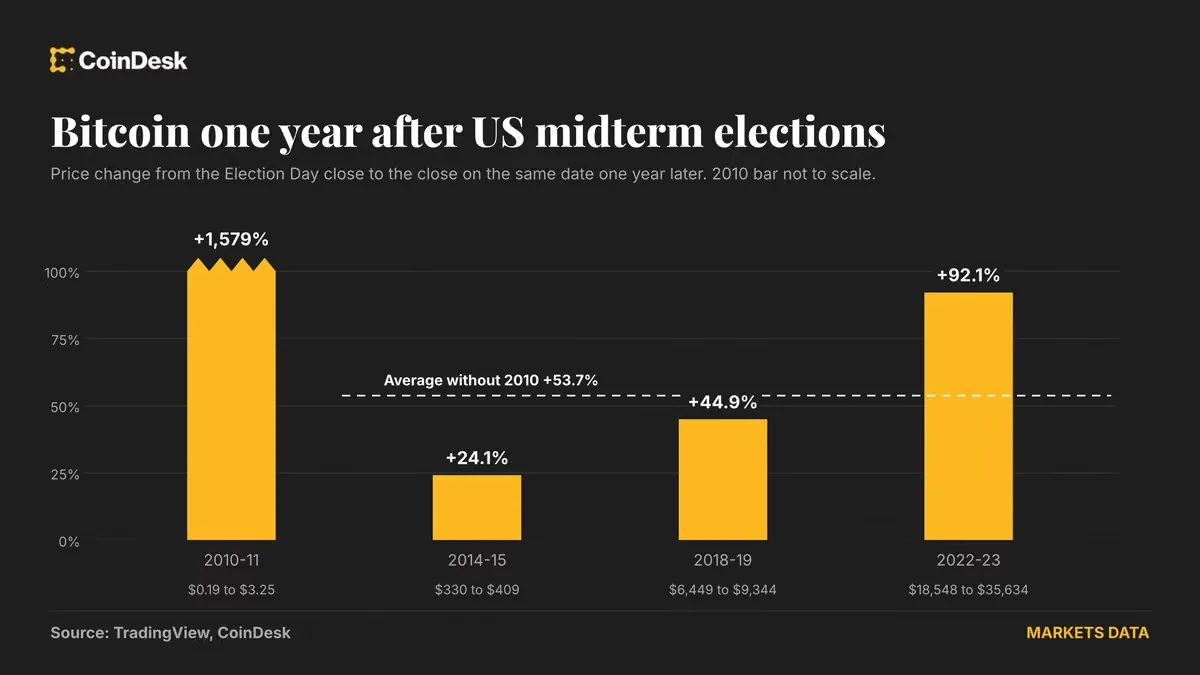
Since its emergence in 2009, Bitcoin has passed through four midterm cycles. Setting aside 2010, when the crypto market was still very small and peripheral, the following three midterms produced an average price gain of 53.7% in the year after election day. The figure is calculated from the daily close on election day to the same date a year later, based on an analysis of data compiled by CoinDesk.
In 2010, Bitcoin did surge 1,579%, but the market was too small at the time for that figure to serve as a valid benchmark. Now, with Bitcoin trading around $80,000 after touching a low below $60,000 in June, some analysts see potential for further gains after 3 November. Bitcoin has even rebounded more than 35% from its low, fueling speculation that a new bull market is beginning.
Even so, the history of Bitcoin's post-midterm moves does not by itself prove political influence. Some observers argue that the surge is more closely tied to the four-year cycle centered on the halving—a mechanism in the Bitcoin protocol that cuts the mining reward in half every four years. After each halving, Bitcoin's price tends to spike sharply, peaking 12 to 18 months later, then entering a bear market. Interestingly, those bear markets occurred in midterm years: 2014, 2018, 2022, and now 2026. The recovery after midterms is therefore most likely the start of a new cycle, not a direct effect of election results.
The S&P 500 has a longer track record and also offers a positive signal. Since 1950, the index has gained an average of 15.17% in the year after midterms, well above the 7.30% average in other years, according to Hartford Funds data. That performance is a tailwind for Bitcoin and other risk assets.
The 2026 midterm results themselves could change how President Donald Trump runs the government in the final two years of his term. If the Democratic Party wins one or both chambers of Congress, the politics of a ballooning federal budget could heat up, especially since the debt ceiling issue remains unresolved. Trump's push to allocate $350 billion in mandatory defense funding will likely be hampered, according to an analysis by the Brookings Institution. Democrats could also use legislative hurdles to halt funding for escalation in the Middle East.
In crypto, Democratic committee chairs could investigate potential conflicts of interest related to Trump's personal gains from digital assets. Democratic lawmakers have sent oversight letters about the president's ties to crypto and his family's businesses. The Trump memecoin launched in January 2025 has also caused heavy losses for retail investors. However, the Supreme Court's ruling in Trump v. Slaughter keeps most financial regulators under White House control, so Congress may not be able to do much to block the administration's efforts to promote crypto.
For now, the market has priced in a divided-government scenario, with expectations that Democrats will control at least one chamber of Congress. Regardless of the outcome, innovations such as equity tokenization appear set to proceed, with or without issuer support. The issuer-sponsored model allows the token to be the share itself, so rights and control remain intact.
For Indonesian investors, this US political dynamic is worth watching because fiscal and monetary policy in the US directly affects global capital flows, including to the domestic crypto market. The domestic regulator, Bappebti, and players in Indonesia's crypto asset industry need to anticipate volatility that may arise from post-midterm global sentiment. The question is whether this post-midterm rally will repeat itself, or instead mark a turning point driven by more fundamental factors?