Behind the Competition That Forges F1's Future Engineers: From Mini Races to the Grand Prix Paddock
Baca dalam 60 detik
- STEM Racing World Finals 2026 di Singapura mempertemukan 91 tim pelajar dari 36 negara, dengan tim asal Arab Saudi, Lynx Racing, keluar sebagai juara.
- Kompetisi ini bukan sekadar balapan mobil mini bertenaga CO2, tetapi juga mengasah keterampilan desain, pemasaran, dan presentasi yang menjadi tiket masuk ke industri F1.
- Sejumlah alumni telah menembus tim F1 seperti Red Bull, Aston Martin, dan Williams, menandakan jalur ini semakin strategis di era budget cap.
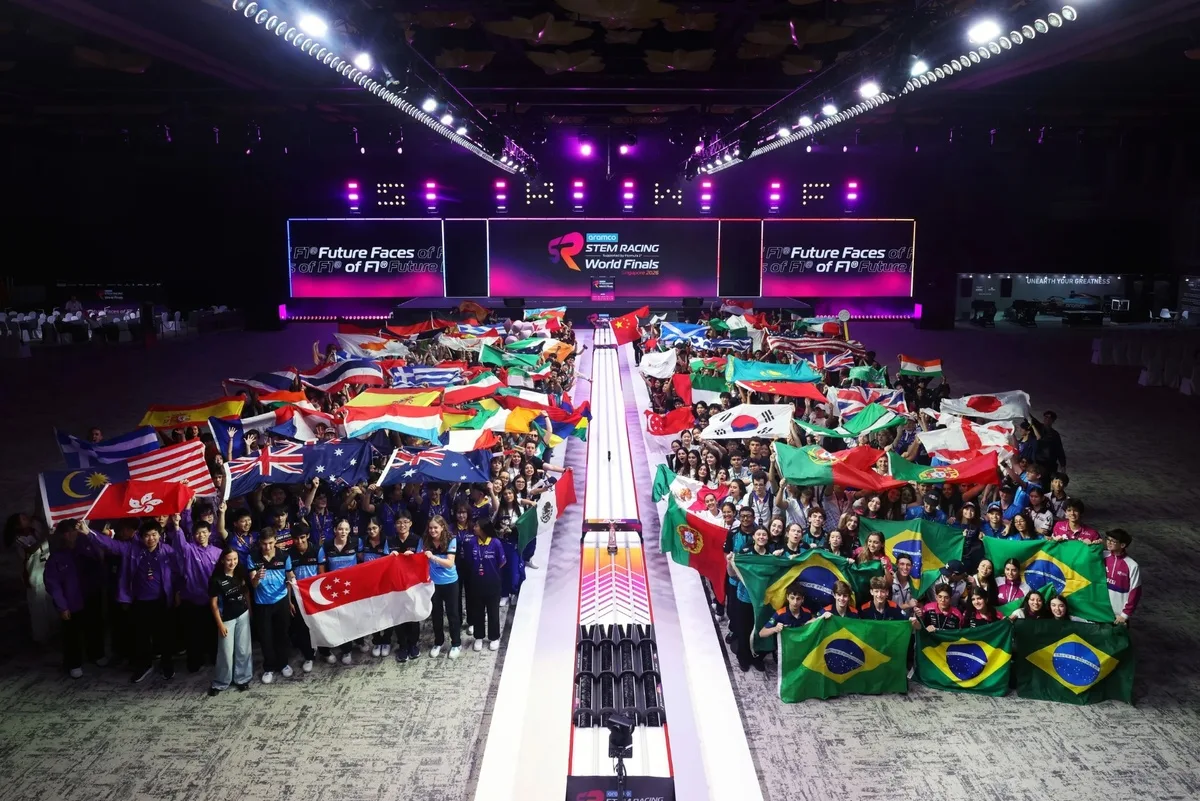
The Singapore Grand Prix stage does not belong only to elite drivers. Amid the bustle of the paddock, six high school students from Saudi Arabia—four boys and two girls—moved about with enthusiasm. They are Team Lynx Racing, champions of the STEM Racing World Finals 2026, a four-day international engineering competition held at Resort World Sentosa, Singapore, last week. They received the prestigious trophy right on the grand prix podium, watched by two-time world champion Fernando Alonso, before being invited on a tour of the Aston Martin garage.
For some of them, that moment may not be their last. There is hope that one day they will return to the paddock in a real F1 team uniform. The competition, formerly called F1 in Schools, was indeed designed as a crucible for young talent interested in engineering and manufacturing.
Since it was conceived in 2000, STEM Racing has challenged groups of three to six students to design and produce a miniature F1 car powered by a CO2 cartridge. The car must speed down a 20-meter track at up to 70 km/h. Regional and national champions earn the right to compete in the annual world finals. The 2026 edition in Singapore was the largest yet: 91 teams from 36 countries competed for various awards.
Although the cars are tiny, the level of difficulty resembles real F1. Teams are free to design and produce the car using professional CAD software, testing aerodynamic knowledge to cut drag. The final product is made with a CNC router machine, while the front and rear wings are 3D-printed before assembly, painting, and racing. A rule book more than 70 pages thick must be followed, and every car must pass scrutineering like a real race car.
But judging does not stop at the track. Teams are also required to compile a marketing portfolio and sponsorship plan, build a brand, present ideas before judges, and set up an impressive pit stand. With a maximum of six members, there is nowhere to hide. For teams that reach the world finals, the financial challenge becomes real: funding the trip to Singapore is no cheap matter.
In the large ballroom of Resort World Sentosa, the competitive spirit was thick. Noah from Germany's Spectrum team, who would later take third place, said he enjoyed learning under pressure. "I like the competitive element. Here you really learn to work together as a team," he said. Meanwhile Aarav, leader of Singapore's Nebula team, said he was impressed by the level of competition. "It's very interesting to see how other teams solve the same problems," he said.
This competition is not merely a showcase. A number of alumni have broken into the F1 industry. Kyriakos Theofanidis, the 2016 champion from Greece, is now a mechanical engineer at Red Bull Ford Powertrains. James Mitchell from Australia, who competed in the 2023 world finals, was recruited by Aston Martin. Laurence Vines, an alumnus from the UK, now works as a structural design engineer at Williams and remains involved as a mentor and judge.
"I wanted to work in F1. When I was 15, I wrote letters to every team for an internship. Without connections, I didn't know the way until I found this competition by chance," Vines said.
Vines said the competition helped him master tools such as CAD, CFD, and FEA simulation far earlier. "I didn't know any of that before. At 15 I was already designing miniature cars, and the rules were very detailed," he added. Thanks to the competition, he received a full scholarship at University College London and interned at Williams.
A similar story comes from Amy Martin. Initially not interested in F1, she gathered school friends and became part of one of the girls' teams at the world finals. After winning the Marketing Award, she was selected for the Williams Engineering Academy 2016 and met Nico Rosberg in the paddock. "For a 16-year-old girl, that was truly inspiring. I decided I would do anything to get into F1," she recalled. She now works as a financial controller at Mercedes High Performance Powertrains.
For F1 teams, this competition is increasingly important. In the budget cap era, identifying young talent starts earlier. McLaren racing director Randy Singh acknowledged that their graduate scheme has produced figures such as performance engineer Oscar Piastri and the head of strategy. "STEM Racing is very useful because it teaches how an F1 team works—design, research, marketing, and the commercial side," he said. He advised teenagers to pursue any technical field that involves teamwork, whether it is STEM Racing, Formula Student, rockets, or competitive sport.
STEM Racing founder Andrew Denford feels the program has only just begun to turn a corner after its 2024 rebranding. "We started in 2000 to grow interest in engineering and manufacturing. Now 77 countries are involved, and the level keeps rising," he said. He added that the post-Netflix explosion in F1's popularity has also boosted the number of participants, with an entry-level program for six-year-olds.
In Indonesia, a similar stirring is beginning to show. Events such as the Madrasah Robotics Competition and national science olympiads serve as early venues, but there is not yet an ecosystem that connects directly to the motorsport industry. Yet the need for engineers in the automotive and renewable energy sectors keeps growing. The presence of Southeast Asian teams in the world finals—such as Nebula from Singapore—shows that the opportunity is open, provided there is consistent coaching and financial support.
Wherever the 2026 finalists go—to the F1 paddock, the aerospace industry, or paths not yet imagined—the experience in Singapore has equipped them with skills and confidence. The question is, will more countries, including Indonesia, send their representatives to this stage?