Inflation Rises to 3.28 Percent, Home Minister Tito Warns Regional Governments on 3.5 Percent Ceiling
Baca dalam 60 detik
- Inflasi tahunan September 2026 naik ke 3,28 persen dari 3,19 persen pada Agustus, mendekati ambang batas 3,5 persen.
- Mendagri Tito Karnavian menekankan stabilitas harga pangan sebagai prioritas karena langsung memukul 20 persen masyarakat terbawah.
- Daerah dengan inflasi tinggi seperti Sulawesi Utara, Maluku Utara, dan Papua diminta segera berkoordinasi dengan Badan Pangan dan Bulog.
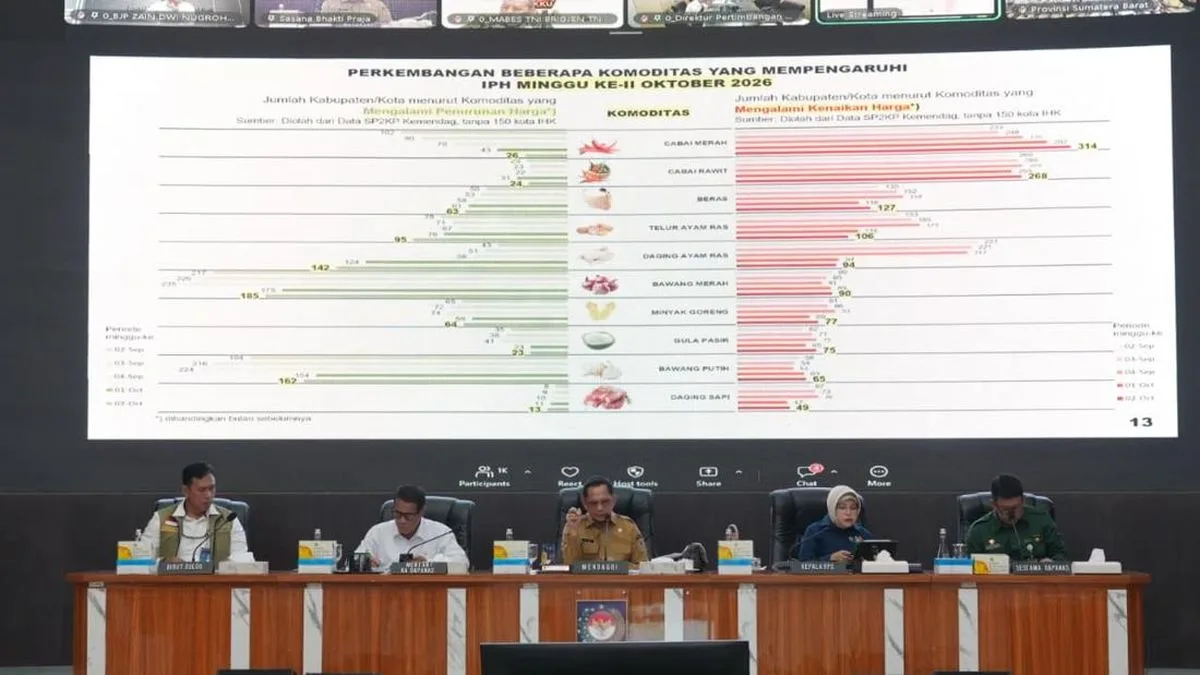
Home Minister Muhammad Tito Karnavian has asked regional governments to strengthen inflation control after the Central Statistics Agency recorded that annual (year-on-year) inflation rose to 3.28 percent in September 2026, up from 3.19 percent in August. The figure is edging closer to the upper limit of the government's 3.5 percent target, raising concerns about pressure on the purchasing power of vulnerable groups.
At the Regional Inflation Control Coordination Meeting at the Sasana Bhakti Praja Building, Ministry of Home Affairs, Jakarta, on Monday (12/10), Tito stressed that a spike above 3.5 percent would be felt immediately by the lowest-income 20 percent of the population. "We are watching this figure closely so it does not go above 3.5 percent, which is the government's target. Because if it goes above 3.5 percent, decile-1, decile-2, the bottom 20 percent of society will feel it," he said.
Beyond annual inflation, monthly price pressures also increased. Month-to-month inflation in September 2026 was recorded at 0.30 percent, higher than 0.21 percent in August. The food, beverages, and tobacco group was the main driver of monthly inflation, while the transportation sector contributed the largest pressure to annual inflation due to fuel price increases triggered by global geopolitical conflict.
Although transportation exerted major pressure, Tito highlighted the importance of maintaining food price stability. According to him, fluctuations in the prices of basic necessities directly affect the purchasing power of lower-income groups. "But the most critical sector we must guard closely is food and beverages, because it is directly connected to the lower-class population," he stressed.
The meeting also marked the signing of a Joint Circular on the Management of Facilities and Infrastructure and Agricultural Extension Staffing. Tito asked regions with high inflation to take concrete steps immediately. At the provincial level, attention focused on North Sulawesi, North Maluku, Gorontalo, Papua Pegunungan, and Central Papua. At the district level, the areas highlighted included North Minahasa, South Minahasa, Gorontalo, Nabire, and Kapuas. At the city level, Manado, Kotamobagu, Ternate, Sorong, and Banjarmasin were placed on the watch list.
To anticipate price spikes, Tito asked regional governments, particularly in areas with a high price development index, to coordinate immediately with the Food Agency, Perum Bulog, and food-sector businesses to identify commodities that need stabilizing. "So for all of us, especially the regions, those with high figures, coordinate immediately with the Food Agency, then with Bulog, with food-sector entrepreneurs on what needs to be stabilized so that we do not break through 3.5 nationally," he concluded.
This coordination step is considered crucial to dampen price volatility in the regions while keeping national inflation within the target corridor. However, the challenges ahead are not light: geopolitical conflict driving fuel price increases could still weigh on the transportation sector, while food volatility could be worsened by extreme weather. Regional governments are required to be not only reactive but also proactive in mapping supply chains and strengthening food reserves. The question is, can this cross-agency coordination hold back the pace of inflation before it breaks through 3.5 percent?