ESDM Claims Makassar Fuel Queues Have Eased, but Finds Modified Tank Modus
Baca dalam 60 detik
- Kementerian ESDM menyatakan antrean panjang di SPBU Makassar dan sekitarnya sudah terurai setelah koordinasi lintas lembaga, namun investigasi lapangan mengungkap indikasi penimbunan BBM lewat modifikasi tangki kendaraan.
- Fenomena El Nino yang membuat jalur sungai dangkal memaksa pengalihan distribusi ke truk, memperpanjang waktu tunggu di SPBU; pemerintah menegaskan stok aman dan meminta masyarakat tidak panic buying.
- Ke depan, penegakan hukum terhadap penyimpangan distribusi dan kesiapan infrastruktur menghadapi cuaca ekstrem akan menjadi ujian bagi tata kelola energi nasional, terutama menjelang periode permintaan tinggi.
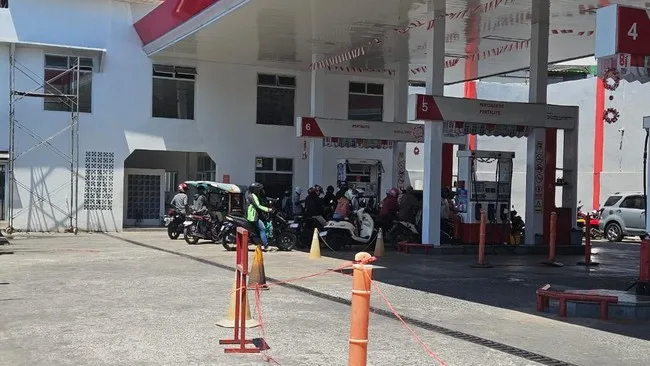
The Ministry of Energy and Mineral Resources (ESDM) has confirmed that vehicle queues at a number of gas stations in Makassar, South Sulawesi, and its surrounding buffer areas have eased. The claim came after intensive coordination between ESDM, PT Pertamina (Persero), BPH Migas, as well as local governments and law enforcement agencies. But behind the improvement, field teams found indications of distribution irregularities that have complicated the situation.
Director General of Oil and Gas at the Ministry of ESDM, Laode Sulaeman, said a special handling scheme had been implemented to address congestion at gas stations. According to him, the queue peak occurred several days ago, but field innovations managed to restore conditions. "At gas stations with long queues, they have now eased," he said when met at the DPR RI Building, Jakarta, Wednesday (16/9/2026).
Nevertheless, Laode did not deny findings of irregularities in the form of fuel hoarding. One modus that has emerged is the use of vehicles with modified tanks—enlarged by 50% to 75% of standard capacity. The practice is suspected of worsening queues due to abnormal refueling volumes. "The tanks are enlarged, where the capacity should be X, it is increased to X plus 50% or X plus 75%," he explained. His office stressed it would take firm action against perpetrators and is analyzing the pattern of irregularities.
Weather factors also complicated distribution. Laode explained that the El Nino phenomenon caused shallowing in river routes usually traversed by fuel transport vessels. As a result, shipments were diverted to truck fleets that require longer travel times. "Trucks are not as fast as shipments via river, so there is waiting time that must be prepared at gas stations," he added. The government asked the public not to panic because fuel stocks are assured to be safe.
"The condition of fuel distribution in Makassar, Gowa, Takalar, and Maros is now more conducive. This is the result of joint work between Pertamina, local governments, and law enforcement," said Okky Aditya Wibowo, Acting Area Manager Communication, Relations & CSR Pertamina Patra Niaga Regional Sulawesi.
Pertamina Patra Niaga Regional Sulawesi reported that refueling activity at gas stations is now more orderly and no longer disrupts traffic flow. The company stressed it continues to monitor distribution to distributors and coordinate with local governments and law enforcement to anticipate field dynamics. The public is urged to buy fuel according to need and not make excessive purchases.
For readers in Indonesia, especially businesses and investors, this episode highlights the vulnerability of the energy supply chain to weather anomalies and downstream irregularities. Dependence on certain modes of transport—such as river routes—is a weak point that can trigger spikes in logistics costs and supply uncertainty. Going forward, strengthening multi-modal distribution infrastructure and technology-based supervision at gas stations is a necessity. Without that, the potential for similar queues could recur, especially when seasonal demand rises or extreme weather hits.
The question is, will enforcement against distribution irregularities proceed consistently, or will it only be a temporary response until queues reappear?