West Kalimantan Burns 48,536 Hectares, Japanese Helicopter Grounded: Haze Cripples Operations
Baca dalam 60 detik
- BNPB mencatat total lahan terbakar di Kalimantan Barat mencapai 48.536 hektare hingga 14 September 2026, hasil gabungan data SiPongi dan pengukuran lapangan.
- Jarak pandang di bawah 1 kilometer di sembilan kabupaten/kota membuat helikopter CH-47 Chinook bantuan Jepang belum dioperasikan karena butuh visibilitas 3.500–5.000 meter.
- Sebaran polutan pekat diprediksi BMKG masih berpusat di Kalimantan dan merembet ke Sumatra serta Papua, memicu risiko kesehatan dan gangguan penerbangan.
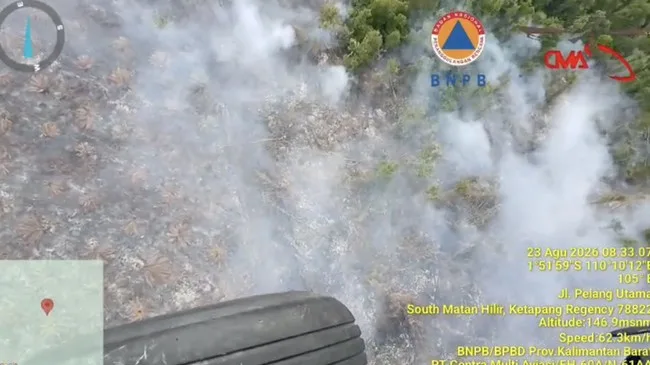
Forest and land fires in West Kalimantan have spread to 48,536 hectares as of 14 September 2026, making it the worst episode in Indonesia this year. The figure was compiled from two different sources: SiPongi data up to 31 July 2026 of 38,310 hectares, plus BNPB field measurements from 1 August to 14 September 2026 totaling 10,224 hectares.
Acting Head of BNPB's Center for Disaster Data, Information and Communication, Berton Panjaitan, explained the merging of the two methods to obtain a real picture. "We combined SiPongi data with field measurements so the total reflects the actual condition," he said at a press conference on Tuesday (15/9/2026).
In the field, the joint team is still pursuing 19 fire spots with an estimated area of 261.5 hectares. Of that number, 180.8 hectares have been extinguished—175.8 hectares by the Ground Task Force and 5 hectares through water bombing. The remaining 80.7 hectares are today's operational target. BNPB has deployed 14,759 ground personnel, five weather modification patrol/operation units, and nine water bombing helicopters.
However, aerial efforts are hampered. A CH-47 Chinook helicopter provided by Japan has arrived in West Kalimantan but cannot yet be flown because visibility is too low. The Japanese side requires visibility of 3,500–5,000 meters before operating the fleet. "Visibility is very low, so the helicopter cannot yet be operated," said Berton.
The irony is that nine areas in West Kalimantan—Mempawah, Pontianak, Melawi, Sambas, Ketapang, Kubu Raya, Sintang, Kapuas Hulu, and Singkawang—recorded visibility below 1 kilometer. Although light to heavy rain fell in Sambas, Sintang, Bengkayang, Singkawang, and Sekadau, air quality remained poor due to pollutants from the forest and land fires.
The BMKG forecast for 15–16 September 2026 shows the thickest pollutant concentrations are still centered in West Kalimantan, Central Kalimantan, and South Kalimantan. Distribution is also observed in South Sumatra, northern Sumatra, the bird's head region of Papua, and Merauke. BNPB urges affected residents to wear masks when active outdoors.
Besides West Kalimantan, forest and land fires have also hit other priority provinces. As of 14 September 2026, burned areas were recorded at 19,303.99 hectares in South Kalimantan, 19,851.65 hectares in Riau, 15,976.1 hectares in Central Kalimantan, 6,552.31 hectares in South Sumatra, 5,761.57 hectares in East Kalimantan, and 2,998.02 hectares in Jambi. In East Kalimantan specifically, 319.95 hectares still need to be handled, especially in the Nusantara Capital City (IKN) area.
"Extinguishing is carried out massively and in a measured way. We prioritize the Ground Task Force supported by the Air Task Force for maximum results," said Berton.
The government is strengthening personnel and equipment, accelerating the mobilization of gear, and reinforcing data integration. The collaboration involves BNPB, BPBD, the Fire Department, Satpol PP, TNI, Polri, Manggala Agni, the Fire Care Community, volunteers, and the private sector. The public is asked not to burn trash carelessly or discard cigarette butts before the fire is truly out, and to report fire spots to the call center 117.
For readers outside Kalimantan, the impact of the fires does not stop at provincial borders. Haze that blocks visibility could disrupt domestic flight schedules, slow logistics, and raise airline operating costs. The plantation and forestry sectors face production risks, while poor air quality can suppress labor productivity and increase health spending. Investors with exposure to the agribusiness, energy, and transportation sectors need to watch this development closely.
The question is whether the rain that has begun to fall in recent days is enough to ease the haze, or whether it is merely a pause before the next peak of the dry season. Without improved visibility, even the Chinook fleet that has arrived is just a force waiting on the weather.