Binance Hacker Dumps Rare Token, FUN Price Plunges 90% Overnight
Baca dalam 60 detik
- Peretas Binance membuang 134,1 juta token FUN ke pool Uniswap yang likuiditasnya hanya sekitar US$16.000, memicu kejatuhan harga lebih dari 90%.
- Aksi jual bertahap lewat 150 transaksi itu hanya menghasilkan sekitar US$250.000, jauh di bawah nilai buku aset curian yang ditaksir US$1,17 juta.
- Masih ada 580,8 juta FUN di dompet peretas yang bisa kapan saja dilepas ke pasar, menjadi ancaman nyata bagi pemegang token kecil lainnya.
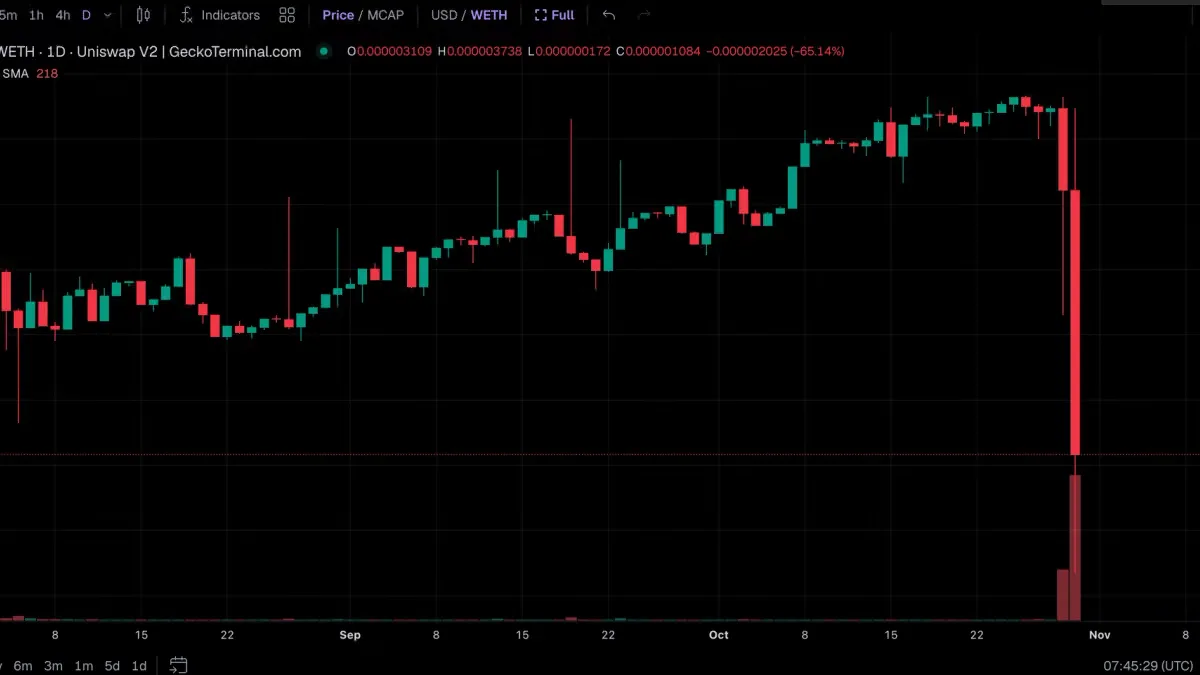
The price of FUNToken (FUN) collapsed by more than 90% within hours after a wallet linked to the Binance hack released hundreds of millions of the token into a decentralized market with almost no liquidity. The episode is a stark reminder that the fallout from a major hack does not stop at the exchange that was attacked, but spills over into peripheral assets that have long escaped scrutiny.
According to GeckoTerminal data, the price of FUN in the Uniswap pool where the sale took place fell from about 0.0000037 wrapped ether (WETH) to 0.00000017 WETH. Across the broader spot market, CoinGecko recorded that FUN lost 68% of its value in 24 hours. Uniswap itself is a decentralized exchange that lets users trade directly against liquidity pools rather than through an order book as on centralized exchanges.
FUN is not a new name. The token was launched in the 2017 ICO wave by FunFair Technologies, which at the time raised US$26 million in just four hours to build a blockchain-based online casino platform. The project now operates under the name FUNToken. Its small market value makes it vulnerable when hit by large sell orders.
The hacker in question is the actor behind the breach of Binance's hot wallet, which set a record as the largest cryptocurrency hack in history, with assets taken worth more than US$6 billion. According to Arkham Intelligence, the haul included major assets such as tether (USDT), USD Coin (USDC), bitcoin, ether, TRON, and solana, as well as a number of second-tier tokens including FUN, Prom (PROM), Reserve Rights (RSR), RedStone (RED), Origin Protocol (OGN), and Gitcoin (GTC).
What makes the situation thorny is the inability of centralized exchanges to close the gap in decentralized markets. Stablecoin issuers such as Tether and Circle moved quickly to freeze the stolen assets they control, and FUNToken asked centralized exchanges to temporarily disable FUN deposits. But transactions on Uniswap cannot simply be stopped. It is this gap that the hacker exploited.
The Etherscan chronology shows that on Thursday at 23.28 UTC, a wallet labeled "Binance Hot Wallet Exploiter 2" sent 714.9 million FUN to a new address. Three minutes later, that address began selling tokens into the FUN/WETH pool on Uniswap v2. More than 150 transactions took place over several hours, with one sale routed through PancakeSwap. The last sale was recorded on Friday at 04.17 UTC.
Joshua Frank, co-founder and CEO of The Tie, had previously warned of this risk. In a thread on platform X, he ranked the hacker's holdings against each token's daily trading volume. The value of FUN held by the hacker at the time reached US$6.23 million, or 252% of the token's daily volume, placing it at the top of his watchlist.
"The hacker holds more than the entire reported daily trading volume on FUN and PROM," Frank wrote, adding that daily volume is only a rough guide for estimating how deep prices could fall.
The systemic impact is visible in other small tokens the hacker also dumped. Reserve Rights (RSR) fell 17.6% in 24 hours, RedStone (RED) weakened 17.1%, Gitcoin (GTC) shed 16.6%, while Origin Protocol (OGN), yearn.finance (YFI), and 1inch (1INCH) were cut by between 9% and 13.6%. By comparison, bitcoin and ether fell only 1.8% and 2.9% respectively over the same period.
Although the selling has stopped and the pool price rebounded 75% in the past hour, the shadow of selling pressure has not lifted. The seller's wallet still holds 580.8 million FUN that could be released at any time. Frank stressed that the main question is not simply how much was stolen, but how much can still be moved, how fast the hacker liquidates it, and which markets have enough liquidity to absorb it.
For Indonesia, the case is relevant given the growing interest of retail investors in crypto assets, including small-cap tokens traded on decentralized exchanges. Authorities such as Bappebti and the crypto Self-Regulatory Organization (SRO) need to strengthen liquidity-risk literacy, because the domestic market also has indirect exposure through global platforms. Without adequate understanding, local investors could be the last to bear losses when large wallets suddenly dump assets.
Going forward, monitoring the movement of stolen funds will test the DeFi ecosystem: will protocols like Uniswap adopt emergency freeze mechanisms, or will they uphold the principle of code neutrality even at the risk of becoming an escape route for criminals? The answer to that question will shape the direction of global crypto regulation, including in Indonesia.