AHY and Ahmad Luthfi Test HexBricks in Demak, a New Strategy Against Pantura Abrasion
Baca dalam 60 detik
- Menteri Koordinator Infrastruktur AHY bersama Gubernur Jawa Tengah Ahmad Luthfi menanam mangrove di Desa Timbulsloko, Demak, sebagai bagian dari solusi berbasis alam untuk melindungi pesisir Pantura.
- Teknologi HexBricks buatan BRIN dipadukan dengan mangrove untuk memperkuat pemulihan ekosistem dan menahan gelombang laut, sekaligus membuka lapangan kerja lokal.
- Pemerintah berencana mengevaluasi efektivitas kawasan percontohan seluas 6,56 hektare ini sebelum memperluas penerapannya ke wilayah pesisir lain di Pantura.
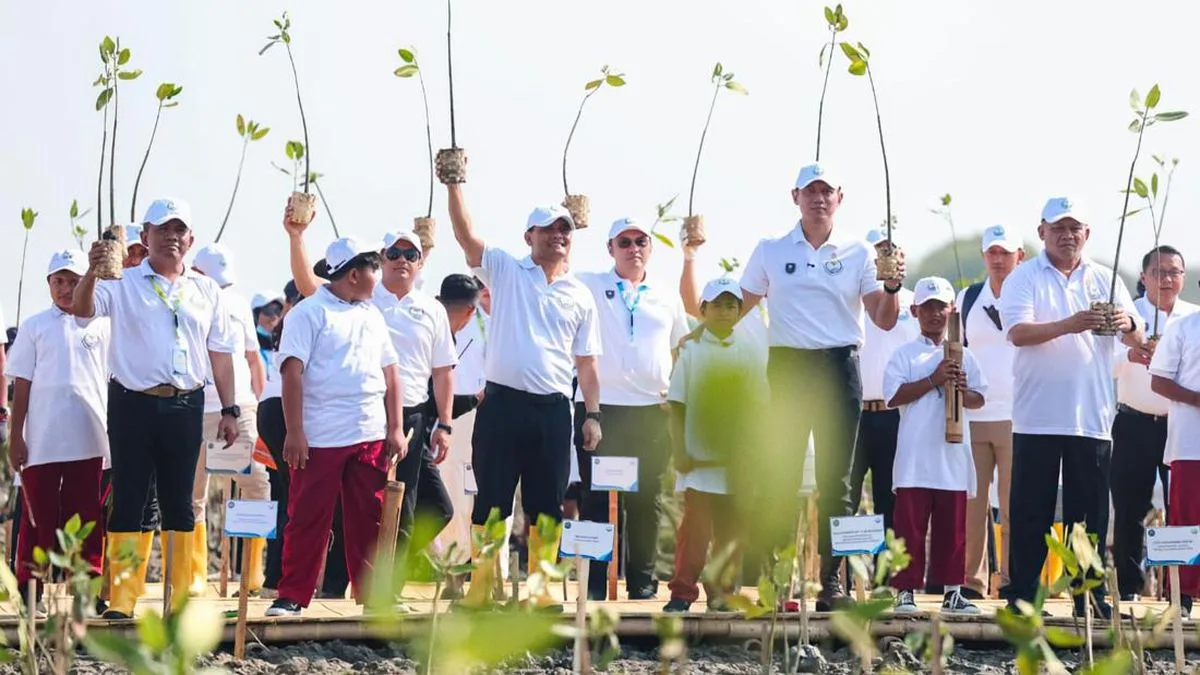
The government officially began a trial of coastal protection for Java's North Coast (Pantura) by combining mangrove planting and HexBricks technology in Timbulsloko Village, Sayung District, Demak Regency, on Monday (19/10). The step is part of efforts to address abrasion, tidal flooding, and land subsidence that increasingly threaten coastal areas.
Coordinating Minister for Infrastructure and Regional Development Agus Harimurti Yudhoyono (AHY), together with Central Java Governor Ahmad Luthfi, took part directly in planting mangroves. According to Luthfi, the action is a preventive measure to reduce the risk of coastal damage. He said the northern coastline of Central Java stretches 651 kilometers and crosses 17 regencies/cities, thus requiring integrated handling.
HexBricks is an innovation by the National Research and Innovation Agency (BRIN) in the form of a modular structure designed to support the recovery of mangrove areas. In Timbulsloko, the technology is applied together with raised beds and bamboo structures on a 6.56-hectare pilot area, with the initial planting phase covering 1,200 square meters. Its effectiveness will be evaluated through monitoring of mangrove growth, sedimentation, structural performance, and benefits for the surrounding community.
AHY stressed that mangroves help dampen ocean wave energy, thereby reducing the impact of abrasion. In addition, the production of HexBricks by local residents is expected to create jobs and additional income for coastal communities. The government is adopting a hybrid approach, combining the construction of coastal embankments and sea dikes with nature-based solutions.
"Today's effort is a preventive effort, namely by planting mangroves," said Ahmad Luthfi.
Head of the Java North Coast Management Authority (BOPPJ) Didit Herdiawan Ashaf explained that Timbulsloko is being used as a demonstration plotting or pilot area to study the application of coastal protection in line with the local natural characteristics. According to him, the approach in each region may differ because the thematic conditions are not the same. Didit also ensured that the construction of Pantura protection will not block fishermen's and fish farmers' access to the sea or ponds.
Previously, the Central Java Provincial Government ran the Mageri Segoro movement, which throughout 2025 recorded the planting of about 2.34 million mangrove stems on 257 hectares of land. The program is spread across 107 villages, 54 districts, and 17 regencies/cities. The achievement is an initial capital, but the HexBricks trial in Timbulsloko will determine whether this model is worth replicating in other areas.
Going forward, the success of this pilot area will be a benchmark for expanding Pantura protection. If proven effective in holding back abrasion and providing economic benefits, the government may adopt it more widely. However, challenges remain: ensuring long-term maintenance, community involvement, and a balance between physical infrastructure and natural ecosystems. Will this hybrid model become a new standard for Indonesia's coastal protection?