Liquid Nitrogen for PCs: Extreme Solution or Just Showing Off?
Baca dalam 60 detik
- Pendingin nitrogen cair mampu menurunkan suhu CPU hingga -150°F, tetapi memerlukan pengawasan manual dan berisiko merusak komponen.
- Teknik ini hanya relevan untuk overclocker kompetitif dan laboratorium, bukan pengguna rumahan yang menginginkan peningkatan performa praktis.
- Pusat data AI mulai melirik pendinginan kriogenik untuk mengurangi konsumsi air dan kebisingan, meski masih menghadapi tantangan teknis.
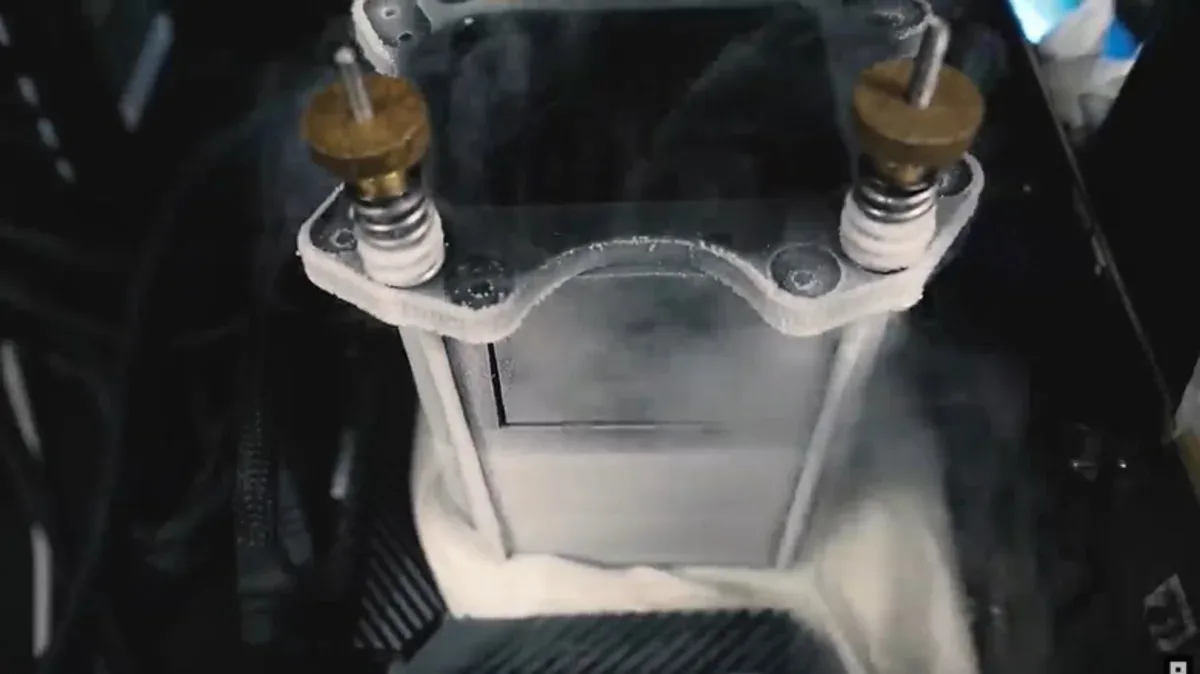
Using liquid nitrogen as a PC coolant is nothing new among extreme overclockers, but does this method make sense for ordinary users? The answer is almost certainly no. Liquid nitrogen has a boiling point of around -320°F, far colder than conventional cooling systems require. However, applying this technology to a home PC demands special equipment, constant monitoring, and a high tolerance for the risk of component damage.
Most modern PCs rely on a combination of heatsinks and fans to manage heat. For everyday tasks such as browsing the web or typing documents, those solutions are sufficient. When workloads increase—for instance, during heavy gaming or 3D rendering—liquid cooling (AIO) becomes the more sensible choice. Yet for the few who want to push a CPU to its absolute limit, liquid nitrogen offers unmatched cooling performance.
Even so, a liquid nitrogen cooling system cannot simply be installed as is. It requires a special container called a nitrogen "pot" mounted on top of the CPU's metal block. As the nitrogen evaporates, heat from the processor is drawn out. In benchmark testing, CPU temperatures can drop to -150°F. Unfortunately, the system is not automatic; users must keep adding liquid nitrogen as it evaporates and keep the temperature stable to avoid a "cold bug"—a condition in which the CPU gets so cold that it stops working.
Beyond temperature issues, condensation poses a serious threat. Cold nitrogen vapor can cause dew and potentially short circuits. The entire CPU socket area must be insulated with special materials. Even standard thermal paste can become brittle and crack at extreme temperatures, so cryogenic compounds are needed. All of this confirms that liquid nitrogen cooling is not for ordinary users.
"This is a fundamentally impractical method, and it should be left to competitive overclockers and engineering labs," the original article assessed.
Although impractical for home use, liquid nitrogen cooling has produced spectacular achievements. An overclocking team from Poland managed to run DOOM Eternal at 1,000 FPS, while id Software, the developer, reached only 400 FPS. This figure shows the extreme potential of cryogenic cooling, but also highlights that the method is only suitable for competitions and experiments.
On the other hand, the data center sector is starting to look at similar technology. With the surge in AI workloads pushing CPUs and GPUs to their limits, the need for advanced cooling is increasingly urgent. Several commercial systems for AI data centers are being developed, offering reduced water consumption and lower noise levels. However, technical challenges and high costs remain barriers to mass adoption.
For Indonesia, where the tropical climate and average room temperatures are high, PC cooling is a concern in itself. Users in major cities such as Jakarta or Surabaya often face hot ambient temperatures, so even standard cooling systems sometimes struggle. However, liquid nitrogen is clearly not the answer for everyday needs. Solutions such as AIO liquid coolers or additional fans with good air circulation are far more relevant and economical. The domestic data center industry also still relies on conventional cooling, even though energy efficiency is becoming an increasingly crucial issue as cloud and AI services grow.
Going forward, liquid nitrogen cooling is likely to remain a specialized niche. The question is whether this technology will find a place in commercial AI data centers, or instead be replaced by other cooling innovations such as immersion cooling that are more operationally friendly. Only time will tell, but for now, for the majority of PC users, liquid nitrogen remains an excessive luxury.