237-Day Crew-12 Mission Ends, SpaceX Successfully Returns Four Astronauts to Earth
Baca dalam 60 detik
- Kapsul Crew Dragon 'Freedom' milik SpaceX mendarat di Samudra Pasifik pada Kamis (waktu setempat) setelah menyelesaikan misi 237 hari di Stasiun Luar Angkasa Internasional.
- Komandan Jessica Meir, pilot Jack Hathaway, astronaut ESA Sophie Adenot, dan kosmonaut Rusia Andrey Fedyaev menjalani pemeriksaan medis sebelum kembali ke Houston.
- Keberhasilan ini menegaskan dominasi SpaceX dalam transportasi awak ke ISS, sekaligus membuka jalan bagi misi komersial dan penelitian lebih lanjut.
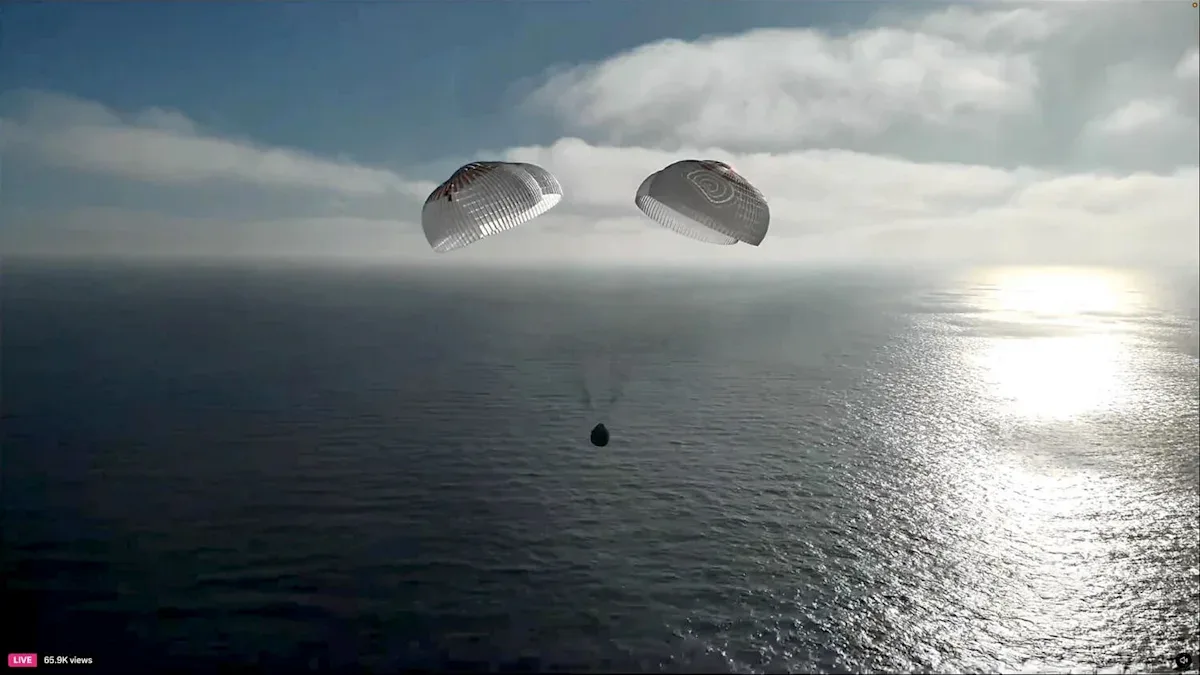
SpaceX's Crew Dragon capsule "Freedom" brought four astronauts safely back to Earth on Thursday, after 237 days orbiting aboard the International Space Station (ISS). The splashdown in the Pacific Ocean, about 50 miles west of Los Angeles, marked the end of the Crew-12 mission, which was filled with scientific experiments and station maintenance operations.
Commander Jessica Meir, pilot Jack Hathaway, European Space Agency (ESA) astronaut Sophie Adenot, and Russian cosmonaut Andrey Fedyaev enjoyed their final day in weightlessness before their capsule began its deorbit maneuver. Crew Dragon's thrusters fired for nine minutes, slowing the vehicle enough to leave orbit. About 36 minutes later, the capsule entered the atmosphere at nearly 5 miles per second, undergoing dramatic deceleration from air friction that created a fireball. The main parachutes then deployed, slowing the capsule to 15 mph before a soft landing at 11:34 local time.
The SpaceX team quickly evacuated the crew from the capsule and brought them aboard the recovery ship Shannon. Flight doctors conducted initial checks as the astronauts began readapting to gravity. They were then flown to Johnson Space Center in Houston for debriefing and physical therapy. "The thing I'm looking forward to most is seeing my 3.5-year-old daughter," Meir said before leaving the ISS. She also missed nature, the wind, and leaves. Hathaway, meanwhile, said he could not wait for a hot shower.
While aboard the ISS, Crew-12 not only carried out routine station maintenance tasks but also conducted dozens of experiments prepared by scientists on Earth. The mission was part of ongoing efforts by NASA and international partners to use low Earth orbit as a research laboratory, from materials science to biology. The presence of astronauts from various countries—the United States, Europe, and Russia—reflected cooperation that has remained intact despite geopolitical tensions on Earth.
From an altitude of 260 miles, Meir described the view of the ocean dominating the ISS windows. "We realize how vast and important the ocean is for this planet's ecosystem," she said. She stressed the need for serious efforts to protect the oceans. Such experiences often prompt astronauts to reflect on Earth's fragility and the importance of environmental conservation.
Currently aboard the ISS, Crew-13, led by Jessica Watkins, along with pilot Luke Delaney, CSA astronaut Joshua Kutryk, and Russian cosmonaut Sergey Teteryatnikov, has taken over duties since October and will serve for six months. In addition, Soyuz MS-29 cosmonauts Pyotr Dubrov and Anna Kikina, as well as NASA astronaut Anil Menon, have been on the station since July for an eight-month mission. This crew rotation ensures the continuity of ISS research and operations.
The success of Crew-12 reaffirmed SpaceX's role as NASA's primary provider of crew transportation services. With its reliable Crew Dragon fleet, the company owned by Elon Musk now handles nearly all commercial crew missions to the ISS. Meanwhile, Boeing with Starliner is still facing various technical hurdles. This dominance not only benefits NASA in terms of cost and schedule but also accelerates the commercialization of space, including plans for private space stations in the future.
For Indonesia, this development offers valuable lessons about the importance of technological self-reliance and long-term investment in space research. Although Indonesia does not yet have a crewed spaceflight program, participation in satellites and microgravity research could be an initial step. SpaceX's success shows that collaboration between government and the private sector can accelerate innovation in the space sector.
Going forward, the question is how quickly commercial space stations will replace the ISS, which is scheduled to retire in 2030. With more private actors, including SpaceX and Blue Origin, the future of space exploration will increasingly be shaped by market dynamics and regulation. Will Indonesia take a larger role in the global space economy?