BGN Gives Schools the Right to Reject Unsuitable MBG Meals, Food Safety Standards Tested
Baca dalam 60 detik
- Badan Gizi Nasional menegaskan sekolah berwenang menolak paket Makan Bergizi Gratis yang tidak memenuhi standar, termasuk yang berbau tidak sedap atau tanpa label.
- Kebijakan ini menjadi ujian pertama transparansi rantai pasok program yang menelan anggaran besar dan melibatkan ribuan dapur mitra.
- Jika pengawasan tidak konsisten, program berisiko kehilangan kepercayaan publik dan menghambat pencapaian target gizi nasional.
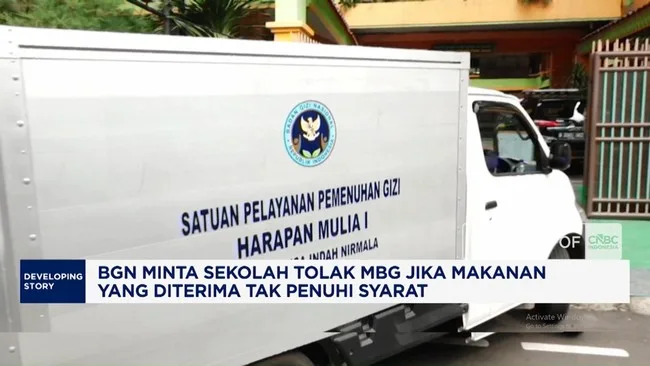
The National Nutrition Agency (BGN) has affirmed that schools have the right to reject Free Nutritious Meals (MBG) packages that do not meet requirements. BGN Head Sudaryono stated that food with an unpleasant odor, without a label, or not in accordance with regulations can be returned directly by the school. This policy was conveyed in the Power Lunch program on CNBC Indonesia, Wednesday (16/9/2026).
The move marks an important shift in the governance of a government priority program. Until now, schools have often been in a passive position as recipients of supplies. With the authority to reject, schools now act as the first line of field supervision that can prevent risky food from entering students' mouths. BGN appears to recognize that centralized oversight is not enough to reach thousands of distribution points every day.
However, this policy also raises questions about consistency. What is the exact parameter for "unpleasant odor"? How should the rejection procedure work so it does not disrupt students' meal schedules? Without clear technical guidance, schools may hesitate or even misuse the authority. BGN needs to immediately issue a detailed protocol, including a mechanism for reporting and replacing rejected packages.
From an industry perspective, this policy can encourage kitchen partners and food ingredient suppliers to improve hygiene and labeling standards. Those who fail to meet the requirements risk losing contracts. Conversely, producers who can maintain quality have the opportunity to strengthen their position. The effect is a natural selection in a supply chain that has so far been difficult to monitor.
"Food with an unpleasant odor, without a label, or not in accordance with regulations can be rejected by the school," said BGN Head Sudaryono.
For investors and businesses in the food sector, this signal deserves attention. The MBG program is a large market involving procurement on a massive scale. If standard enforcement strengthens, demand for labeled packaging, quality testing, and cold chain logistics will increase. Companies engaged in packaging, distribution, and food technology could receive a spillover of orders.
On the other hand, the government needs to ensure that the authority to reject does not create supply gaps. If many packages are rejected, students may end up not receiving nutritional intake that day. An emergency mechanism is needed, for example providing replacement food from the nearest kitchen or a reserve budget. Without that, the program's noble goals could be disrupted by operational problems.
Going forward, the effectiveness of this policy will depend on three things: clarity of standards, training for schools, and transparency of rejection data. The public has the right to know how many packages are rejected and what the follow-up is. If BGN can build an open reporting system, trust in MBG can be maintained. Conversely, if rejection is only an appeal without consequences, the program risks losing legitimacy in the eyes of parents and the public.