XRP Trails Far Behind: Why Holders Since 2018 Are Still at a Loss While Bitcoin and Ether Soar
Baca dalam 60 detik
- Harga XRP kini sekitar $1,33, masih 62,5% di bawah puncak Januari 2018, sementara Bitcoin dan Ether telah melampaui rekor lamanya.
- Pasokan beredar XRP melonjak 63% sejak 2017, menggerus nilai per token meski kapitalisasi pasar relatif stabil.
- Minimnya adopsi ETF dan fokus Ripple pada infrastruktur pembayaran membuat permintaan XRP tertinggal dari pesaingnya.
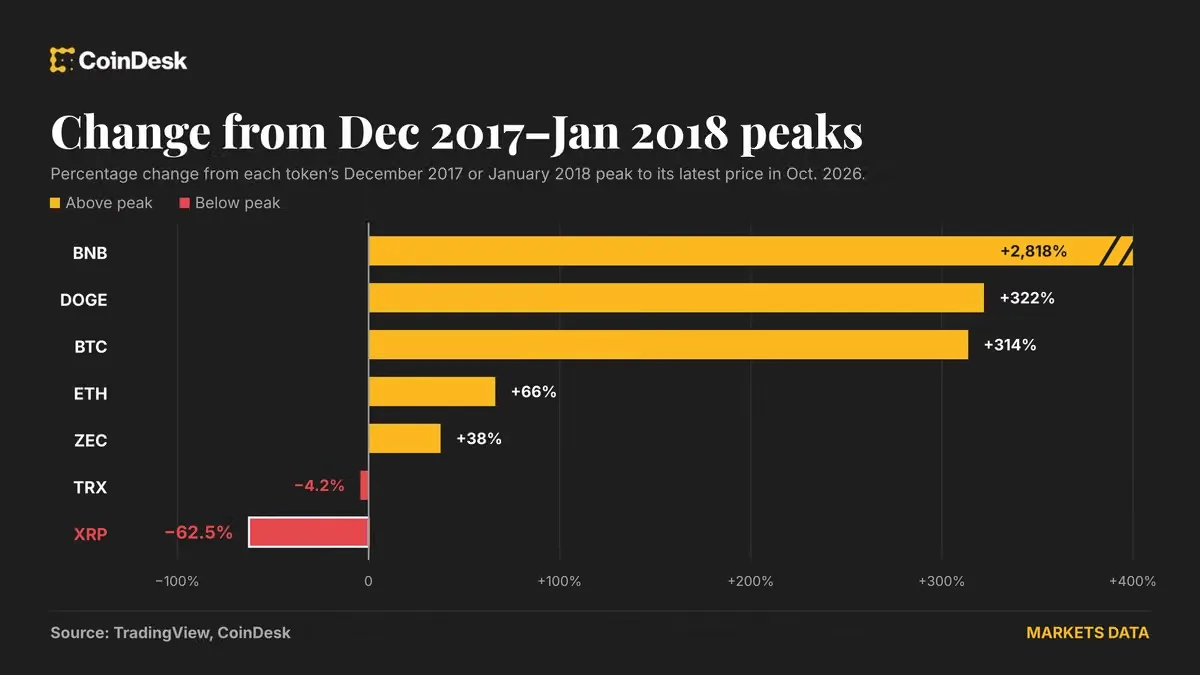
XRP, the cryptocurrency focused on cross-border payments, has still not been able to deliver gains for investors who bought at the peak of the 2018 cycle. The token's price now sits around $1.33, down 62.5% from its record $3.55 in early January 2018. That means anyone who bought then is still at a loss after nearly nine years, even though it briefly touched $3.66 in July 2025 before collapsing again. Meanwhile, Bitcoin has surged 314% from its December 2017 peak, Dogecoin is up 322%, and BNB has jumped about 2,800%. Ether is up only 66%, but remains far above its 2017 level. XRP is one of the few major assets that has failed to sustainably surpass its old record.
Analysts point to supply growth as the culprit. Nicolai Sondergaard, a senior analyst at Nansen, revealed that the amount of XRP in circulation rose 63%, from 38.7 billion in 2017 to 63.1 billion, while total market value fell only about 3%. "More XRP in circulation means each token represents a smaller share of a relatively unchanged total value," he said. In other words, even though market capitalization has not changed much, the price per coin is pressured by the growing supply.
Oliver Carding, head of marketing at Tesseract Group, argues that XRP has actually recovered when measured by total value, not price per token. "In value terms, XRP has recovered. About 63% more XRP is in circulation than at the peak, so the same market cap would produce a price about 39% lower," he explained. Tesseract is an institutional digital asset management firm with more than $500 million in assets under management.
Weak institutional adoption through ETFs is another factor. Paul Howard, a senior director at market maker Wincent, said XRP ETF uptake has been very sluggish compared with Bitcoin and Ether. SoSoValue data shows that since its debut nearly a year ago, XRP ETFs have gathered only $1.80 billion, while Bitcoin ETFs often attract more than $1 billion in a single day. Trading activity has also weakened, with spot volume down 53.5%, perpetual futures volume down 44%, and the number of active addresses down 10.7%.
Ripple, the company closely tied to XRP, is more focused on building cross-border payment infrastructure, the RLUSD stablecoin, and trade finance products. Howard argues this diverts attention from XRP as an investment asset. "Ripple has worked hard to build payment infrastructure, RLUSD, and trade finance products around the use of the ledger and the coin, and this shifts focus away from core XRP," he said. In addition, the DeFi, AI, and memecoin sectors that attract large capital flows and traditional finance integration have not been seriously pursued by XRP.
Regulatory burden also looms. In December 2020, the SEC sued Ripple and two of its executives for allegedly raising $1.3 billion through XRP sales without registering as securities. A federal judge in 2023 ruled that XRP sales on public exchanges were not securities offerings, but sales to institutional investors were. Ripple was fined $125 million in 2024. The case only ended in August 2025 when both parties dropped their appeals. Carding argues the long regulatory uncertainty explains why XRP did not return to its 2018 peak during the 2021 bull run, when Coinbase suspended trading. "Since then, XRP is down about 59%, compared with Bitcoin's 32% and Ether's 44%, and its circulating market cap is down about 56%," he added.
XRP is not the only coin left behind. Carding noted that six of the nine other assets in the January 2018 top 10 are also still below their levels at that time. To monitor XRP's movements, he suggests watching the XRP-to-Bitcoin ratio, net monthly distributions after re-escrow, and changes in fund holdings. "Continued relative weakness while distribution slows would indicate weakening demand," he said. In plain terms, if new supply slows but XRP still lags Bitcoin, that is a sign investor interest is thinning.
For Indonesian investors, the XRP phenomenon is a valuable lesson about the importance of understanding supply dynamics and institutional adoption before investing in crypto assets. Increasingly strict domestic regulations through Bappebti and the planned oversight by OJK also demand extra caution. Looking ahead, the question is whether Ripple can restore XRP's glory, or whether the token will remain in the shadow of Bitcoin and Ether? Only time will tell, but one thing is certain: in crypto, not all coins are created equal.