Trump-Xi Summit: Trade Truce Extended, AI and Taiwan Still Hanging
Baca dalam 60 detik
- AS dan China sepakat memperpanjang gencatan senjata dagang hingga 10 Januari, lebih pendek dari perkiraan semula.
- Tidak ada kesepakatan konkret soal risiko AI, isu Taiwan, maupun pembelian komoditas dalam pertemuan tiga hari itu.
- Pertemuan lanjutan di APEC Shenzhen dan G20 Miami akan menjadi ujian apakah ketenangan saat ini bertahan.
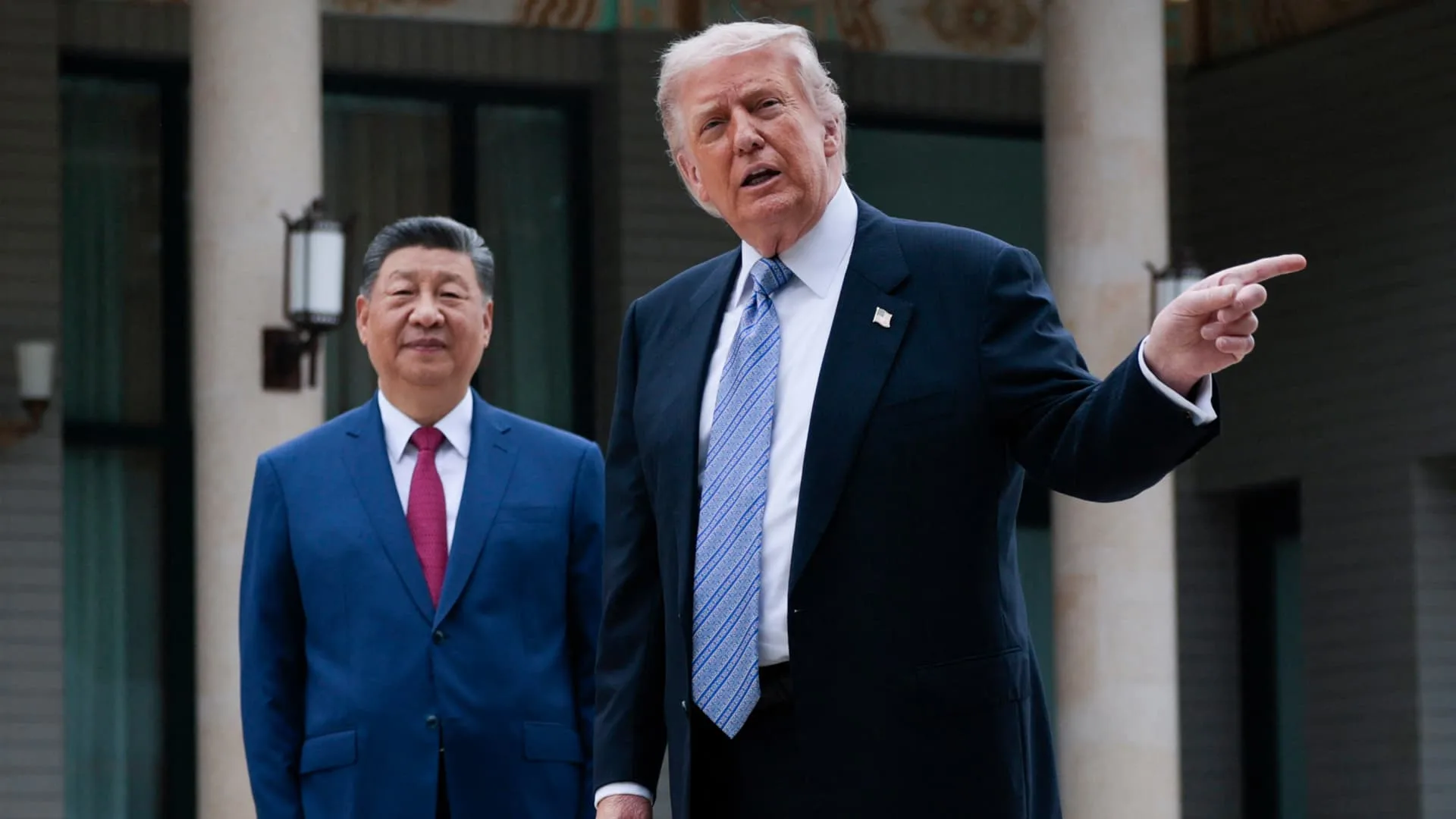
US President Donald Trump and Chinese President Xi Jinping closed a three-day state visit in Washington with one concrete result: an extension of the trade truce until January 10. The agreement was announced by US Treasury Secretary Scott Bessent, extending a pact that had been set to expire in November. Beyond that, however, there was almost no meaningful breakthrough—especially on artificial intelligence risks, Taiwan, and China's purchases of US commodities.
The two-month extension was shorter than many observers had expected, with many predicting a six-month extension. According to several China analysts who spoke to CNBC, the short duration could slightly benefit Washington because the threat of renewed trade tensions remains a bargaining chip. The truce itself was born from the Trump-Xi meeting in Busan, South Korea, which lowered US tariffs and suspended Beijing's controls on exports of rare earths and critical minerals.
Symbolically, China appeared more confident. On arriving at the White House, Xi stated that "the Thucydides Trap can be overcome"—a rhetorical shift from the May meeting in Beijing, when he still questioned whether the two countries could avoid the historical trap between a rising power and a ruling one. Xi stressed that healthy competition without confrontation is possible: "This should be a race to catch up with each other, not a struggle in which one wins and one loses."
For observers in China, the tone was appreciated. Hai Zhao, director of international political studies at the Chinese Academy of Social Sciences, called the visit a "great success" and stressed that the Chinese public was pleased to see Xi received well in Washington. Meanwhile, Cui Shoujun of Renmin University assessed the setting of bottom lines—intense competition without military conflict—as the most significant political outcome, injecting certainty into a bilateral relationship that has long been volatile.
Yet behind the ceremonial pomp—the red carpet, state banquet, and military display—several crucial issues evaporated. On AI, Trump in a Truth Social post before Xi's arrival said he wanted to "leave it exactly as it is," and claimed that was also China's position. Xi then struck a different tone, stressing that both countries have the "capability and responsibility to develop and manage AI for good, and to ensure its development always remains under human control." Nevertheless, there was no specific announcement on AI governance.
"There are various issues in this complex relationship that are not really handled at the leader-to-leader level institutionally and comprehensively," said Dewardric McNeal, a senior policy analyst at Longview Global.
The Taiwan issue was also barely touched. Xi, in Beijing's official readout, called on the US to "oppose Taiwan independence," but Trump has not made public comments on Taiwan at this summit. The Chinese readout also said the two leaders discussed the Middle East situation, without mentioning the Iran war. China's special envoy for the Middle East, Zhai Jun, later said in Singapore that the consensus reached would be crucial to cooling the conflict.
Strikingly, the summit was almost absent from US television. Major networks did not broadcast the military procession and Xi's welcome because of a suspension of the White House TV pool coverage—a form of solidarity with MS NOW, CNN, and Politico, which Trump had barred the previous week. A federal judge ordered access restored, but several journalists from the three outlets were still barred on Thursday morning, while Chinese state media were allowed in. Trump later complained on Truth Social that the moment of Xi's arrival "was actually made for television."
For Indonesia, the summit's outcome carries direct implications. The two-month truce extension creates uncertainty for market players and Indonesian exporters, especially in the commodities and manufacturing sectors linked to the China-US supply chain. The rupiah exchange rate and portfolio capital flows are also vulnerable to shifts in the two giants' trade sentiment. On the other hand, the absence of an AI agreement opens room for Indonesia to accelerate its national AI regulatory framework without having to wait for unclear global standards. Meanwhile, the APEC meeting in Shenzhen in November will be an important moment for Jakarta to push the digital economy and energy transition agenda amid the rivalry between the two powers.
With two follow-up meetings already scheduled, markets will watch whether the current calm is only surface-level. As Scott Kennedy of CSIS warned, "on the surface it looks like a polo match, calm, but underneath there is a lot of kicking, and that kicking will become more visible as we enter the new year." The question now: will Indonesia be able to take advantage of the gap between the two giants, or will it instead be swept up in a larger current of uncertainty?