Maple Seed-Inspired Single-Actuator Drone Flies More Precisely, Error Drops 43.5%
Baca dalam 60 detik
- Peneliti SUTD Singapura mengembangkan metode kendali untuk drone satu aktuator yang meniru biji maple, menurunkan error posisi hingga 39,5% dan kecepatan 43,5%.
- Pendekatan ini menggabungkan prediksi lintasan (NMPC) dan koreksi cepat (INDI), memungkinkan drone mengantisipasi gangguan angin dan beban tambahan.
- Teknologi masih eksperimental dan bergantung pada pelacakan eksternal, namun berpotensi untuk pemantauan lingkungan di Indonesia.
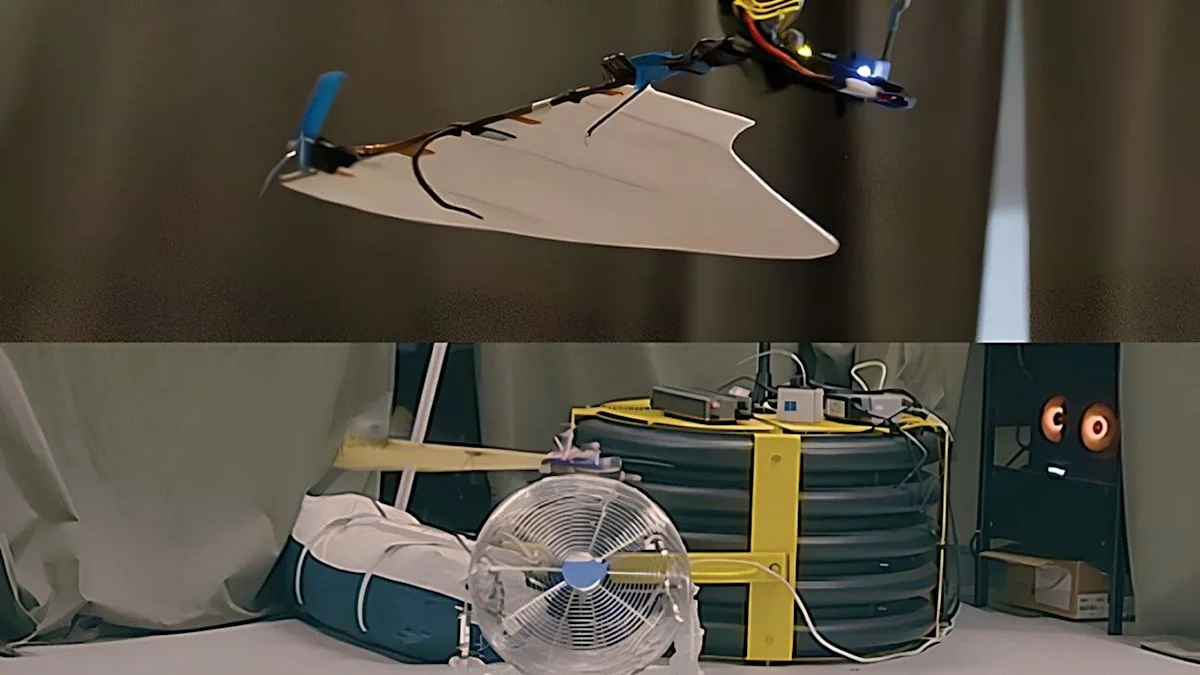
A flying robot with only one moving component might sound simple, but controlling it precisely is a significant challenge. Researchers from the Singapore University of Technology and Design (SUTD) have developed a control method that allows such minimalist drones to anticipate their next movements, as reported in a recent study.
The tested platform is named SAM (Samara Seed-Inspired Single-Actuator Monocopter), inspired by maple seeds that spin as they fall. This drone uses a single actuator to generate lift and control direction simultaneously, unlike conventional drones that rely on multiple rotors. This compact design offers efficiency but makes accurate trajectory tracking difficult.
To overcome these limitations, the research team implemented nonlinear model predictive control (NMPC), which predicts the drone's movements several moments ahead, combined with Incremental Nonlinear Dynamic Inversion (INDI), which utilizes real-time feedback for rapid correction against disturbances. They also built a hybrid model that captures the interaction between SAM's spinning and tilting motions.
Experiments used three SAM variants: short-wing, long-wing, and ultralight. Each presented different challenges, such as low lift efficiency, curved wings, and limited thrust. The short-wing and long-wing variants were tested on circular, figure-eight, and multi-level circular trajectories, even under gusts of wind from a fan. Meanwhile, the ultralight variant was tested on a circular trajectory while carrying a 5-gram load.
"Because the entire system relies on a single actuator, every motor command must be precisely planned and timed," said Dr. Emmanuel Tang, the study's lead author. He added that the predictive planning horizon allows the drone to fly more accurately despite wind disturbances or additional loads.
As a result, the combined NMPC and INDI approach outperformed benchmark controllers. This technology is still in the experimental stage and relies on external tracking and off-drone computation. Future research will focus on reducing dependence on external tracking and moving more computation onboard the drone.
Professor Foong Shaohui, associate head of the Engineering Product Development pillar at SUTD, stated that this platform could one day support applications such as environmental sensing and climate monitoring, especially where compact and scalable designs are highly valuable.
For Indonesia, this single-actuator drone technology opens opportunities for monitoring forests, peatlands, and remote, hard-to-reach areas. With lower operational costs and a compact size, such drones can be effective tools in disaster mitigation and environmental data collection. However, challenges in system integration and flight regulations still need to be addressed before widespread implementation.
Looking ahead, the question is how quickly this research can transition from the laboratory to the field, and whether Indonesia can become one of the early adopters for sustainable natural resource monitoring.