KKP 2027 Budget Ceiling Set at Rp16.65 Trillion, Rp30.22 Trillion Additional Request Rejected by DPR
Baca dalam 60 detik
- Komisi IV DPR menetapkan plafon anggaran KKP 2027 tetap Rp16,65 triliun, menolak penambahan Rp30,22 triliun yang diajukan kementerian.
- Keputusan ini memaksa KKP memprioritaskan program yang sudah berjalan, termasuk Kampung Nelayan Merah Putih, tanpa ekspansi baru.
- Bagi pelaku industri perikanan, stabilitas pagu bisa berarti kepastian jangka pendek, tetapi ambisi hilirisasi dan budidaya skala besar berpotensi tertunda.
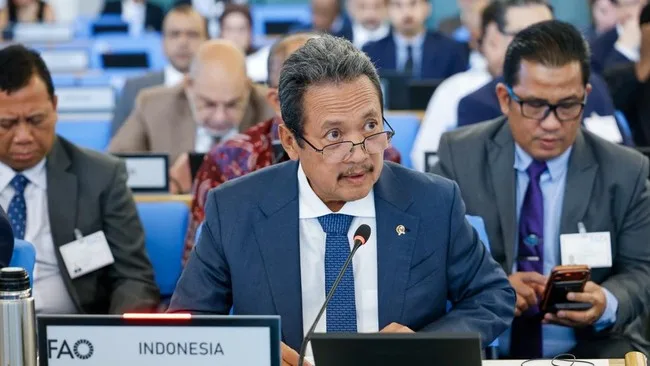
House Commission IV officially locked the budget ceiling of the Ministry of Marine Affairs and Fisheries (KKP) for fiscal year 2027 at Rp16.653 trillion. The figure did not move from the ceiling set earlier, while also rejecting the Rp30.22 trillion in additional funds requested by the ministry.
The decision was taken at a working meeting of Commission IV with Minister of Marine Affairs and Fisheries Sakti Wahyu Trenggono at the Parliamentary Complex, Jakarta, Wednesday (16/9/2026). Commission IV Chair Siti Hediati Hariyadi—better known as Titiek Soeharto—said the decision referred to a letter from the House Budget Committee on the outcome of deliberations on the 2027 State Budget Bill. "The KKP ceiling did not change after the working committee deliberations," she said in the forum.
Of the total ceiling, the largest share remains allocated to the Fisheries and Marine Management Program, at Rp12.203 trillion. The rest is spread across the Industrial Value-Added and Competitiveness Program (Rp313.70 billion), Vocational Education and Training (Rp315.16 billion), Environmental Quality (Rp347.82 billion), and Management Support (Rp3.47 trillion).
Previously, KKP proposed a budget jump to accelerate a number of strategic initiatives. Besides building Kampung Nelayan Merah Putih (KNMP) at 600 points, the additional funds were intended for the thematic inland fish farming program, revitalization of saline tilapia ponds in the Pantura area, and empowerment of coastal communities. However, the proposal stalled at the Budget Committee.
Responding to the decision, Trenggono said his office would complete the programs already planned with available resources. "We are targeting the existing ones to be finished first. Later we will report again to the President," he said after the meeting. He stressed that the Rp16.65 trillion ceiling was still sufficient for KNMP construction, though he did not detail whether the target of 600 locations could be fully met.
"As for the budget for priority programs, they are called priority programs, so they must have been programmed. But what is certain is that we will finish them with the existing budget first. The future ones we will discuss later." — Sakti Wahyu Trenggono, Minister of Marine Affairs and Fisheries
This House decision implies that state spending next year will be more disciplined, especially amid fiscal pressure and other priorities such as infrastructure and energy. For the marine sector, a stable ceiling does provide certainty, but it also limits room to maneuver for expansion. Yet downstreaming of fishery products and the development of large-scale aquaculture are among the engines of blue economy growth that have been touted.
For investors and businesses in the fisheries sector, this signal warrants attention. Projects that depend on government spending—such as fishing village construction, pond infrastructure, and labor-intensive programs—may proceed at a slower pace. On the other hand, budget constraints could open opportunities for private partnerships, especially for processing and distribution of catches. Regional governments are also required to be more creative in boosting locally generated revenue from the marine sector.
Going forward, the question is whether KKP will again propose additional funds through the revised budget mechanism, or instead rely on efficiency and non-budget financing schemes. Without a breakthrough, national fisheries production targets and fishermen's welfare could face a bumpy road.