Six Months of US-Iran War: A USD 38 Billion Bill and a New Test for Washington's Defense Budget
Baca dalam 60 detik
- Kantor Anggaran Kongres AS mencatat pengeluaran operasi militer melawan Iran menembus USD 38 miliar per 1 Agustus 2026, hanya dalam enam bulan.
- Angka itu menggerus ruang fiskal Washington di tengah tekanan belanja domestik dan mempercepat debat soal prioritas alokasi pertahanan.
- Bagi Indonesia, eskalasi ini berpotensi mengubah peta harga minyak, arus modal, dan posisi diplomasi ASEAN di kawasan.
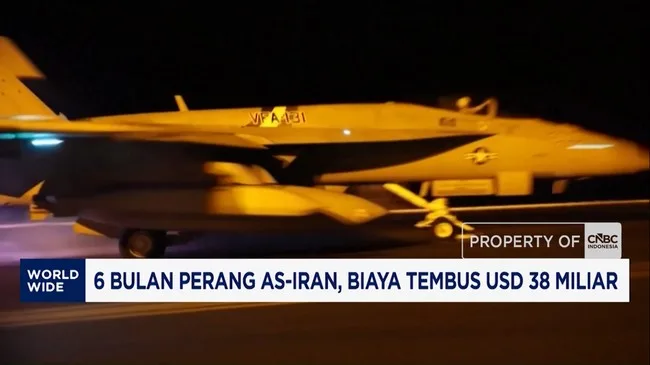
The war between the United States and Iran, now in its sixth month, has cost up to USD 38 billion as of August 1, 2026. The figure was compiled by the Congressional Budget Office (CBO), a nonpartisan body that routinely calculates the fiscal impact of government policy, and it is the first measurable indicator of how deeply the conflict is draining the superpower's coffers.
What makes this figure important is not just its size but its speed. Over half a year, military operational spending has already approached half the total annual defense budget of several mid-sized countries. The CBO places this burden in the context of dual pressure: on one hand, Washington must fund combat readiness; on the other, domestic spending needs — infrastructure, health, and energy subsidies — have not diminished.
Several defense analysts assess that the CBO figure only reflects direct costs — ammunition, fuel, fleet operations, and personnel rotations. Indirect costs, such as veterans' care, equipment replacement, and higher risk premiums in energy markets, typically only become apparent years after a conflict ends. This pattern occurred in the Iraq and Afghanistan wars, whose final bills far exceeded initial projections.
"Every month the conflict continues, Washington's fiscal space narrows, and that forces Congress to choose between adding debt or cutting other programs," said a fiscal policy analyst who monitors CBO reports, describing the dilemma facing policymakers.
For global markets, the fastest signal to be picked up is the movement of oil prices. Tensions around the Strait of Hormuz — a shipping lane that carries about one-fifth of the world's oil supply — are keeping the energy risk premium high. Importing countries, including Indonesia, feel the effects through fuel import costs and pressure on the trade balance.
From a geopolitical standpoint, this protracted war tests the consistency of Washington's alliances in the Middle East while opening space for other powers to expand their influence. Iran, which has long maintained trade and diplomatic ties with a number of Asian countries, is predicted to increasingly orient its economic axis eastward. For ASEAN, this dynamic demands a careful position: too close to one camp risks losing economic benefits, too neutral risks being seen as irrelevant.
Indonesia's context becomes crucial at this point. As Southeast Asia's largest economy and an oil importer, Indonesia has a direct stake in energy price stability and the smooth flow of shipping lanes. The rupiah is also vulnerable to a stronger dollar, which usually accompanies conflict escalation, because global investors tend to shift to safe assets. On the other hand, a surge in commodity prices such as coal and CPO — caused by global supply chain disruptions — could be a temporary boon for domestic exporters, though the benefits are uneven.
The Indonesian government faces a dual test: keeping energy subsidies from ballooning while preserving people's purchasing power. Historically, every USD 10 per barrel rise in world oil prices adds tens of trillions of rupiah to the state budget burden. If the US-Iran conflict continues until the end of the year, the macro assumptions in the budget risk missing the mark, and that will force mid-course policy revisions.
The question now hanging in the balance: will Washington slow the pace of its military operations to contain costs, or instead expand pressure to bring the conflict to a swift end? That decision will determine not only the direction of the war but also the direction of global energy and financial markets — including for Indonesia, which sits at the crossroads between its economic interests and its diplomatic position.