Lightning in the Age of Global Warming: Blessing or New Threat?
Baca dalam 60 detik
- Petir yang selama ini menjadi simbol kekuatan alam kini berubah seiring memanasnya atmosfer bumi, dengan proyeksi peningkatan frekuensinya di berbagai belahan dunia.
- Para ilmuwan mencatat ketidakpastian besar dalam memprediksi dampak perubahan iklim terhadap petir, namun sepakat bahwa wilayah lintang tinggi akan mengalami kenaikan aktivitas petir.
- Fenomena petir kering dan kebakaran hutan yang dipicu petir semakin sering terjadi, menciptakan lingkaran umpan balik yang memperparah krisis iklim.
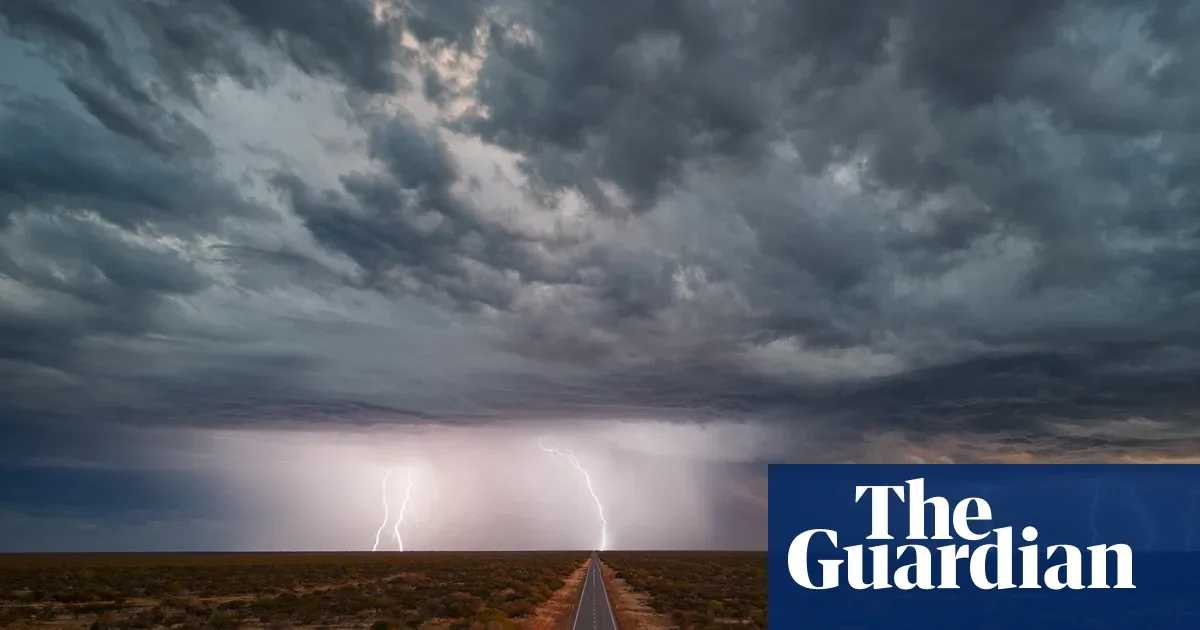
In a rock alcove in Kakadu National Park, northern Australia, a figure the Bininj people call Namarrkon is carved. In their belief, Namarrkon is a creator ancestor who splits the clouds with his stone axe, triggering thunder and lightning, then releases the rain that sustains the land. This story is not merely myth; it reflects how lightning has long been an inseparable part of human life and nature.
Yet behind its grandeur, lightning holds extraordinary power. Every second, an average of 60 lightning flashes strike around the world, some stretching more than 800 kilometers. A single flash can release up to seven gigajoules of energy—equivalent to 1.67 tons of TNT—and in an instant heat the surrounding air to about 30,000 degrees Celsius, five times hotter than the surface of the Sun. This energy plays an important role in regulating Earth's electric field, the nitrogen cycle, ozone production, and the breakdown of greenhouse gases such as methane.
Unfortunately, global warming does not only change lightning's role in the Earth system, but also the behavior of lightning itself. Last July, more than 48,000 lightning strikes triggered large wildfires in Canada and the northwestern United States, destroying homes and blanketing cities across North America with smoke. Meanwhile, a heat wave in the UK last summer produced nearly 30,000 lightning strikes in southeastern England in a single day.
Global data show that about a quarter of a million people are struck by lightning each year, with around 24,000 deaths. In Australia alone, lightning kills 5-10 people per year and injures about 100. These figures show that lightning is not only a spectacular natural phenomenon, but also a real threat to human safety.
Scientific understanding of lightning has advanced rapidly since Benjamin Franklin in the 18th century proved the link between static electricity and lightning. Today, scientists know that lightning forms when warm, moist air rises to the cold upper parts of storm clouds, forming ice crystals that collide with soft ice particles (graupel), transferring electrons, and triggering an electrical discharge. Nevertheless, the exact trigger of that discharge remains a mystery; some studies link it to cosmic rays or the buildup of ionized air "streamers".
What is clear is that more than 80% of lightning occurs over land, concentrated in central Africa, parts of South America, and the Himalayas. The place most frequently struck by lightning is Catatumbo in Venezuela, which the Bari people call the "House of Thunder", where warm air from Lake Maracaibo collides with the Andes Mountains and produces thunderstorms on 140-160 nights per year. Conversely, the polar regions almost never experience lightning.
Atmospheric warming does increase the water vapor content and the energy for convection within storm clouds, but its effect on lightning is not that simple. A recent review of studies still in the peer review process found that projections of lightning change per degree of global warming vary widely, with an average increase of 7.5%. Although there is great uncertainty in the tropics, scientists agree that lightning will increase at high latitudes.
Andrew Dowdy, a lightning expert from the University of Melbourne, stressed that "it is clear that in a warmer world, some conditions that support thunderstorms may increase," but he also highlighted "great uncertainty" in understanding the impact of climate change on lightning. This difficulty is partly due to the complexity of modeling small-scale processes and the lack of high-quality long-term data. By combining cyclone and front records with thunderstorm data, Dowdy and his colleagues were able to track the frequency of these events back to 1979, and found an increase along the eastern coast of the continent as well as a shift of cyclone activity toward the poles in the Southern Hemisphere.
In addition, lightning can also strike without a storm. A recent report from Emergency Leaders for Climate Change Australia warns that the number of fires triggered by dry lightning—lightning that strikes the ground without rain—is increasing. Forests in southeastern Australia recorded 50% more dry lightning strikes in 2000-2016 than in the previous two decades, creating "a dramatic shift in fire conditions". Dowdy explained that "lightning is a natural ignition source for fires" and fires caused by lightning tend to burn larger areas because they often occur in remote locations and in large clusters.
Another worrying phenomenon is extreme fires that create their own weather in the form of pyrocumulonimbus (pyroCb) clouds. These clouds form when heat and water vapor from large fires rise to the stratosphere, creating a vortex that draws in water vapor and triggers lightning. Jason Evans of the University of New South Wales noted a "massive increase" in pyroCb events in Australia; during the 2019-2020 Black Summer fires, their number nearly matched the total of the previous 40 years. PyroCb is not only a symptom, but also reinforces the feedback by triggering new fires ahead of the fire front. Evans stressed that once a pyroCb forms, "it cannot be controlled. We can only get out of the way."
This changing lightning phenomenon shows that humans are no longer merely subject to the forces of nature, but also help create them. Like the story of Namarrkon that reminds us of the duality of lightning—beautiful yet frightening, life-giving yet destructive—we are faced with the question: to what extent will climate change alter the landscape of lightning, and are we ready to face the consequences?