Kia Carens EV Courts the Electric MPV Market, Final Price Still Subject to Change
Baca dalam 60 detik
- Kia Sales Indonesia membuka kemungkinan revisi harga Carens EV sebelum peluncuran resmi, meski estimasi awal sudah berada di bawah BYD M6.
- Segmen MPV medium listrik 7 penumpang masih kosong, dan Kia ingin mengisi ceruk itu dengan strategi harga berbasis riset pasar.
- Insentif bea masuk dan PPnBM nol persen menjadi kunci daya saing harga, tetapi kepastian akhirnya bergantung pada fine-tuning menjelang peluncuran.
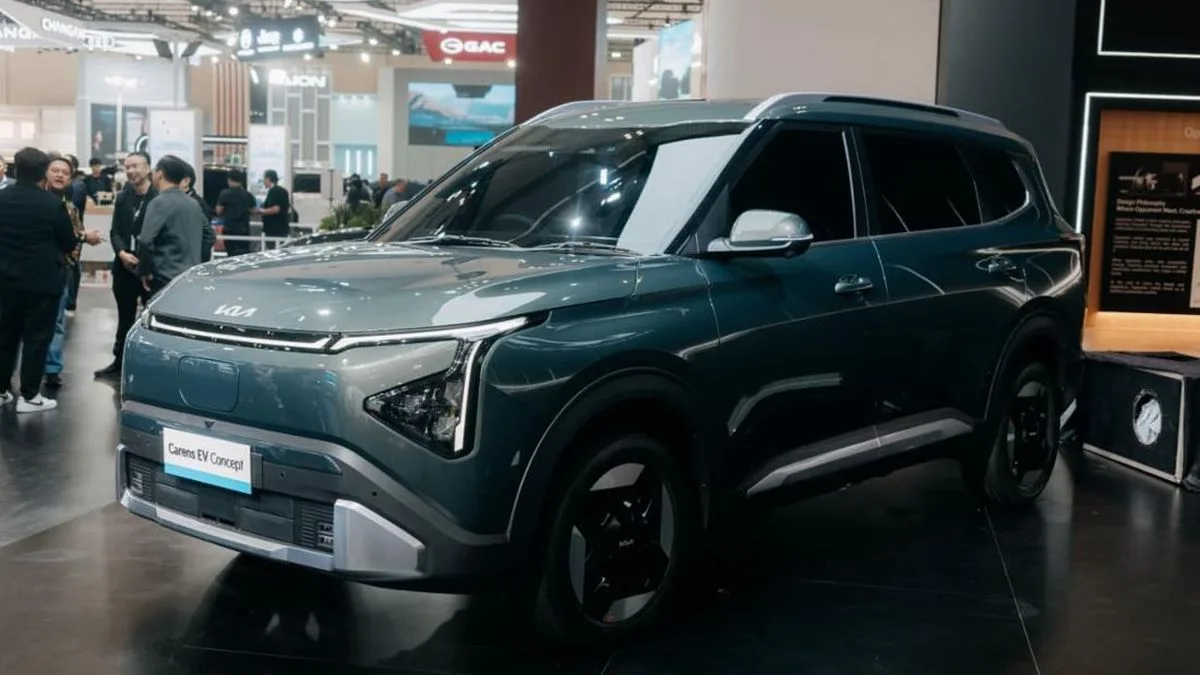
PT Kia Sales Indonesia (KSI) has confirmed that the official price of the Carens EV is not yet final. Although pre-booking estimates have been published in the range of Rp382 million to Rp432 million (OTR Jakarta), Vice President Operation KSI Harry Yanto said there is still room for adjustment before launch. He made the statement in Jakarta on Wednesday (28/10), signaling that the pricing map for seven-seat electric MPVs in Indonesia is not yet fully locked in.
The initial estimate places the Carens EV below the BYD M6, which is currently priced at Rp395 million for the Standard variant, Rp435 million for Superior, and Rp445 million for Superior Captain (OTR Jakarta). However, that price gap is not a guarantee. Harry said the fine-tuning process will take into account market response and the product value on offer. "It could go up a little or down a little," he said, stressing that the final decision will be announced ahead of the launch.
Interestingly, Kia denies that the initial pricing was meant to undercut competitors. According to Harry, the figure came from market value research—how much consumers are willing to pay for the features and dimensions on offer. This approach reflects a shift in strategy for the South Korean brand in the domestic electric vehicle segment: not merely matching competitor prices, but building its own value justification.
The Carens EV is positioned to fill the medium MPV or C-MPV segment, which prioritizes comfort and a spacious cabin. Currently, battery-electric medium MPVs with seven-seat capacity are still very rare in Indonesia. The BYD M6 is recorded as the only direct competitor in that niche. Kia sees this gap as an opportunity to broaden its customer base, especially families that need a large-capacity electric vehicle without having to jump to the premium segment.
The Carens EV's price competitiveness is inseparable from government facilities. Harry said the 0 percent import duty exemption and 0 percent PPnBM for locally assembled electric vehicles are important factors enabling Kia to set an attractive price. Without those incentives, he said, the price of a medium electric MPV would struggle to compete with fossil-fuel vehicles in the same segment. This policy is also a signal that the government remains committed to pushing electrification through fiscal instruments.
For consumers, the uncertainty over the final price can serve as a reason to delay a purchase decision. On the other hand, for Kia, price flexibility is a tool to gauge demand elasticity before production and distribution run at full capacity. This step is reasonable in a still-young market, but it also poses a challenge: the pre-booking already underway needs to be managed so as not to create wrong expectations.
Going forward, the question is not simply whether the Carens EV will be cheaper than the BYD M6, but whether Kia can maintain price consistency after launch. If the fine-tuning ends in an increase, the pre-booking momentum could be disrupted. Conversely, if the final price remains competitive, the Carens EV could accelerate the penetration of electric MPVs in the domestic market—while also forcing competitors to adjust their strategies. The launch in the near future will be the first test.