Erick Thohir Challenges Public to Prove Support: Women’s League Is Running, Fans Asked to Show Up
Baca dalam 60 detik
- PSSI bersama operator liga dan klub peserta menyepakati Indonesia Women’s League berlangsung minimal lima tahun sebelum dievaluasi.
- Erick Thohir menilai tuntutan agar liga putri digelar harus dibarengi kehadiran penonton di stadion, bukan sekadar pernyataan di media sosial.
- Keberlanjutan kompetisi dinilai bergantung pada kesiapan finansial dan operasional klub agar tidak berhenti di tengah musim.
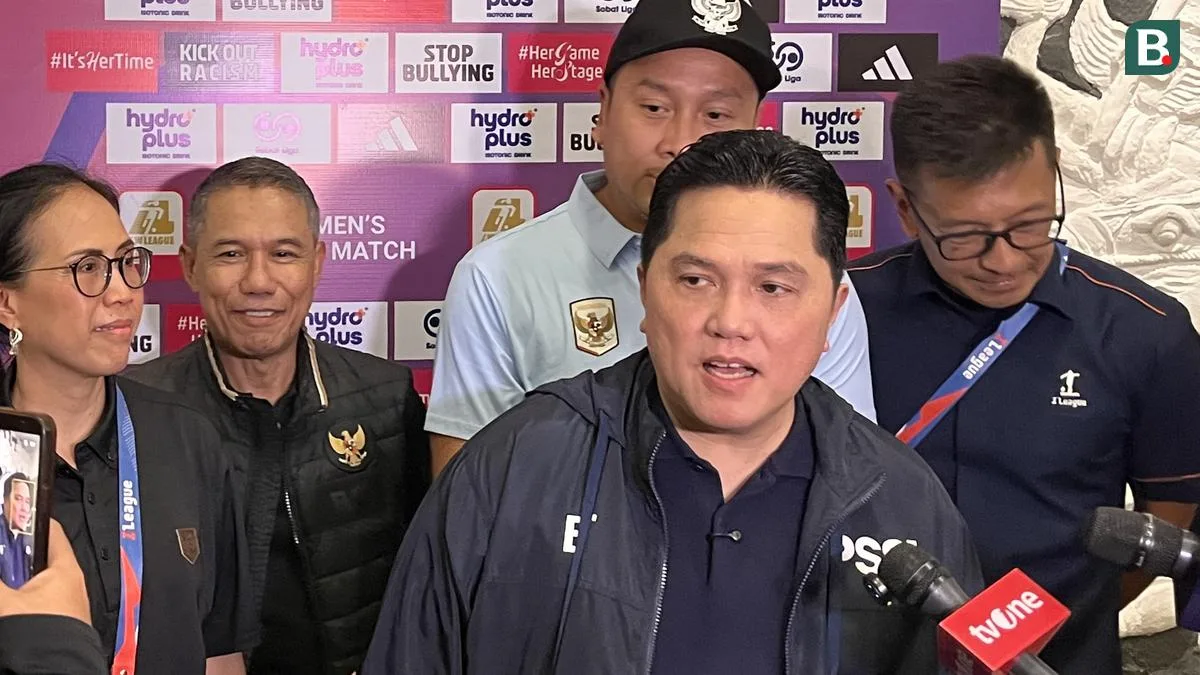
PSSI Chairman Erick Thohir used the opening of the Indonesia Women’s League 2026/2027 at Stadion Madya, Jakarta, on Sunday (18/10/2026), to throw down a challenge to the public: prove your support for women’s football by coming to the stadium, not just by demanding that the league be held. The statement was aimed at groups that have long questioned the existence of a national women’s competition.
Erick did not deny that calls for the women’s league to get underway promptly are reasonable. However, he argued that support which stops at statements in digital spaces will not be enough to bring the competition to life. According to him, spectator attendance is the most tangible indicator of whether the public truly wants this league to grow.
“Come on, those of you who have been shouting, where’s the league, come and watch now,” Erick said, as quoted from remarks after the competition’s opening.
He also asked supporters to back their respective clubs as well as the national team players who are now spread across the participating teams. Support for clubs and national team players is seen as a direct form of public contribution to the women’s football ecosystem.
Just as important, Erick emphasized a joint commitment between PSSI, the league operator, and participating clubs to run the Indonesia Women’s League for the next five years. Only after that period will a comprehensive evaluation be carried out. This agreement serves as a kind of guarantee that the competition will not stop midway simply because of a change in leadership or momentary pressure.
For Erick, the league’s sustainability cannot be separated from the readiness of the clubs. He reminded that the running of competitions is often disrupted by financial problems or internal conflicts that cause clubs to withdraw mid-season. Therefore, the league’s development must be built gradually on a solid foundation, not merely ensuring the competition gets underway in its inaugural season.
The statement implies that the biggest challenge for the Indonesia Women’s League is not whether the league exists, but how to keep the competition’s pulse stable from season to season. Participating clubs are required to have adequate management and revenue sources so they do not depend on the organizer. In the context of national football, a sustainable women’s league also serves as an entry point for developing women’s national team players, who have often lacked competitive match minutes.
Erick hopes public enthusiasm will not stop at the opening ceremony. He wants the public to show support by following matches regularly, both at the stadium and through broadcast channels. That way, the women’s league will not merely exist as a formality, but truly become part of Indonesia’s football culture.
Going forward, the test for the Indonesia Women’s League is whether that five-year commitment can attract investment and sponsor attention on a sustainable basis. Without stable financial support, the organizing agreement may continue, but the quality of the competition and player welfare risk standing still. The public now also has a role in determining the direction: will the demands voiced so far turn into real presence in the stadium stands?