University of Chicago's $20 Bracelet Silences Smart Speakers with Ultrasound
Baca dalam 60 detik
- Riset Universitas Chicago menciptakan gelang yang memancarkan sinyal ultrasonik 25 kHz untuk mengacak rekaman suara di sekitar pengguna.
- Perangkat ini memanfaatkan kelemahan fisik mikrofon murah, bukan meretas perangkat, sehingga tidak memerlukan akses ke sistem apa pun.
- Meski efektif dalam radius tiga kaki, para ahli memperingatkan bahwa solusi ini hanya tambal sulam dan tidak menggantikan regulasi perlindungan data yang mengikat.
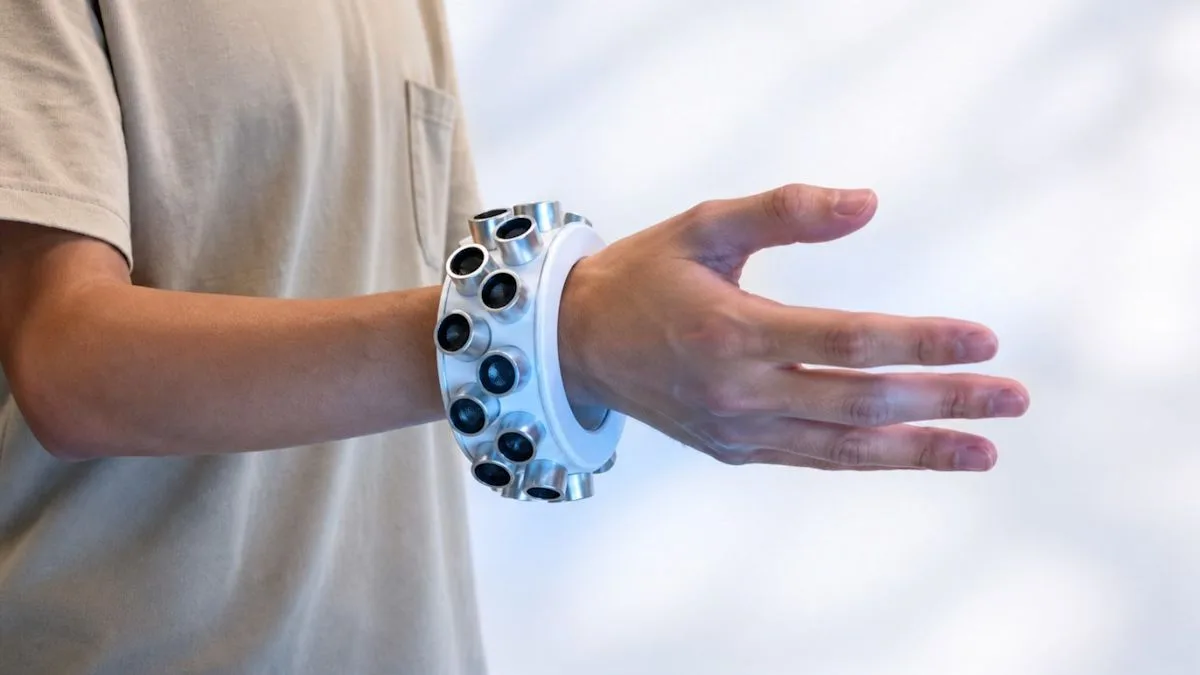
A research team from the University of Chicago has developed a prototype bracelet capable of disabling the microphones of nearby smart speakers without needing to touch the devices. This tool, named the Bracelet of Silence, emits ultrasonic waves around 25 kHz—above the human hearing threshold—which causes commercial microphones to pick up sound as unreadable static.
This idea emerged from a growing concern: always-listening household devices, such as Amazon Echo or Google Home, frequently activate themselves incorrectly. Researchers from Northeastern University, David Choffnes and Daniel Dubois, even played 120 hours of television audio to smart speakers and recorded dozens of false activations. This finding confirms that fears of eavesdropping are not mere paranoia.
Unlike solutions that rely on a mute button that must be trusted, this bracelet gives users full control. Its mechanism exploits the nonlinear properties of microphones: when receiving a strong ultrasonic signal, the microphone converts this noise into audible sound, causing recorded conversations to turn into white noise. The effect is equivalent to injecting interference directly into the microphone's circuit, without physical contact.
The prototype uses 24 transducers arranged in two rings of 12 units each, providing omnidirectional coverage with minimal blind spots. Interestingly, the natural movement of the wrist while speaking actually enhances the jamming performance compared to a static arrangement. In a demonstration, activating the bracelet during a phone call immediately turned the audio on the other end into pure static.
However, its effectiveness is limited to a radius of about three feet—sufficient for close-range conversations, but not an entire room. The bracelet also cannot erase audio already recorded before activation. Furthermore, the ultrasonic emissions might be audible as a high-pitched tone to children and animals.
"This creates an arms race, and consumers will lose that race. Everything like this is a half-measure or a temporary solution. There will always be a way around it," said Woodrow Hartzog, a professor of law and computer science at Northeastern University.
Hartzog's criticism highlights a fundamental weakness: surveillance systems can adapt by filtering out ultrasonic noise or switching to alternative sensors. This, in turn, would erode the bracelet's effectiveness and drive an endless cycle of upgrades.
This bracelet is part of an ecosystem of "privacy armor" products, each addressing different surveillance modalities. Project Alias, for example, sits atop a smart speaker and emits noise until a local keyword is spoken. Alexagate attaches to Echo devices and scrambles microphones with ultrasound, but remains fixed to a single speaker. Meanwhile, Scott Urban's Reflectacles glasses block infrared to counter facial recognition cameras.
"New technologies continue to erode our privacy and anonymity. People are looking for an escape, and that's what I'm trying to provide," Urban said.
For Indonesia, this development offers important lessons. With the growing penetration of smart speakers and IoT devices in major cities, the risk of audio eavesdropping is becoming increasingly real. Newly enacted personal data protection regulations need to consider hardware dimensions, not just software policies. Furthermore, price-sensitive Indonesian consumers might be attracted to affordable solutions like this if mass-produced.
Nevertheless, the researchers emphasize that this bracelet is not a substitute for enforceable data protection policies. The device merely buys a few feet of silence while users await stronger regulations. The question is, will such innovation foster collective awareness or instead become an excuse for the industry to disregard privacy responsibilities?