Bapanas 2027 Budget Capped at Rp161.9 Billion, Rp16 Trillion Request Rejected
Baca dalam 60 detik
- Komisi IV DPR menetapkan pagu Badan Pangan Nasional 2027 hanya Rp161,9 miliar, tak ada penambahan.
- Angka itu jauh di bawah permintaan Bapanas sekitar Rp16 triliun untuk bantuan pangan dan stabilisasi harga.
- Keputusan ini memaksa Bapanas memangkas program, sementara jumlah keluarga penerima bantuan diprediksi turun.
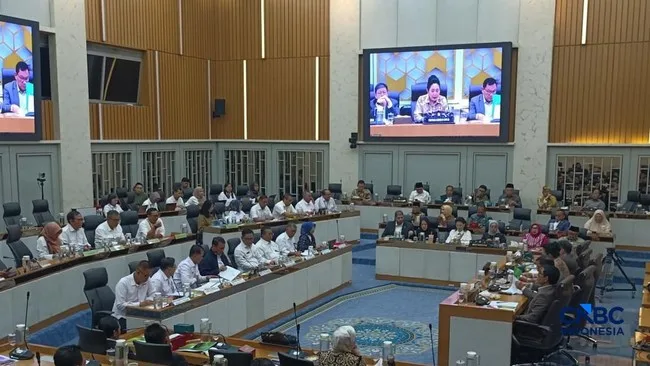
House Commission IV officially locked the National Food Agency (Bapanas) budget for 2027 at Rp161.9 billion, with no additional funds whatsoever. The decision was made in a hearing with the head of Bapanas on Wednesday (16/9/2026), and dealt a heavy blow to the agency, which had previously requested an additional Rp16 trillion.
Commission IV chair Siti Hediati Hariyadi, also known as Titiek Soeharto, stressed that the ceiling referred to the outcome of deliberations by the House Budget Committee. "The National Food Agency's budget ceiling for fiscal year 2027 is set at Rp161.9 billion with no additional budget," she said during the meeting. The figure is identical to the initial agreement on 1 September 2026, meaning there is no room for further negotiation.
A breakdown of the allocation shows the largest share goes to management costs. The Availability, Access, and Consumption of Quality Food Program receives only Rp49.68 billion, while the Management Support Program absorbs Rp112.21 billion. In other words, only about 30% of the budget actually reaches strategic food programs, while the rest covers operations and staff salaries.
Earlier, Bapanas principal secretary Sarwo Edhy said the regular Rp161 billion budget was only enough for staff spending and routine activities. "We proposed an additional budget of around Rp16 trillion," Sarwo said after a meeting on 19 August 2026. The funds were allocated for food aid, the Food Supply and Price Stabilization (SPHP) program for rice, corn and soybeans, the B2SA program (Diverse, Nutritious, Balanced and Safe), control of food-insecure areas, and fresh food supervision.
Notably, the Rp16 trillion request was already lower than the 2026 food aid budget of Rp17 trillion. Bapanas reasoned that the number of beneficiaries was expected to shrink as the economy improves. "For 2027, based on existing data, the beneficiaries are fewer," Sarwo said. In 2026, aid was distributed to 33.2 million KPM, which he said were the extreme poor. However, the exact 2027 KPM figure has not been obtained because it is still awaiting data from the Ministry of Social Affairs.
The House decision raises a big question: how can Bapanas carry out its food stabilization mandate with a budget that is almost entirely consumed by management costs? Titiek asked Bapanas to prioritize the available budget to maintain food availability, stabilize supply and prices, manage government food reserves, and address food and nutrition insecurity. Without additional funds, however, the agency's room to maneuver is very limited.
For Indonesian readers, especially investors and market players, the decision could signal that the government next year will rely on other fiscal instruments for food intervention. The SPHP program, which has helped support rice prices in the market, may depend on the budgets of other ministries or state food companies. Without a substitute, the risk of food price volatility ahead of the political year could rise. Farmers and lower-income consumers are the most vulnerable to the impact.
"The National Food Agency needs to prioritize the available budget to maintain food availability, stabilize supply and prices, manage government food reserves, and address food and nutrition insecurity," Titiek Soeharto said.
Going forward, attention will focus on two things: first, whether Bapanas can rationalize its programs without sacrificing its stabilization function; second, whether the government will shift the burden of food aid to the remaining 2026 budget or to other ministries. Without clarity, national food security could be at stake amid global uncertainty.