Webb Telescope Reveals 'Cosmic Cauldron' in NGC 7129, a New Window on Star Birth
Baca dalam 60 detik
- James Webb Space Telescope berhasil menembus awan debu di nebula NGC 7129 dan memotret puluhan bintang muda yang sebelumnya tersembunyi.
- Citra ini memperlihatkan bagaimana pancaran jet dan radiasi bintang purba mengubah gas di sekitarnya, menciptakan kondisi bagi kelahiran bintang-bintang baru.
- Penemuan ini membuka peluang bagi astronom Indonesia untuk terlibat dalam riset pembentukan bintang melalui data terbuka JWST.
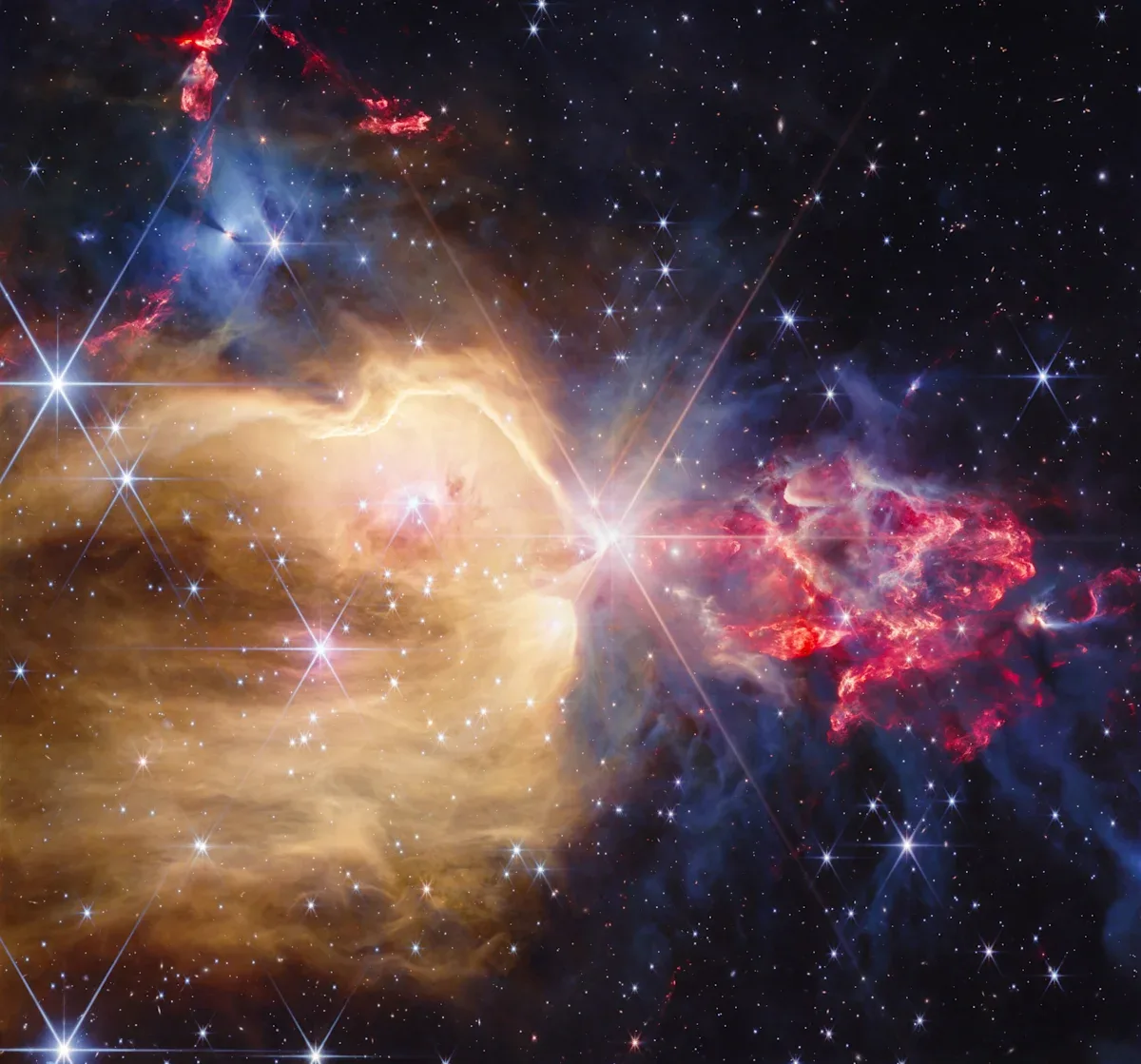
The James Webb Space Telescope (JWST) has once again made a breakthrough. This time, the infrared telescope owned by NASA and international partners captured a rare view of the nebula NGC 7129, a "cosmic cauldron" where new stars are born, located about 3,300 light-years from Earth. The image, released on Tuesday (6/10), shows stars that were previously hidden behind a thick blanket of dust.
The nebula NGC 7129 is known as an active star-forming region. Within it, dozens of protostars—the precursors of stars—are at various stages of evolution. Although they come from the same molecular cloud, the stars in this cluster apparently formed at different times. This phenomenon provides insight into the complex and non-uniform dynamics of the star formation process.
What makes this image special is its ability to capture the powerful interaction between young stars and their surroundings. The strong jets and radiation emitted by these stars heat, shock, and stir the surrounding hydrogen gas. In the image, golden regions indicate hot atomic hydrogen, while red areas show cooler molecular hydrogen that has been heated by shock waves from the new stars.
The European Space Agency (ESA) said in a statement that the highly luminous central star, LkHα 234, plays an important role. This pre-main-sequence star has a mass about 5 to 8 times that of the Sun. The outflow of material it emits has carved a golden cavity on the left side of the nebula, compressing the surrounding gas and creating conditions that trigger the formation of additional stars. "Webb captured the commotion from the nebula's stellar jets," ESA said.
"The stars in this cluster have different ages—even though they all formed from the same cloud, they formed at different times. The very bright central star, LkHα 234, is very influential. Its outflow carves the golden cavity seen to its left, compresses it, and creates conditions for more stars to form." — European Space Agency (ESA)
These observations confirm that young stars are not merely passive products of gas clouds, but active agents that alter their environment. Their radiation and jets can trigger or even hinder the formation of subsequent stars, a complex feedback process that is only beginning to be understood thanks to JWST's infrared sensitivity.
For Indonesia, this image is not just cosmic beauty. JWST data is openly available to the global astronomy community, including researchers in the country. The National Institute of Aeronautics and Space (Lapan) and universities such as ITB and UI have astrophysics programs that can use the data for star formation research. Involvement in JWST data analysis will strengthen Indonesia's human resource capacity in infrared astronomy, while opening the way for international collaboration.
In addition, the development of a national observatory and radio telescopes such as those planned in Kupang could complement JWST data. By combining infrared and radio observations, Indonesian researchers have the opportunity to make significant contributions to understanding the physical processes in nebulae such as NGC 7129.
Going forward, the big question is how far JWST can reveal details of the earliest stages of star formation, including how protoplanetary disks form around protostars. Will the findings from NGC 7129 change theoretical models of star birth? And can Indonesia seize this momentum to increase its role in global space science? Only time will tell, but one thing is certain: the universe continues to hold mysteries waiting to be solved.