Pramono Anung: As a Global City, Jakarta's Disaster Response Must Be Swift and Precise
Baca dalam 60 detik
- Gubernur DKI Jakarta Pramono Anung menuntut sistem penanggulangan bencana yang gesit dan akurat karena status Jakarta sebagai kota global.
- Rakorda Penanggulangan Bencana 2026 menyoroti sinergi lintas sektor, mulai dari BNPB, BMKG, TNI/Polri, hingga dunia usaha dan komunitas.
- Kemarau panjang El Nino meningkatkan risiko kebakaran di permukiman padat, sementara penataan 13 sungai utama masih terkendala pembebasan lahan.
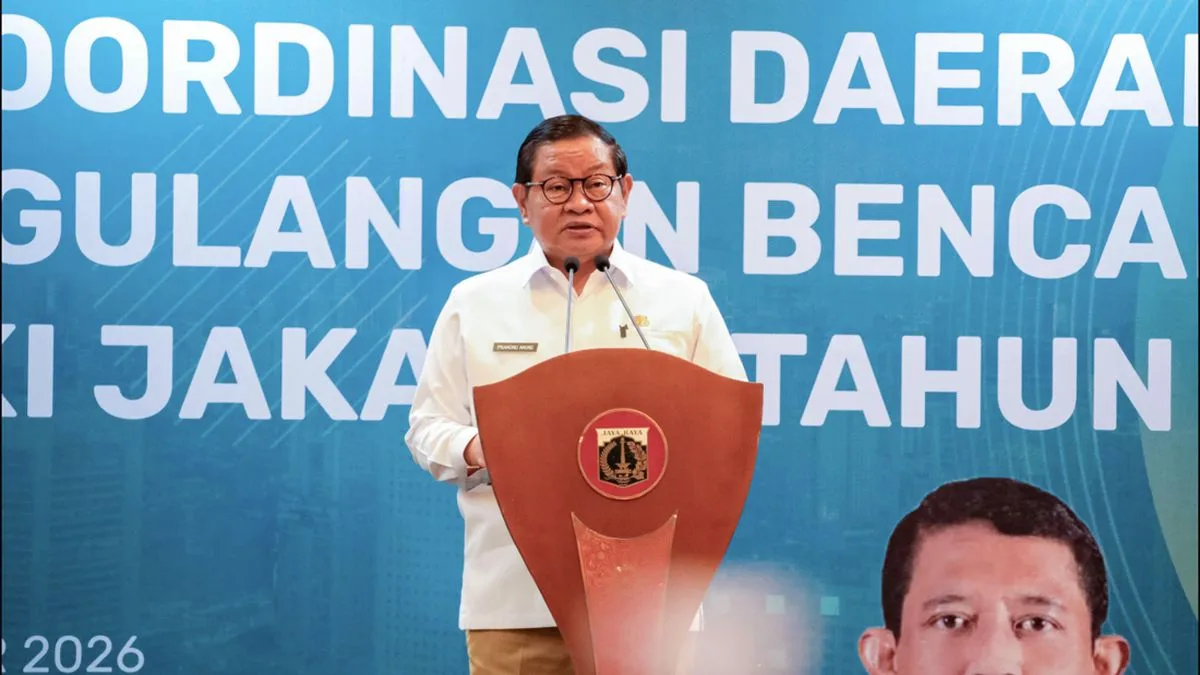
DKI Jakarta Governor Pramono Anung stressed that Jakarta's position as a global city demands a disaster management system that is not merely responsive but also precise. He made the statement while opening the 2026 DKI Jakarta Provincial Disaster Management Regional Coordination Meeting (Rakorda) themed "Declaring a Disaster Emergency Status: Challenge or Opportunity" at Hotel Aryaduta Menteng, Central Jakarta, Tuesday (6/10).
According to Pramono, disaster issues are highly sensitive for a city of international scale because they concern residents' safety, economic continuity, and Jakarta's image in the eyes of the world. "Accuracy and speed in anticipating are of the utmost importance," he said, stressing that disaster handling cannot be borne by a single agency alone.
He called synergy among all stakeholders the main key, involving regional apparatus, BNPB, BMKG, TNI, Polri, Forkopimda, the business sector, volunteers, communities, and the public. This collaboration is deemed important because each type of disaster has different characteristics that demand a coordinated response.
One threat of serious concern is fire in densely populated settlement areas. Pramono asked his ranks to increase vigilance and preventive measures, especially in high-risk areas. "The fire potential is now very high, especially in densely populated areas," he said, asking all ranks to anticipate and safeguard their respective areas.
For flood handling, the DKI provincial government coordinates with the central government and neighboring regions, particularly in arranging rivers that cross regional borders. Pramono explained that land acquisition is the focus of the DKI provincial government, as done at Ciliwung, Krukut, and Cakung Lama rivers, while the construction of retaining walls falls under the central government's authority. "Matters relating to inter-regional borders are actually the task of the central government," he said.
He also stressed that disaster handling does not stop at the emergency response phase. Recovery for affected residents must be carried out comprehensively and not partially, involving the Social Affairs Agency, the PPKUKM Agency, the Health Agency, and the Education Agency. "Post-incident handling is the main thing," he asserted.
"Through this Rakorda, we hope it can be a momentum to strengthen Jakarta's disaster preparedness, evacuation mapping, logistics and infrastructure adequacy, and handling of displaced people's needs that meet minimum service standards." — Marulitua Sijabat, Head of the DKI Jakarta BPBD Implementing Unit
Head of the DKI Jakarta BPBD Implementing Unit Marulitua Sijabat added that the Rakorda also discussed evacuation readiness, logistics and infrastructure adequacy, and meeting displaced people's needs in accordance with minimum service standards. The forum is expected to be a turning point in strengthening Jakarta's preparedness against various disaster risks.
With the complexity of threats covering floods, fires, and other potential disasters, the question ahead is how quickly cross-sector coordination can be translated into real action on the ground. As a global city, Jakarta is not only required to have an advanced early warning system but also to ensure that every rupiah of budget and every policy truly protects residents in the most vulnerable areas.