UNNES Public Health Students Design Healthy School in Semarang, Produce 12 Products
Baca dalam 60 detik
- Mahasiswa Prodi Kesehatan Masyarakat UNNES menjalankan program SEHATI di SD Negeri Gajahmungkur 02 Semarang pada September lalu.
- Program ini melibatkan lima peminatan dan menghasilkan beragam luaran, termasuk naskah kebijakan, dashboard interaktif, hingga unit komposter.
- Wali kelas 6 menyambut baik inisiatif ini dan berharap kolaborasi dengan lebih banyak guru ke depannya.
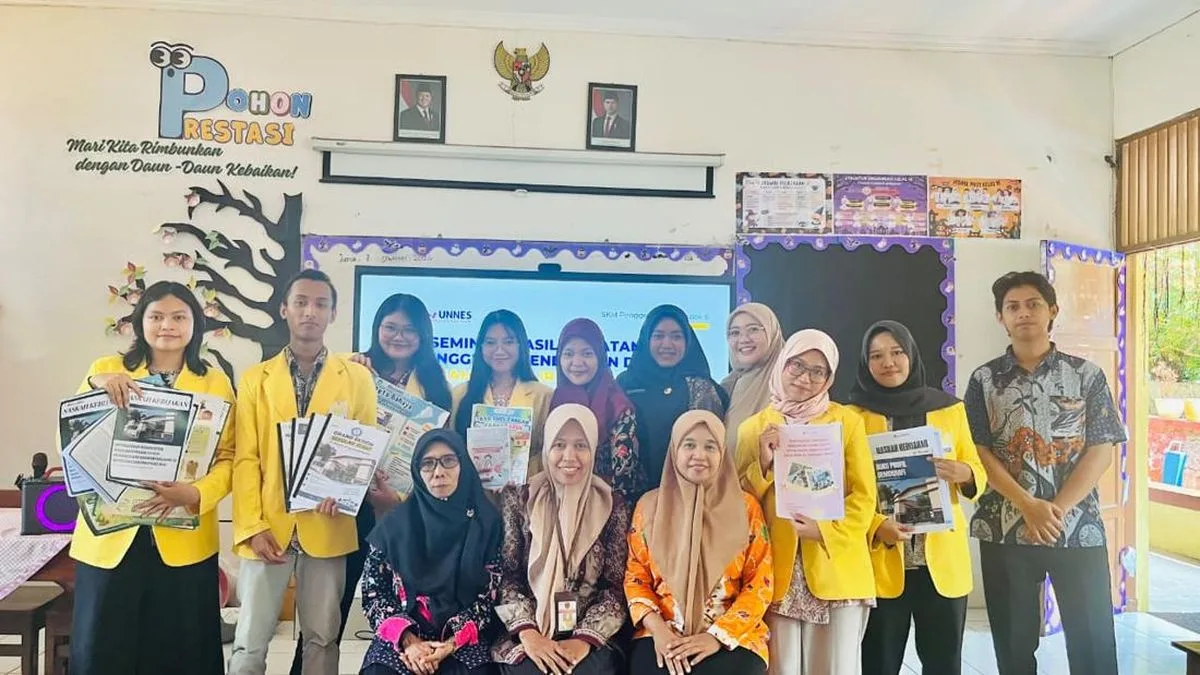
Students of the Public Health Study Program at the Faculty of Medicine, Universitas Negeri Semarang (UNNES), held the SEHATI program (Healthy, Safe, Orderly, and Clean School) at SD Negeri Gajahmungkur 02, Semarang, last September. The activity was a concrete application of public health knowledge in a school setting, involving students from five specializations: Biostatistics and Population, Environmental Health, Health Promotion, Occupational Safety and Health (K3), and Health Policy Administration (AKK).
Unlike typical community service activities that often amount to brief counseling sessions, the SEHATI program produced a number of concrete products that the school can use directly. These outputs include a policy draft, healthy school design, academic paper, policy draft, interactive dashboard, digitization of health data, school demographic profile book, data-based nutritional status analysis, hazard mapping, evacuation route map, educational modules and posters, and a composter unit. These products touch on various aspects, from health data management, environmental health, and health promotion to safety in the school environment.
In its implementation, the students did not only create documents but also mapped potential hazards through hazard mapping and prepared an evacuation route map. In environmental health, they built a composter unit as a means of managing school waste. Meanwhile, the digitization of health data and the interactive dashboard were designed to help present school health data in a more structured and easy-to-use way. This approach shows that public health students are equipped not only with theory but also with analytical and solution-design skills.
The homeroom teacher of grade 6 at SD Negeri Gajahmungkur 02, Dina Puspitasari, appreciated the activity. According to her, the program provided real benefits for the school and students. "We thank the students very much. We saw how the process went from the beginning until this point. It was extraordinary, everything was good and, God willing, also beneficial for the school and our students. The products are also very useful," she said. She hoped that in the future the students could involve more teachers in the process of gathering information about the school's condition. "The suggestion is perhaps to communicate more with several teachers, so it is not just one source. Because opinions are subjective, maybe involving one, two, or three people would make the data more certain," she added.
The SEHATI program is an example of how universities can contribute directly to improving the quality of health and safety in elementary schools. By involving students from various specializations, the program produced not only academic outputs but also practical solutions that can be applied. Going forward, a similar model could potentially be replicated in other schools, especially in areas with limited resources. However, challenges remain, such as program sustainability and integration with school policy. Will initiatives like this become the standard in public health education? Time will tell, but UNNES's step deserves appreciation as a concrete effort to build a healthy generation and a better school environment.