NASA Finds Signs of Subsurface Ocean on Ariel, a Moon of Uranus: 170 Km Deep
Baca dalam 60 detik
- Data NASA mengungkap Ariel, bulan Uranus, kemungkinan menyimpan lautan bawah permukaan setebal 170 km—jauh melampaui rata-rata kedalaman Samudra Pasifik.
- Model orbital menunjukkan eksentrisitas masa lalu Ariel memicu gaya pasang-surut yang membentuk rekahan kerak, mengimplikasikan keberadaan air cair sebagai penopang struktur.
- Temuan ini memperkuat hipotesis dua dunia berair di sistem Uranus dan mendorong misi eksplorasi masa depan untuk memverifikasi langsung.
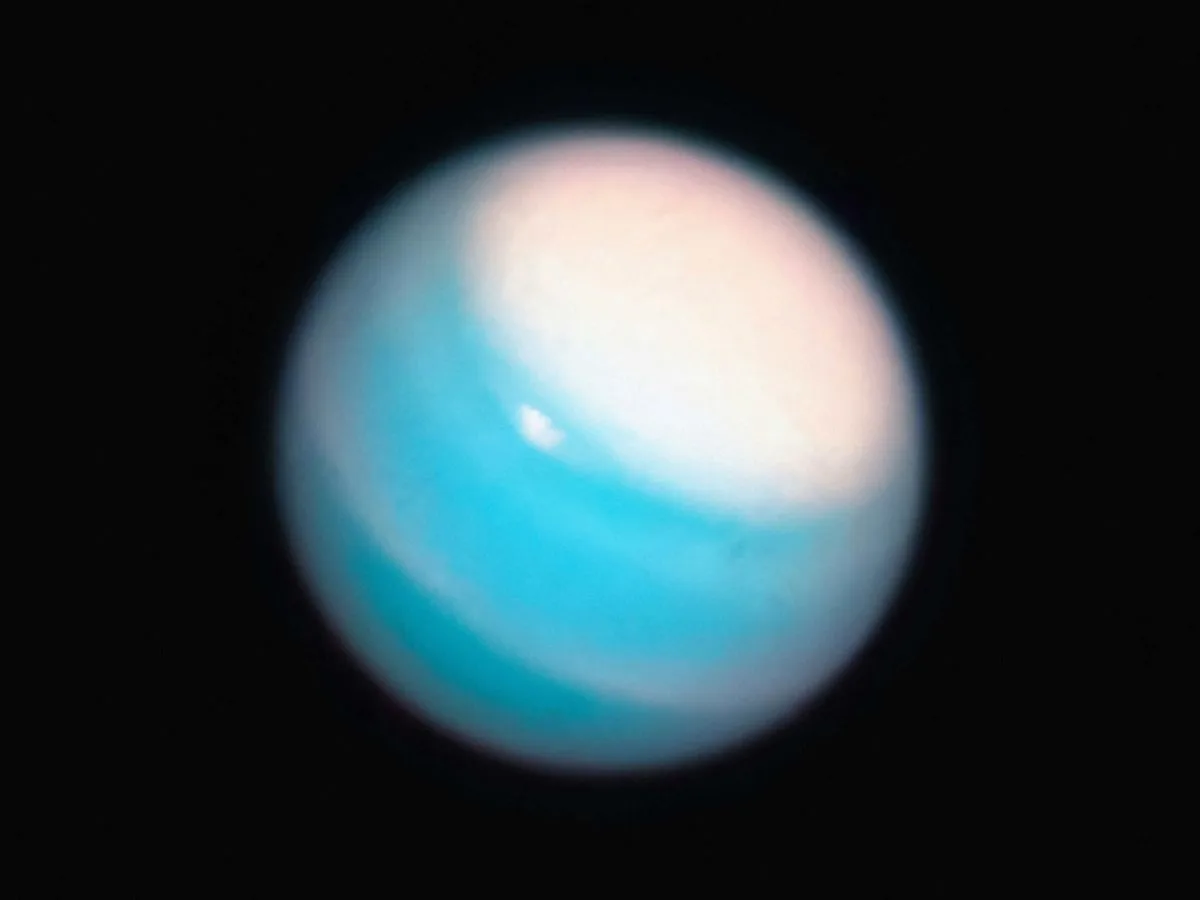
The United States space agency (NASA) has once again highlighted the potential for hidden oceans in the solar system. This time, attention is on Ariel, one of Uranus's icy moons, which is thought to harbor a subsurface ocean more than 170 kilometers deep—or about 40 times the average depth of the Pacific Ocean, which is only 4 kilometers. The findings were published in the journal Icarus and indicate that the small, crack-covered world is not merely a solid ball of ice.
Ariel, about 1,159 kilometers in diameter, is the brightest and second-closest moon to Uranus. Its surface is covered with canyons, ridges, and graben—zones where the crust drops below the surrounding surface. Some structures appear very old, while others are relatively young, indicating past geological activity. Researchers also identified smooth areas thought to have been formed by cryovolcanism, eruptions of water, ice, or other volatile materials instead of magma.
The latest study focuses on how Ariel's interior and orbit could produce those surface features. The key is orbital eccentricity—a measure of how far an orbit deviates from a perfect circle. Today, Ariel's orbit is nearly circular, but models show that in the past its eccentricity could have reached 0.04, about 40 times its current value. As Ariel moved closer to and farther from Uranus, the giant planet's gravity would repeatedly stretch and squeeze the moon, creating strong tidal forces.
These tidal forces are thought to have placed great stress on Ariel's icy crust, triggering the formation of cracks and giant ridges. However, stress models compared with actual surface features reveal that a subsurface ocean is the most plausible explanation. According to planetary scientist Alex Patthoff, the cracks could occur if there were a thin ice layer above a large ocean, or a smaller ocean with a much more eccentric orbit. "Whatever the scenario, an ocean seems to be part of the equation," he said.
This is not the first such finding from that research team. Previously, they analyzed Miranda, another icy moon of Uranus, and found evidence that Miranda may once have had a substantial subsurface ocean. If both studies are confirmed, Uranus could potentially host two watery worlds among its moons—a finding that could change the understanding of habitability in the outer solar system.
Nevertheless, human knowledge of Ariel and Miranda remains very limited. So far, close-up observations have covered only the southern hemispheres of both moons, while the northern hemispheres are largely untouched. Scientists cannot yet determine when Ariel's ocean existed or how long it lasted. Future missions to Uranus are expected to photograph unexplored regions and test the predictions about cracks and ridges proposed in this study.
"The cracks on this moon can be explained by a thin ice layer above a large ocean, or a smaller ocean with a much more eccentric orbit. Either way, an ocean seems to be required," said Alex Patthoff, a planetary scientist.
For Indonesia, this finding is not merely astronomical discourse. Understanding subsurface oceans on icy worlds can enrich domestic geoscience and astrobiology research, especially in the study of extreme environments and the potential for life beyond Earth. Institutions such as BRIN and national observatories can use NASA's open data to develop similar models for other solar system objects, while also strengthening human resource capacity in planetary science.
Going forward, the question is no longer whether Ariel has an ocean, but how long that ocean lasted and whether similar processes occur on other icy moons in the solar system. With a Uranus mission still in the planning stage, each discovery like this becomes a stepping stone toward a more complete understanding of worlds long regarded as mere balls of ice.