Bitget Hacked for Rp5.6 Trillion, Circle and Tether Freeze Only Rp5 Billion
Baca dalam 60 detik
- Peretas Bitget menguras dana senilai $351,6 juta, namun stablecoin yang berhasil dibekukan hanya sekitar $318 ribu.
- Circle dan Tether bergerak cepat memblokir dompet peretas, berbeda dengan respons lambat pada kasus Drift April lalu.
- Sisa dana dalam bentuk Ethereum senilai puluhan juta dolar masih belum dapat dibekukan karena tidak ada otoritas pusat.
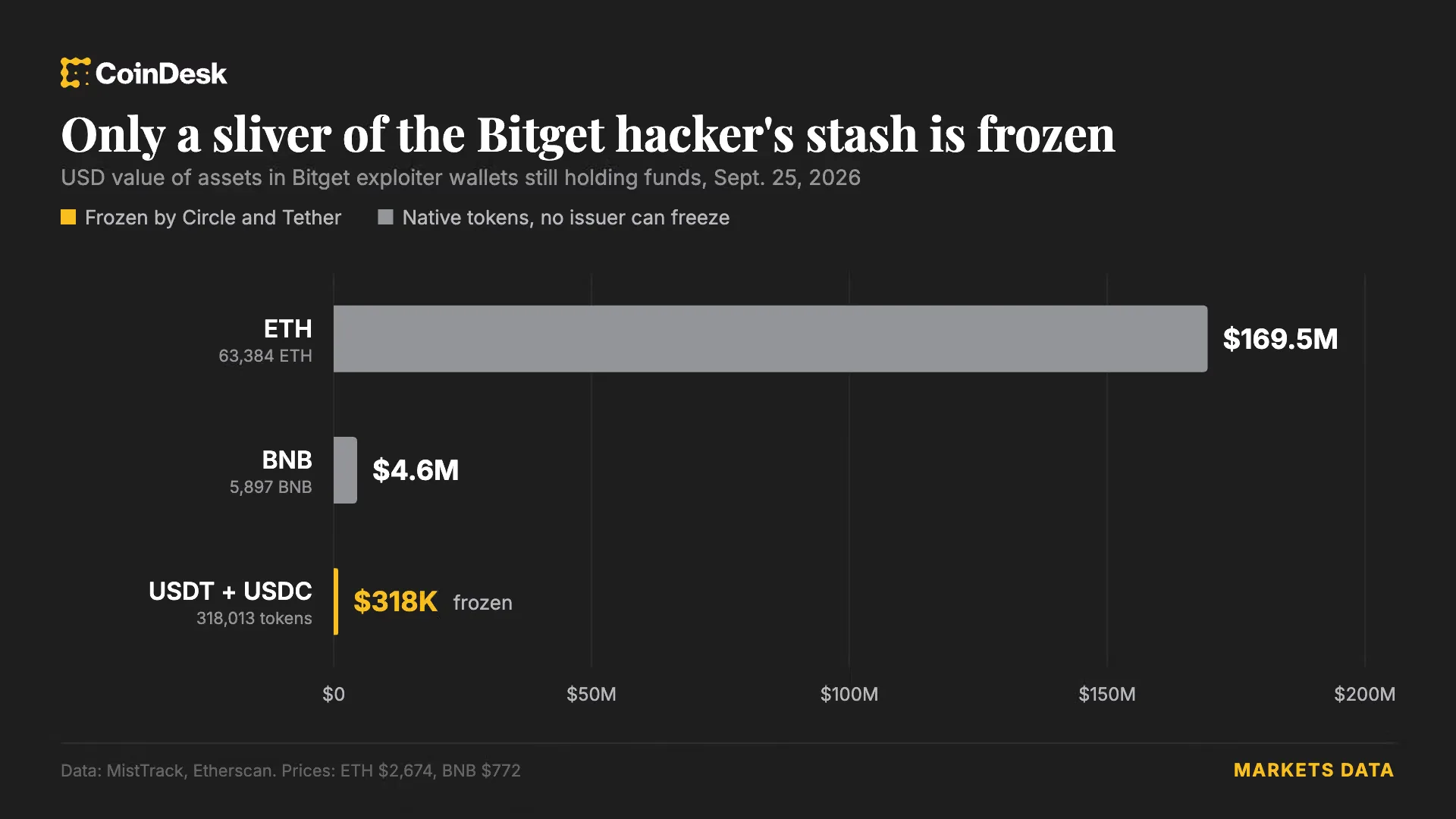
A cyber attack on crypto exchange Bitget caused losses of US$351.6 million (around Rp5.6 trillion), but asset-freezing efforts by stablecoin issuers Circle and Tether managed to stop only a small fraction of the stolen funds. On-chain data shows Circle blacklisted an address flagged by Etherscan as "Bitget Exploiter 8" on Friday at 05.00 UTC. The wallet held around 170.47 ETH, 218,023 USDT, and 99,990 USDC. MistTrack, a blockchain security firm, reported that Tether subsequently blocked the same wallet. The total stablecoins frozen came to around US$318,000, or less than 0.1% of the total losses.
The failure to freeze the majority of the assets highlights the limits of centralized oversight mechanisms in the crypto ecosystem. Most of the hacked funds remain in the form of Ethereum (ETH) across various addresses that no issuer can freeze. MistTrack noted that other hacker wallets still control more than 63,000 ETH, equivalent to tens of millions of dollars. Unlike stablecoins issued by central entities such as Circle and Tether, Ethereum has no single authority that can forcibly freeze assets. This makes non-stable crypto assets harder to trace and seize.
Bitget CEO Gracy Chen explained that the attacker managed to compromise the backend system in the exchange's wallet infrastructure, falsified transaction data, and triggered the authorization process to move funds. She stressed there was no compromise of private keys. Chen confirmed that Bitget's user protection fund, worth more than US$464 million, will cover all losses. The statement gives users assurance that their funds are safe, even though the process of recovering the stolen assets remains unclear.
"We detected unauthorized access to our wallet backend system. However, private keys were not exposed. User funds are protected by the user protection fund we manage," Gracy Chen said in her official statement.
Circle's swift response in the Bitget incident contrasts with its stance in the US$285 million Drift hack last April. In the Drift case, the attacker moved around US$232 million in USDC from Solana to Ethereum using Circle's own cross-chain transfer protocol. Critics such as ZachXBT argued Circle could have acted faster to block the wallet and freeze the funds. Circle argues it only freezes assets when legally required. The difference in handling has raised questions about the consistency of stablecoin issuers in responding to security incidents.
For Indonesia, this case reflects the risks faced by domestic crypto investors. Although Bappebti and Bank Indonesia continue to strengthen crypto asset regulation, the ability to freeze funds across borders remains limited. Users in Indonesia who store assets on global exchanges such as Bitget need to understand that legal protection for stolen funds depends heavily on the jurisdiction and policies of the stablecoin issuer. The incident also underscores the importance of diversifying asset storage, including using cold wallets to reduce the risk of exchange hacks.
Going forward, the crypto industry will face greater pressure to improve transparency and asset recovery mechanisms. Regulators in Asia Pacific, including Indonesia, are expected to tighten oversight of exchanges and stablecoin issuers. The question is whether stablecoin issuers will be given greater authority to freeze assets proactively, or whether, on the contrary, regulation will limit their power in the name of decentralization. What is clear is that the Bitget hack is a reminder that in the crypto world, speed and cross-jurisdictional coordination remain the main weak points.