Gibran Diploma Dispute Hearing at Constitutional Court: Fate of Ruling Hinges on Justices' Deliberation Meeting
Baca dalam 60 detik
- MK belum memutuskan apakah perkara syarat pencalonan Gibran Rakabuming Raka berlanjut ke tahap pembuktian atau langsung diputus.
- Rapat Pemusyawaratan Hakim (RPH) menjadi penentu arah perkara, dengan tenggat 14 hari sejak permohonan dicatat.
- Jika tidak ada pembuktian, putusan dijadwalkan 28-29 September 2026; jika berlanjut, putusan akhir paling lambat 5 Oktober 2026.
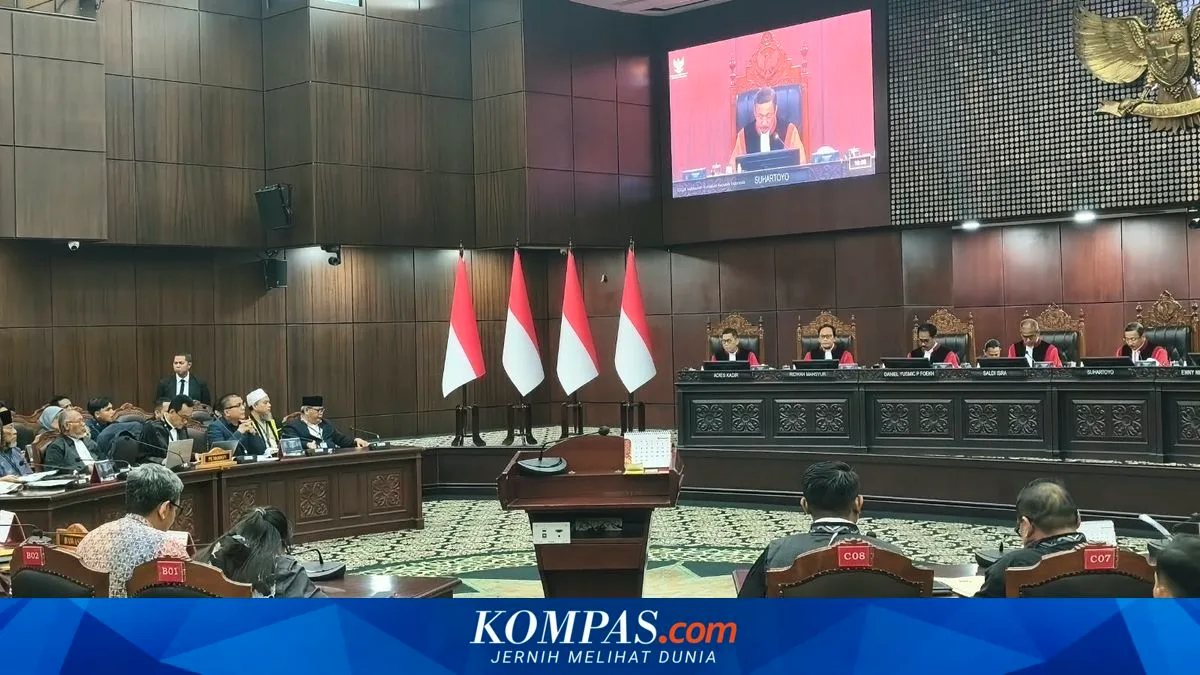
The Constitutional Court (MK) is still weighing its next step in the dispute over the candidacy requirements of Vice President Gibran Rakabuming Raka in the 2024 presidential election. So far, there is no certainty whether case number 01/PHPU.PRES-XXIV/2026 will proceed to the evidentiary stage or go straight to a ruling.
Chief Justice Suhartoyo said the court would first hold a Justices' Deliberation Meeting (RPH) to discuss the case's continuation. The statement was made after a hearing on Wednesday (23/9/2026), which heard testimony from the respondent and related parties. "Later, if from the discussion of this case there is follow-up that the Court needs to address, we will provide further information," Suhartoyo said, as quoted from Kompas.com reporting.
Constitutional Justice Arsul Sani added that he could not yet confirm whether the proceedings would continue to the evidentiary stage. He asked the General Elections Commission (KPU) to provide detailed testimony regarding Gibran's requirement documents in the 2024 presidential election. According to Arsul, that explanation is important to clarify the case, given that it is not certain to proceed to the evidentiary stage. "I also don't know yet whether there will be a follow-up hearing for evidence or not," he said.
The schedule contained in Constitutional Court Regulation (PMK) Number 1 of 2026 shows the case has a tight deadline. After the 23 September hearing, the RPH is scheduled for two days, namely 24-25 September 2026. If the panel of justices decides no evidence is needed, the ruling will be read on 28 or 29 September 2026. However, if evidence is required, the Court will hold follow-up hearings from 29 September to 1 October 2026, followed by an RPH on 2 October 2026, and a final ruling on 5 October 2026.
The case stems from a lawsuit against Gibran's candidacy requirements, which are alleged not to meet the provisions. The Constitutional Court is the final arena for testing the legality of the documents used in the 2024 presidential election. A number of parties have highlighted the importance of clarity on Gibran's legal status, especially because the Court's ruling will affect national political stability and public trust in the election process.
"It will be explained later or this will be further, because I also don't know yet whether there will be a follow-up hearing for evidence or not," said Constitutional Justice Arsul Sani.
For market players and investors, this uncertainty is a risk factor that needs to be watched. The Constitutional Court's ruling could affect the investment climate, especially if it triggers political turmoil. Conversely, swift legal certainty can ease concerns and maintain economic stability. The government and the business world hope the process at the Constitutional Court runs transparently and within legal corridors, so it does not cause prolonged turmoil.
Constitutional law observers assess that the Court's move to hold an RPH is a standard procedure before deciding whether or not to continue with evidence. They emphasize that the decision to proceed to evidence must be based on an urgent need for additional proof. If the panel of justices considers the existing documents sufficient, the case can be ruled on directly. However, if there is doubt, evidence becomes the way to test the validity of the documents thoroughly.
What needs to be noted is that the 14-day deadline requires the Court to work quickly without sacrificing the quality of its ruling. The public will scrutinize every development, especially since this case involves high state officials. Transparency and accountability of the process are key to maintaining the dignity of the judicial institution.
Going forward, will the Court choose the evidentiary path or rule directly? The RPH decision on 24-25 September 2026 will be the initial determinant. If evidence is held, the dynamics of the hearings could bring in experts and witnesses who may reveal new facts. Conversely, a quick ruling will end the uncertainty, but will still leave public questions about the depth of the examination. Whatever the choice, the Constitutional Court's ruling will be an important precedent for election law enforcement in Indonesia.