Imipas Minister Inspects Cibinong Prison, House Calls Ombudsman and Director General of Corrections
Baca dalam 60 detik
- Menteri Imigrasi dan Pemasyarakatan Agus Andrianto bersama Kepala Bappisus Aris Marsudiyanto meninjau langsung bangunan yang sebelumnya disidak Ombudsman RI di Lapas Cibinong.
- Ombudsman RI menemukan dugaan kluster mewah dengan kamar tipe eksklusif, area parkir mobil mewah, dan potensi pungli, sementara pihak lapas mengklaim bangunan itu rumah dinas.
- Komisi XIII DPR RI akan memanggil Ombudsman, Dirjen PAS, Kakanwil Ditjen PAS Jabar, dan Kalapas Cibinong pada Senin (28/9) untuk mengklarifikasi temuan tersebut.
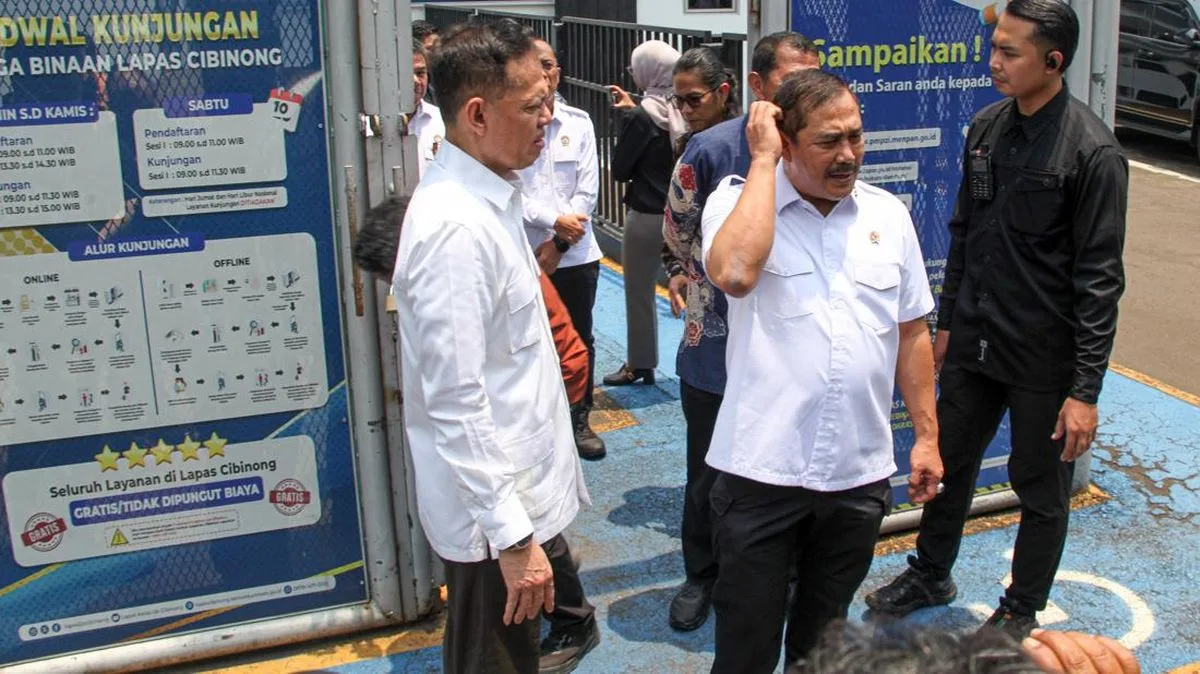
Minister of Immigration and Corrections (Imipas) Agus Andrianto, together with Head of the Agency for Development Control and Special Investigation (Bappisus) Aris Marsudiyanto, visited Cibinong Class IIA Prison in Bogor Regency, West Java, on Friday (25/9), to confirm the findings of the Indonesian Ombudsman's surprise inspection (sidak) regarding alleged luxury facilities for inmates. Their arrival was a swift response to reports of a building with exclusive facilities inside the prison area.
During the inspection, Agus and Aris walked about 100 meters from the parking area to the building in question. Behind a black iron gate with wooden ornaments, there was a row of eight white-walled houses with black fences. One house at the front end was the location previously examined by the Ombudsman team. The Head of Cibinong Prison, Wisnu Hani Putranto, who accompanied the two officials, stated that the building was an official residence.
Agus then questioned who lived in the house. "Is this occupied by staff?" Agus asked. Aris, who also inspected the inside of the house, asked about the presence of air conditioners (AC). Wisnu replied that the staff official residence was equipped with AC, but they were currently removed because they were broken. After leaving the house found by the Ombudsman, the group checked the Assimilation and Education Facility (SAE) of Cibinong Prison, including a building next to the mosque described as a rest area for workers.
A day earlier, the Head of the West Java Regional Office of the Directorate General of Corrections (Kakanwil Ditjenpas Jabar) Yudi Suseno, in a press conference at Cibinong Prison, emphasized that the building visited by the Ombudsman team was an official residence with a decree (SK). "The location referred to by the Ombudsman Team is the assimilation location, formerly called SAE. There are several official residences there," Yudi said on Thursday (24/9). He added that his office was still examining the findings and would take action in accordance with regulations if violations were found.
However, that account differed from the chronology presented by the Indonesian Ombudsman on the same day in Jakarta. The Ombudsman said it found several room types inside the luxury cluster, a parking area for luxury cars, and suspected illegal levies (pungli) at the prison. The Ombudsman team also claimed it had been obstructed or blocked when trying to enter for the inspection on Wednesday (23/9).
The differing narratives between the Ombudsman and the prison have drawn attention. The Ombudsman, as an independent oversight body, has the authority to investigate alleged maladministration, while the Ministry of Imipas is under pressure to prove there was no wrongdoing. The public is waiting to see whether these findings will lead to sanctions or merely become an administrative polemic.
The House of Representatives, through Commission XIII, summoned the Ombudsman, the Director General of Corrections of the Ministry of Imipas, the Head of the West Java Corrections Regional Office, and the Head of Cibinong Prison for early next week, Monday (28/9). The summons is intended to clarify allegations of luxury facilities for inmates and the inspection process described as not smooth. This move by the House shows that corrections issues are beginning to receive serious attention in parliament.
The Cibinong Prison case is not the first to surface. A number of prisons in Indonesia frequently face problems of overcrowding, illegal levies, and unequal facilities. If the alleged luxury facilities for certain inmates are proven, it could reinforce the perception that there is special treatment for prisoners with certain access. It could also trigger broader questions about the governance of correctional institutions across Indonesia.
The Ministry of Imipas under Agus Andrianto faces a credibility test. The swift response of going directly to the field is commendable, but the public will judge whether there is transparent follow-up. The Indonesian Ombudsman is also expected to publish the full results of its investigation so as not to create speculation. Meanwhile, the House through Commission XIII has momentum to push for improvements to the corrections system, not merely to summon related parties to hear their statements.
Going forward, the outcome of the House summons on 28 September will be an indicator of whether this case proceeds to the legal realm or is resolved internally. If there is no firm action, public trust in the guidance of prisoners could erode further. Conversely, if transparency is maintained, this case could become a turning point for corrections reform. Will the Ombudsman's findings open a Pandora's box of similar practices in other prisons, or will they be just a small ripple that quickly subsides?