IKD Becomes Foundation for Social Assistance Data Verification, East Java Rejects Piloting Scheme
Baca dalam 60 detik
- Kemendagri menjadikan Identitas Kependudukan Digital sebagai basis verifikasi penerima bantuan sosial, menggantikan pola pendataan manual yang rawan tumpang tindih.
- Jawa Timur mendeklarasikan seluruh kabupaten/kota masuk program tanpa status percontohan, memperluas cakupan digitalisasi perlinsos secara serentak.
- Pemerintah menyiapkan agen pendamping dan gerakan Peduli Tetangga untuk menjangkau warga yang terkendala perangkat, jaringan, atau literasi digital.
The Ministry of Home Affairs, through the Directorate General of Population and Civil Registration, has positioned the Digital Population Identity (IKD) as the backbone of data verification in the digitalization of social protection. The decision was not made without reason: for years, the distribution of social assistance has often been hampered by inaccurate beneficiary data, making it prone to mistargeting and overlap.
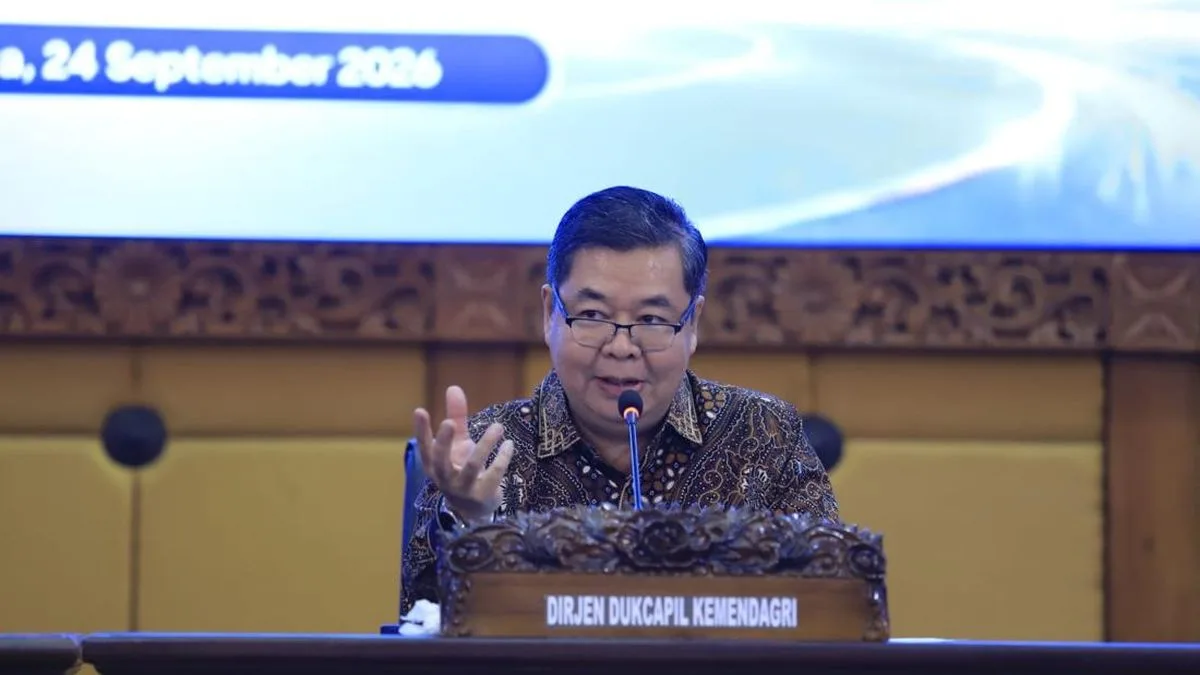
The move emerged at the Coordination Meeting on Accelerating the Digitalization of Social Protection through IKD Activation at the Office of the Regional Secretariat of East Java Province, Surabaya, Thursday (24/9). The forum brought together cross-agency stakeholders to align steps, from the ministry, the provincial government, to regional apparatus.
Director General of Dukcapil at the Ministry of Home Affairs, Teguh Setyabudi, emphasized that the digitalization of social protection cannot be left to a single agency. According to him, the Social Affairs Office cannot work alone and needs synergy with Dukcapil, Kominfo, Bappeda, regional heads, subdistrict heads, urban village heads, village heads, and RT and RW administrators.
"The digitalization of social protection cannot possibly be carried out by one party. There must be cross-agency collaboration down to the smallest level," Teguh said in a written statement, Friday (25/9).
What sets this step apart is East Java's commitment to end the pilot scheme. All regencies and cities in the province are declared required to join the program, with no area left behind simply because it previously held non-piloting status. This declaration marks a shift from a gradual approach to simultaneous implementation.
In the ecosystem being built, IKD functions as a digital identity that makes it easier for citizens to access government services. For the social protection sector, verified identity is an absolute prerequisite because the process of registering beneficiaries requires certainty about who is eligible. Population data equipped with biometrics enables matching of physical characteristics, so verification no longer relies on physical documents that are easily forged.
However, digitalization is not without risk. Limited devices, internet networks, and digital literacy remain a reality in a number of regions. The government anticipates this by preparing Digital Social Protection Agents drawn from civil servants, Family Hope Program facilitators, volunteers, TNI-Polri personnel, and RT and RW administrators. In Surabaya, thousands of agents have been put on standby to help citizens with registration, data entry, and identity verification.
Daily Coordinator for Social Protection Digitalization, Rahmat Danu Andika, acknowledged that not all citizens are able to access services independently. "The problem on the ground is that not all those in need have a mobile phone, not all can access the internet, so agents are needed," he said. Agents serve as facilitators, not eligibility determiners; the determination of aid recipients still follows the data and criteria set by the government.
In addition to agents, the government is promoting the Peduli Tetangga (Care for Neighbors) movement, which encourages the community to recognize residents around them who need social protection. This approach targets those who are not yet registered or have difficulty accessing the digital system, while also updating data periodically.
For Indonesia, this step is an important trial for the integration of public services based on digital identity. If successful in East Java, a similar model could potentially be replicated in other provinces. The challenge is not only technical, but also ensuring that no citizen is excluded due to the digital divide. The question is, will this acceleration be followed by adequate infrastructure readiness and facilitation budget across all regions?