House Pushes for BPGMN Head to Be Chosen from Competent Figures, Not Mere Institutional Representation
Baca dalam 60 detik
- Anggota Komisi IV DPR Johan Rosihan menuntut Presiden memilih kepala Badan Pengelola Gambut dan Mangrove Nasional berdasarkan kompetensi, integritas, dan pengalaman, bukan keterwakilan lembaga.
- BPGMN dinilai harus memperjelas pembagian kewenangan dengan Kementerian Kehutanan agar tidak tumpang tindih dalam restorasi, pengawasan konsesi, dan penegakan hukum.
- Keberlanjutan pencegahan karhutla di lahan gambut menjadi taruhan, karena pengalaman BRGM menunjukkan persoalan ini tidak selesai dalam satu periode pemerintahan.
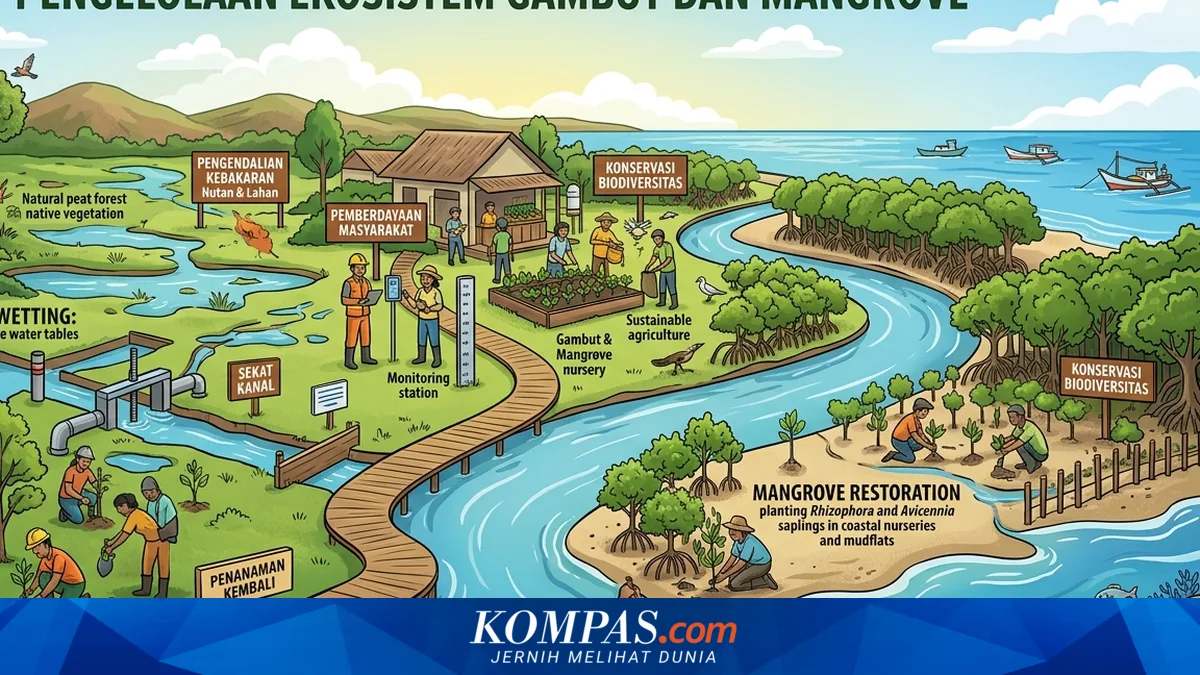
Member of Commission IV of the Indonesian House of Representatives (DPR RI), Johan Rosihan, has asked the President not to turn the National Peat and Mangrove Management Agency (BPGMN) into a place to accommodate institutional representatives. He stressed that the head of the agency must be someone who masters peat and mangrove ecology, as well as capable of managing cross-sector coordination.
"I hope the President chooses a figure based on competence, integrity and experience, not merely institutional representation," Johan told Kompas.com on Friday (25/9/2026). The statement came as the government prepares a new institutional structure that will replace the Peat and Mangrove Restoration Agency (BRGM).
For Johan, the core issue is not whether a new agency exists, but whether the institution being formed can endure and work effectively. He argued that BPGMN must be a stronger continuation of BRGM: adopting practices that have worked well, fixing weaknesses, and ensuring that the prevention of forest and land fires (karhutla) truly reaches the grassroots level.
He also highlighted the importance of meritocracy. According to him, the President's desire to involve scientists and professionals must be reflected from the leadership selection process through to the formation of the technical team. "Because the President also wants the involvement of scientists and professionals, I think the spirit of meritocracy must be visible from the selection of the agency head to the formation of its technical team," he said.
Beyond the question of who leads, Johan urged that the division of authority between BPGMN and the Ministry of Forestry (Kemenhut) be formulated clearly from the outset. He detailed several functions that need clarification: who sets policy, who carries out restoration and rehabilitation, who oversees concessions, who enforces the law, and who holds command when the threat of karhutla emerges.
"BPGMN should not duplicate Kemenhut, but become the President's instrument to integrate cross-ministerial and regional work that has so far been fragmented," he said. The statement implies concern that without a clear division of roles, the new agency risks slowing down responses instead of speeding them up.
From a governance perspective, the DPR's push touches on two things that are often weak points of newly formed institutions: leadership and mandate. The experience of BRGM shows that peat and mangrove restoration demands program continuity, stable funding, and coordination between the central government, regional governments, and communities around peat landscapes. Changes in regime often shift policy direction before results become visible.
For readers in Indonesia, especially businesses and investors in the forestry, plantation, and energy sectors, certainty over BPGMN's authority will affect the investment climate. Unclear authority over who supervises concessions and enforces the law can create compliance risks that are difficult to calculate. Conversely, a clear mandate can strengthen legal certainty and reduce land disputes.
On the environmental side, peatlands and mangroves store large carbon reserves. Damage to both not only triggers emissions but also increases the risk of flooding and seawater intrusion in coastal areas. Therefore, the choice of who leads BPGMN is not merely an administrative matter, but a determinant of whether Indonesia can curb the annual karhutla that has cross-border impacts.
Going forward, the public needs to watch whether the President will announce the name of the BPGMN head through an open selection process or through political considerations. If meritocracy is truly upheld, the criteria of competence and integrity should be publicly testable. The question is, will BPGMN become an agency that truly works at the grassroots level, or merely add a new layer of bureaucracy?