Data Debunks Myth: Bitcoin Unaffected by Rising Long-Term Bond Yields
Baca dalam 60 detik
- Korelasi antara pergerakan harian Bitcoin dan perubahan imbal hasil obligasi AS tenor 10 tahun hanya -0,18, menandakan hubungan yang sangat lemah.
- Meski imbal hasil global melonjak, Bitcoin justru mencatat kenaikan 191% sejak 2021 dan mencapai puncak $126.000, menunjukkan ketahanan terhadap tekanan obligasi.
- Volatilitas pasar obligasi tetap menjadi risiko jangka pendek; indeks MOVE naik 21% dan memicu koreksi Bitcoin dari $87.200 ke $83.500 dalam sehari.
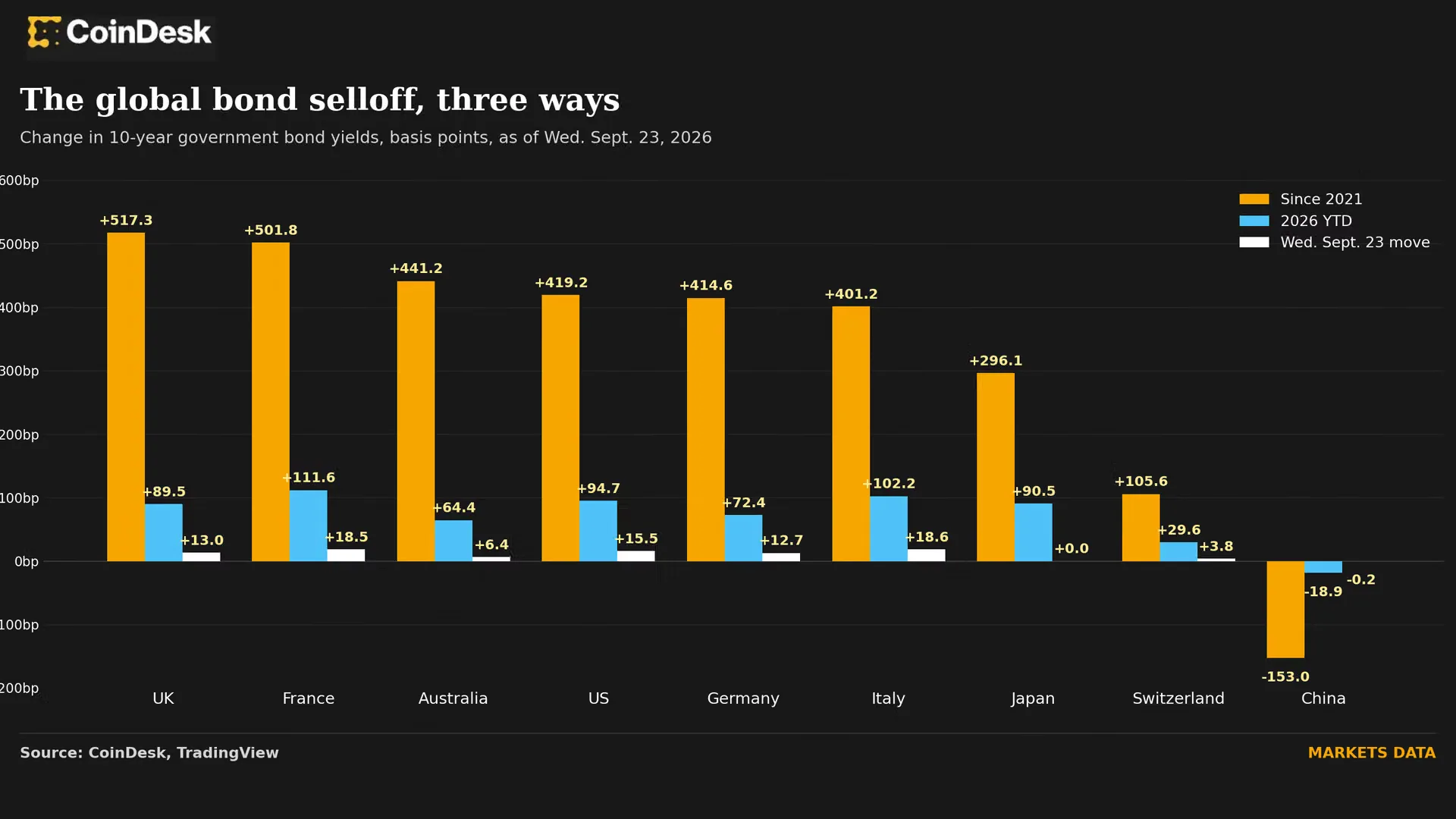
Rising global bond yields are often seen as a negative signal for Bitcoin, but historical data shows the opposite. For years, Bitcoin has had almost no correlation with bonds, even when yields surged to their highest level since 2007.
On Wednesday (24/9), the yield on 10-year US government bonds rose 15 basis points to breach 5.13%, triggering yield increases worldwide. The common narrative holds that higher yields raise the opportunity cost of holding non-yielding assets such as Bitcoin and gold, potentially diverting funds into bonds. That makes sense in theory, but the correlation data refutes it.
A CoinDesk analysis shows the 90-day correlation coefficient between Bitcoin's daily returns and changes in the 10-year US bond yield is only -0.18. That figure is close to zero, indicating almost no reliable relationship. For the 180-day period, the correlation is -0.06, and for one year it is -0.03. Bitcoin also shows no significant correlation with the bond yields of other countries.
The low correlation is in fact a portfolio advantage. "Bitcoin's near-zero correlation with US bond yields is a real value-add, because it shows BTC is not merely traded as an asset sensitive to interest rates," Lacey Zhang, Head of Research at Bitget Wallet, told CoinDesk. According to her, the latest data even shows a 90-day correlation of around -0.17, sometimes close to zero.
Bitcoin's long-term performance reinforces this argument. Since 2021, its price has surged 191% and hit a record $126,000 last October. That feat was achieved even as 10-year bond yields in the UK and France rose more than 500 basis points, while those in the US, Australia, Germany, and Italy rose more than 400 basis points. Yields in Japan and Switzerland rose 296 and 105 basis points respectively, while China's actually fell due to deflation.
Even so, the absence of correlation does not automatically shield Bitcoin from short-term losses, especially when bond market volatility spikes. A sudden surge in turbulence in the Treasury market can tighten financial conditions, raise borrowing costs, and trigger broad risk aversion. The MOVE index, which measures expected bond volatility, rose 21% to 95 points on Wednesday, the highest since April 1. This explains Bitcoin's correction from $87,200 to $83,500 on the same day, though the market may simply have been looking for a reason to correct after a sharp rally.
Wednesday's yield rise was driven by US economic data, not fiscal concerns. The S&P Global Composite PMI rose to 58.4 in September, the highest since July 2021, from 56.0 in August. Business activity grew at the fastest pace in more than five years, accompanied by inflationary pressure. The data reinforced expectations that the Federal Reserve will keep raising interest rates after a 25 basis point hike in September. Yields on 10-year and 2-year bonds duly surged.
However, a deeper analysis shows French yields actually rose higher than US yields on Wednesday, even though the move was triggered by US data. UK yields also rose by nearly as much. According to Robin Brooks, a senior fellow at the Brookings Institution and former chief economist at the IIF, the same happened in Italy and Greece. "Today: strong US economic data, then fiscally vulnerable regions start to burn," Brooks wrote in a Substack post. He added that markets have long punished countries with high public debt. Japan leads with a debt-to-GDP ratio above 200% at the end of 2025, followed by the US at 123.8%, France at 115%, the UK at 102%, and China at 100%. Meanwhile, Switzerland's federal debt is only 16% of GDP, making the Swiss franc (CHF) a safe haven that is slowly displacing the Japanese yen for carry trades.
For Bitcoin, the story is simple. The factors that trigger bond market turmoil—fiscal credibility, growth, and inflation—are already reflected in yields and affect fiat currencies, but in recent years they have not been reflected in Bitcoin's price movements. In other words, Bitcoin moves independently of bond dynamics.
Looking ahead, the question is whether this non-correlative nature will hold if bond volatility continues. If turbulence in the Treasury market increases, Bitcoin could face a deeper correction. However, as long as its fundamentals do not change, Bitcoin remains an attractive diversification alternative amid global uncertainty.