The Mystery of 1998 KY26: The Asteroid That Moves Against Gravity, Could It Be a Remnant of a Soviet Probe?
Baca dalam 60 detik
- Objek bernama 1998 KY26 terus memicu perdebatan di kalangan astronom karena akselerasinya tidak sesuai dengan hukum gravitasi.
- Sejumlah teori diajukan, mulai dari komet gelap, tekanan radiasi matahari, hingga dugaan bahwa benda itu adalah wahana antariksa Uni Soviet yang hilang.
- Misi penyelidikan JAXA, Hayabusa2, gagal mencapai objek tersebut akibat masalah mesin, sehingga teka-teki ini belum terpecahkan.
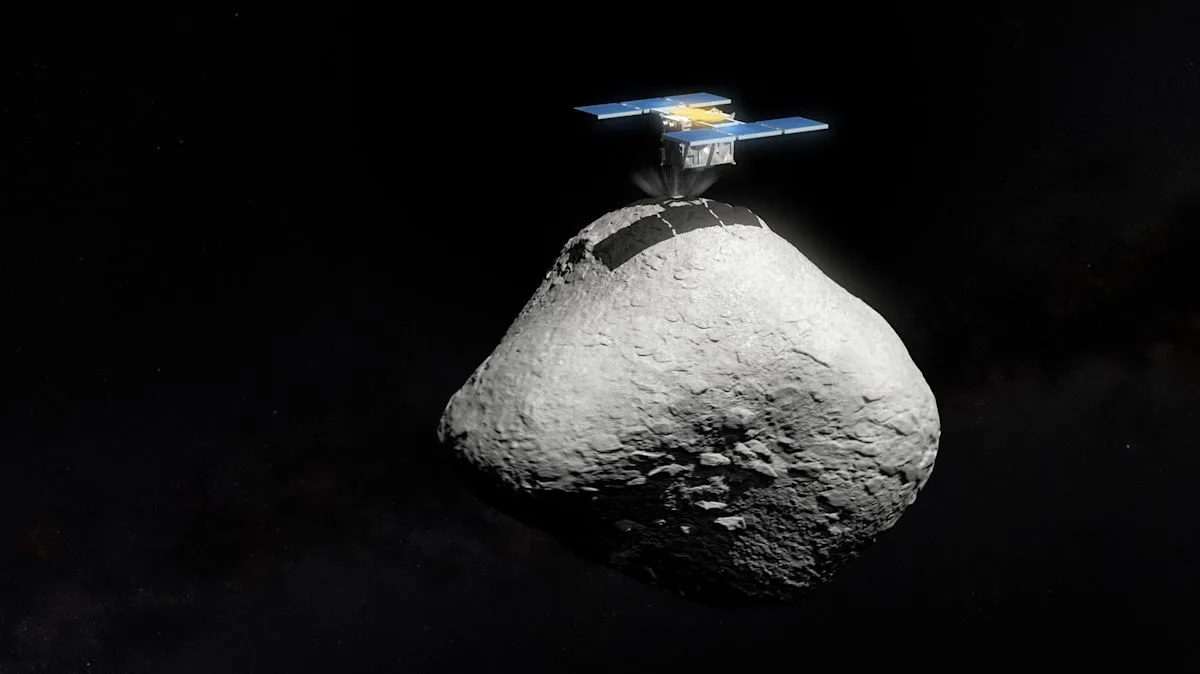
A celestial object about 11 meters across orbiting the Sun has puzzled scientists for more than two decades. Discovered in 1998 by astronomer Tom Gehrels of the University of Arizona and named 1998 KY26, the object shows an acceleration that cannot be explained by Newton's or Einstein's law of gravity. The phenomenon has fueled wild speculation, from a dark comet to the possibility that the object is a remnant of a lost Soviet space mission.
The latest data from research cited by The New York Times reveals that the surface temperature of 1998 KY26 reaches about -47 degrees Celsius. That temperature is too warm to preserve ice, so the sublimation process that usually characterizes comets cannot occur. If there is no ice, then the object is not a comet but something else. Its small size with extremely fast rotation—one full turn in just five minutes—as well as an albedo, or light reflectivity, of 50 percent (compare with the Moon at only 12 percent) further indicates that the object has a dense and reflective composition, possibly metal.
Several theories have been proposed to explain this mysterious acceleration. The first theory states that 1998 KY26 is a "dark comet"—an object that undergoes outgassing like a regular comet, but the process is invisible. However, the too-warm temperature rules out the possibility of sublimating ice. The second theory relies on solar radiation pressure and the Yarkovsky effect, in which photons and heat emitted by the object provide a small push. NASA tends to support this explanation, but critics argue that these forces are too weak to produce the observed acceleration.
The third theory considers 1998 KY26 an asteroid rotating so fast that its material is flung into space. If the flinging occurs consistently in one direction, an additional push would arise. However, astronomers question why the asteroid only "flings" material in one direction. The fourth and most controversial theory comes from Harvard astrophysicist Avi Loeb, previously known for suspecting the interstellar object 3I/ATLAS of being an alien spacecraft. This time, Loeb speculates that 1998 KY26 is Phobos 1, a Soviet probe launched in 1988 to study Mars and its moon, Phobos. The probe went out of control due to an operator's typo and was never found. Loeb notes the striking similarity in size, trajectory, and reflectivity—like metal solar panels. However, NASA rejects this theory because there is no direct evidence that the object is man-made.
"We do not yet have evidence that 1998 KY26 is not a natural object. However, its acceleration anomaly remains a challenge to our dynamical models," said a researcher involved in the study, as quoted from Sky at Night Magazine.
Efforts to uncover the identity of this object had actually been planned. The Japanese space agency, JAXA, had sent the Hayabusa2 spacecraft to investigate 1998 KY26 after completing its mission at the asteroid Ryugu. Unfortunately, the mission was canceled due to an engine problem on the spacecraft. To date, there is no new schedule for an expedition to the mysterious object.
For Indonesia, this phenomenon may seem far removed from everyday life. However, understanding near-Earth objects (NEOs) such as 1998 KY26 has important implications for planetary defense programs and the development of national space technology. The National Institute of Aeronautics and Space (LAPAN), now part of BRIN, has long monitored celestial bodies that could be hazardous. The mystery of 1998 KY26's acceleration is also a reminder that the laws of physics we consider established still hold gaps to be explored—something that can spur basic research in the field of astrodynamics in Indonesia.
Going forward, astronomers hope to send a dedicated mission to photograph and analyze the spectrum of 1998 KY26 directly. If the object is truly natural, then our understanding of asteroid dynamics will undergo a major revision. If not, then the history of space exploration will need to record a new chapter about a lost Soviet probe. One thing is certain: as long as the question of its acceleration remains unanswered, 1998 KY26 will continue to be a touchstone for gravitational theory and human imagination.