ALMA in Chile Activates Band 2 Receiver, Opening a New Window on Star and Planet Formation
Baca dalam 60 detik
- Observatorium ALMA di Chile mulai mengoperasikan penerima Band 2 pada Siklus 13, memperluas jangkauan pengamatan ke pita frekuensi 67–116 GHz.
- Penerima ini mendeteksi garis spektral molekul terdeuterasi dan butiran debu di awan antarbintang, memungkinkan penelusuran tahap paling awal pembentukan bintang dan planet.
- Dengan 1.839 proposal yang masuk dan waktu pengamatan terbatas, persaingan riset semakin ketat; data yang dihasilkan tetap terbuka untuk komunitas ilmiah global.
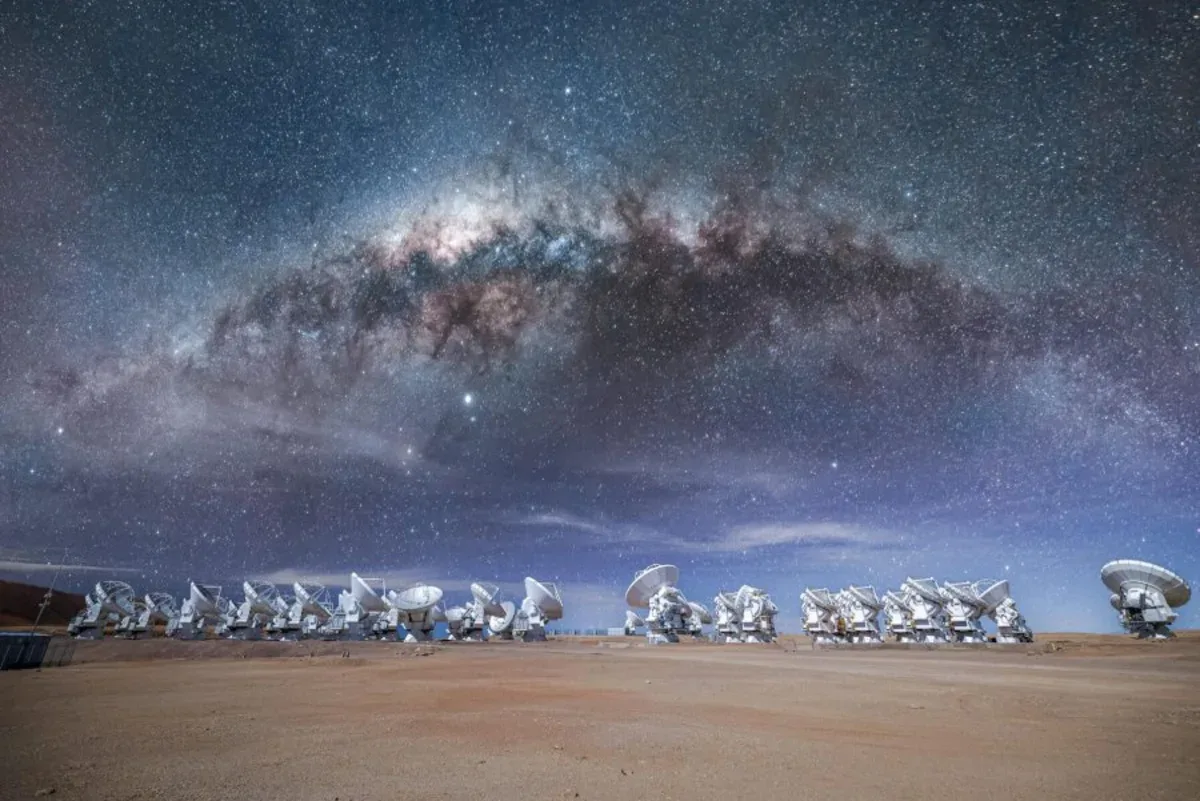
The world's largest radio observatory, the Atacama Large Millimeter/submillimeter Array (ALMA) in Chile, has officially expanded its research capacity by activating a new-generation receiver called Band 2. The move marks the start of Cycle 13—an observation period running until 30 September 2027—and the first time the instrument is used in a regular observing cycle.
Band 2 is an ultra-sensitive detector designed to capture signals in the 67–116 GHz frequency range. This range was previously not covered by other receivers at ALMA. According to ALMA scientist John Carpenter, Band 2's distinctive capability lies in its access to many spectral lines from deuterated molecules—molecules containing heavy hydrogen. These molecules are abundant in the coldest, densest regions of interstellar clouds, just before stars are born. Their signals allow astronomers to examine the physical and chemical conditions at the earliest stage of star formation.
ALMA itself operates on the Chajnantor Plateau in the Atacama Desert, with more than 50 antennas working as an interferometer. The instrument detects radiation at millimeter and sub-millimeter wavelengths invisible to the human eye, enabling scientists to observe cold gas and dust in space. Stars form from clouds of gas and dust; when gravity triggers contraction, a disk can form around a young star and become a place where planets grow.
Astronomer Lucas Cieza of Diego Portales University, who will be involved in Cycle 13, explained that Band 2 is highly sensitive to dust grain emission that can reveal the earliest stage of planet formation. "We are talking about macroscopic objects, about the size of a grain of rice," he said. Cieza also stressed that although other telescopes such as Mexico's Large Millimeter Telescope (LMT) and the United States' Green Bank Telescope (GBT) can observe similar wavelengths, none match ALMA's technical capability. "LMT and GBT are single-dish telescopes with diameters of 50 and 100 meters. ALMA is an interferometer with more than 50 antennas that can be separated by up to 16 kilometers, enabling images with hundreds of times more detail," he said.
The new receiver completes the 10 receiver bands planned for ALMA. Sebastián Espinosa, an astrostatistician at the University of the Andes in Chile, said ALMA has revealed rings and other structures that help understand the accumulation of material and the beginning of planet formation. "Every new signal can help complete a story we previously understood only in part," he said. The technology will also help study distant galaxies: as the universe expands, galaxy light shifts to lower frequencies, and the new receiver expands the range for detecting molecular gas signals in those galaxies. Carpenter added that this will help astronomers measure galaxy distances and study the evolution of the gas that fuels star formation.
Although capacity has increased, observing time remains limited. Espinosa said high demand creates fierce competition and forces careful project selection, so some valuable research may be delayed. Cieza acknowledged the same, but stressed the positive side: "The good news is that all ALMA data eventually becomes public. The observatory's archive already holds an enormous amount of data available to the international scientific community."
For Indonesia, this development offers opportunities for collaboration. Researchers from various countries can submit proposals to use ALMA, and the open data allows further analysis without having to build their own telescope. With competition growing tighter, the ability to craft strong research proposals and process archival data is key for Indonesian scientists who want to contribute to the study of star and planet formation. Looking ahead, the question is: will this open data access be enough to bridge the astronomy research gap between developed and developing countries?