AI and Digital Twin: How Franciscan Friars Are Renovating a 13th-Century Basilica
Baca dalam 60 detik
- Tim arkeolog dan insinyur perangkat lunak menggandeng biarawan Fransiskan untuk merekonstruksi Basilika Santo Fransiskus Asisi yang rusak akibat gempa 1997.
- Teknologi digital twin dan kecerdasan buatan digunakan untuk memetakan 80.000 lebih pecahan fresko serta mendeteksi kerusakan dinding dan lukisan.
- Proyek ini diharapkan selesai tahun depan dan dapat diakses publik, sekaligus menjadi model pelestarian cagar budaya di kawasan rawan gempa.
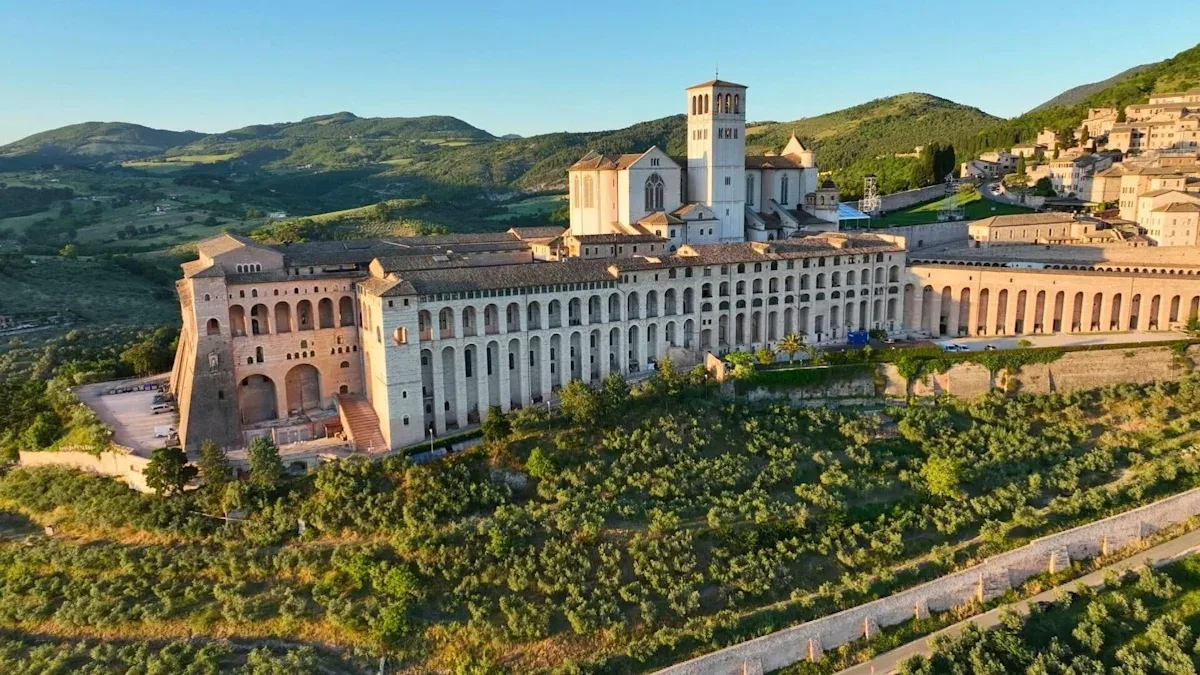
The restoration effort of the Basilica of St. Francis of Assisi in Umbria, central Italy, has entered a new phase. After nearly three decades of failing to piece together more than 80,000 fresco fragments shattered by the devastating 1997 earthquake, the Franciscan friars have now enlisted art historians and software engineers to finish the job with the help of artificial intelligence (AI) and ultra-high-resolution imaging technology.
Sergio Fusetti, who has cared for the basilica's artworks since the 1970s, admits he can no longer rely on manual methods. "It's impossible," he said in Italian. "Only artificial intelligence can help us." The statement marks a major shift in the approach to cultural heritage conservation, from relying on human precision to harnessing algorithms and spatial data.
The basilica, built on the hills of Umbria, is the final resting place of St. Francis, one of Christianity's most beloved figures. He was known as the "first hippie" for renouncing his family's wealth to live in poverty. Medieval masters such as Cimabue, Pietro Lorenzetti, Simone Martini, and Giotto were once invited to paint the story of Francis's life on the church walls. But according to Fusetti's records, the building has endured more than 20 earthquakes since it was built. Two major quakes struck in succession in 1997, killing four people and sending Fusetti to the hospital with injuries.
Friar Guiulio Cesareo, who was still a student at the church at the time, says he remains gripped by fear whenever he feels a tremor. "I'm always afraid," he said. "If I feel something shaking, maybe just the wind, I immediately feel a chill from within. The damage truly shook all of Italy." Although restorers have worked hard to repair the frescoes and artworks, some walls still have holes and the paintings have not fully recovered.
The breakthrough came through a collaboration with Haltadefinizione, a technology company specializing in ultra-high-definition photography. Chief Technology Officer Giovanni Borelli is leading the project to create a digital twin of the basilica. The cameras his team uses can capture details invisible to the human eye. "You can see the brushstrokes, every tiniest detail of the artwork," he said. Borelli's team used cameras, drones, and lasers to take hundreds of thousands of photos that will be stitched together into the highest-resolution 3D blueprint ever made for a building.
This digital twin will serve as a precise reconstruction roadmap if the area is shaken by another earthquake. In addition, Borelli's team plans to use AI to reunite missing fragments and analyze various other problems, such as cracks in paintings, discoloration, flaking paint layers, and lifted paint. "That kind of analysis, done manually by the human eye, would take years just for one pass over the entire building. With AI, it takes only a few minutes," Borelli explained.
"Technology helps us reach more people than ever before, and in a more efficient way." — Friar Guiulio Cesareo
Borelli also wants to make art more accessible. The technology used at the basilica was previously applied to scan the remains of thermal baths built by a Roman emperor. Laser scanners captured details of a 30-foot-high room with delicate mosaics, while cameras revealed hidden spaces and corridors forgotten by history. Virtual reality technology was also used so users could step into Italy's past. "When I founded one of the companies that built this technology, I was a software engineer who knew nothing about art," Borelli recalled. "My main question was philosophical: How good is a digital representation of a physical object? What is lost?"
While acknowledging that virtual reality cannot replace the emotional impact of standing before a historical work, Borelli sees it as a valuable tool. "You can run, let your imagination run wild," he said. Meanwhile, Friar Cesareo views all this technology as a means to a noble end: sharing "the treasures of faith and beauty."
This project is not merely a technical endeavor but also a precedent for cultural heritage preservation in disaster-prone areas. In Indonesia, which has many temples and historical sites in earthquake zones, a similar approach could be considered. The Cultural Heritage Preservation Agency (BPCB) and BRIN have begun adopting 3D scanning for some sites, but AI integration for fragment reconstruction remains rare. If the Assisi model succeeds, it is not impossible that this technology could be adopted to reconstruct temples damaged by earthquakes, such as Prambanan or sites in Lombok and Central Sulawesi.
With a completion deadline next year, the big question remains: will this digital twin truly accelerate physical restoration, or will it merely become a stunning digital archive detached from actual conservation efforts? The public will be waiting to see whether AI's promise as a "last helper" can restore the 13th-century heritage to wholeness.