Solok Regency Races to Restore Access After Flash Flood, Public Service Tents Prepared
Baca dalam 60 detik
- Bupati Solok menetapkan status tanggap darurat 14 hari setelah galodo menerjang Arosuka dan Batang Barus, dengan 173 warga masih mengungsi.
- Jembatan penghubung Arosuka mulai dibuka terbatas, sementara alat berat dikerahkan untuk membersihkan material dan mengeruk Sungai Batang Laso yang tersumbat.
- Pemerintah pusat melalui Satgas PRR memetakan kebutuhan mendesak, termasuk tiga mesin pemecah batu dan dua light tower, guna mempercepat pemulihan layanan publik.
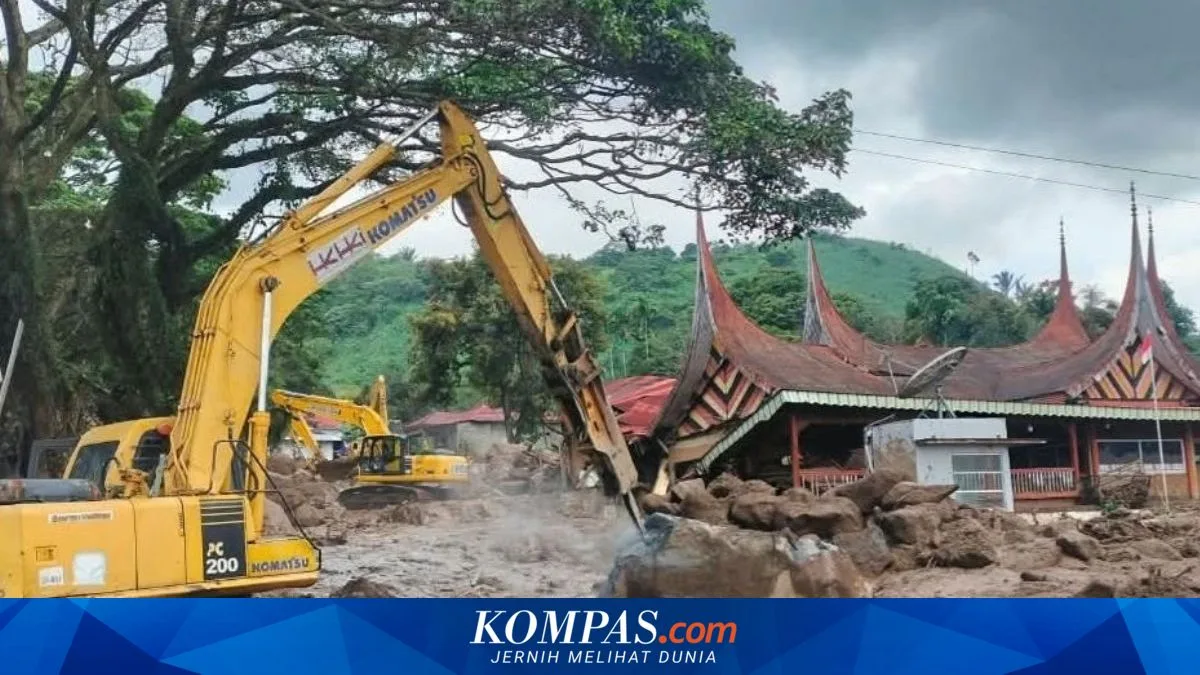
The Solok Regency government in West Sumatra is accelerating the restoration of access and public services after a flash flood (galodo) hit the Arosuka area and Nagari Batang Barus, Gunung Talang District. The Solok Regent declared a 14-day emergency response status, from 22 September to 5 October 2026, alongside efforts to search for one resident still missing and to handle victims.
The disaster, which occurred on Monday (21/9/2026) at around 19.30 WIB, carried sand, rocks, and mud from the upper reaches of the Laso River into residential areas and the Solok Regency government office complex. Reports as of 23 September recorded one death, one serious injury, and three minor injuries. A total of 173 residents took shelter at the regent's official residence, the deputy regent's official residence, the Balai Pemda, and independent locations. Initial data showed 87 houses affected: 19 severely damaged, 16 moderately damaged, and 52 lightly damaged.
Entering the third day, the connecting bridge in Arosuka began to be passable under an open-close system. A joint team involving the TNI, Polri, Basarnas, and BPBD continued to sweep the river flow amid terrain filled with flood material. Cleaning of roads, the office area, and public facilities was carried out with heavy equipment, while the Balai Wilayah Sungai V Padang conducted emergency dredging and pumping in the Batang Laso River, whose flow was blocked by a landslide.
The National Post Supervision Team of the Sumatra Post-Disaster Rehabilitation and Reconstruction (PRR) Task Force inspected the location on 23 September 2026. They mapped urgent needs, including three stone crushers and two light towers to support the continuation of material clearing. This step underscores that the response does not stop at evacuation, but also prepares infrastructure so that public services can run again.
For readers outside Solok, this event is a reminder that hydrometeorological risks in Indonesia are increasingly real. Flash floods carrying volcanic material and sediment from upstream are common in watersheds (DAS) experiencing land degradation. The impact is not only on loss of life and damaged homes, but also on the disruption of government and local economic functions. Local governments are required to have adaptive contingency plans, including the provision of public service tents and alternative logistics routes.
From a policy perspective, declaring an emergency response status opens access to emergency funding and the mobilization of national resources. However, its effectiveness depends on cross-agency coordination and the speed of field data. The PRR Task Force formed by the central government is expected not only to map needs, but also to ensure that procurement of goods and services can be carried out quickly without neglecting accountability. The experience of several previous disasters shows that logistics delays are a critical point in recovery.
Going forward, attention will focus on whether the Arosuka bridge can be opened permanently before the emergency response period ends, and on the fate of residents still displaced. The Solok Regency government also needs to ensure public services continue, for example through temporary service tents. The big question: to what extent will mitigation investment in the Batang Laso watershed be carried out so that galodo does not recur with greater impact?