Wave of Migrant Insects Swarms Britain, a Signal of Climate Crisis in the Northern Hemisphere
Baca dalam 60 detik
- Sejumlah spesies serangga dari Eropa selatan dan Afrika utara tercatat pertama kali di Inggris sepanjang musim panas 2026.
- Pemanasan global disebut sebagai pemicu utama pergeseran populasi serangga ke arah utara, meski faktor lain seperti pemulihan habitat turut berperan.
- Fenomena ini berpotensi mengubah keseimbangan ekosistem pertanian dan kesehatan masyarakat, termasuk di Indonesia yang menghadapi dinamika serupa.
A wave of insect migration from southern Europe and North Africa was reported to have flooded Britain throughout the summer of 2026, triggering a series of new species discoveries on the country's mainland. The phenomenon is a strong signal that climate change is reshaping the global map of fauna distribution, with consequences that could extend to tropical regions such as Indonesia.
Reports from across Britain point to a significant surge in species that usually inhabit warmer climates. An ecologist at Knepp Estate, West Sussex, Matt Phelps, accidentally heard a loud cricket-like sound from underground one July night. After three hours of searching, he and his colleague found the Verge cricket (Eumodicogryllus bordigalensis) — a species never before recorded in the British Isles. According to Phelps, the appearance coincided with major wildfires in Bordeaux, France, raising the suspicion that some of these insects fled the flames in southern Europe.
The discovery was not an isolated case. A retired secretary in North Cheshire, Jackie Harmer, found the moth Odice pergrata, which originates from the Iberian Peninsula, just a week into her moth-trapping hobby. In North Essex, a city trader, David Cousins, came across a white moth with bluish markings that turned out to belong to a genus never before identified in Britain — known as the spotted seal moth (Enolmis acanthella) in North Africa and southern Europe. Meanwhile, an 18-year-old in Truro, Olly McKeown, did not even need to leave his room to find a praying mantis breeding on the British mainland for the first time; he saw it crawling across his keyboard and around his bedroom furniture.
Liam Crowley, an entomologist at the University of Oxford and a fellow of the Royal Entomological Society, considers the simplest explanation for this shift to be global warming pushing insects northward. However, he stresses that the dynamics at play are highly complex. "There are lots of different factors at work and it's hard to know the exact cause," he said. He gave the example of insects that inhabited Britain a century ago possibly going locally extinct due to habitat destruction, then returning when nature was restored or when the climate crisis made it a last resort. Crowley also noted that some arrivals could be part of a process that has been underway since the last ice age ended 11,700 years ago. "As humans, we tend to be obsessed with our own timescale," he said.
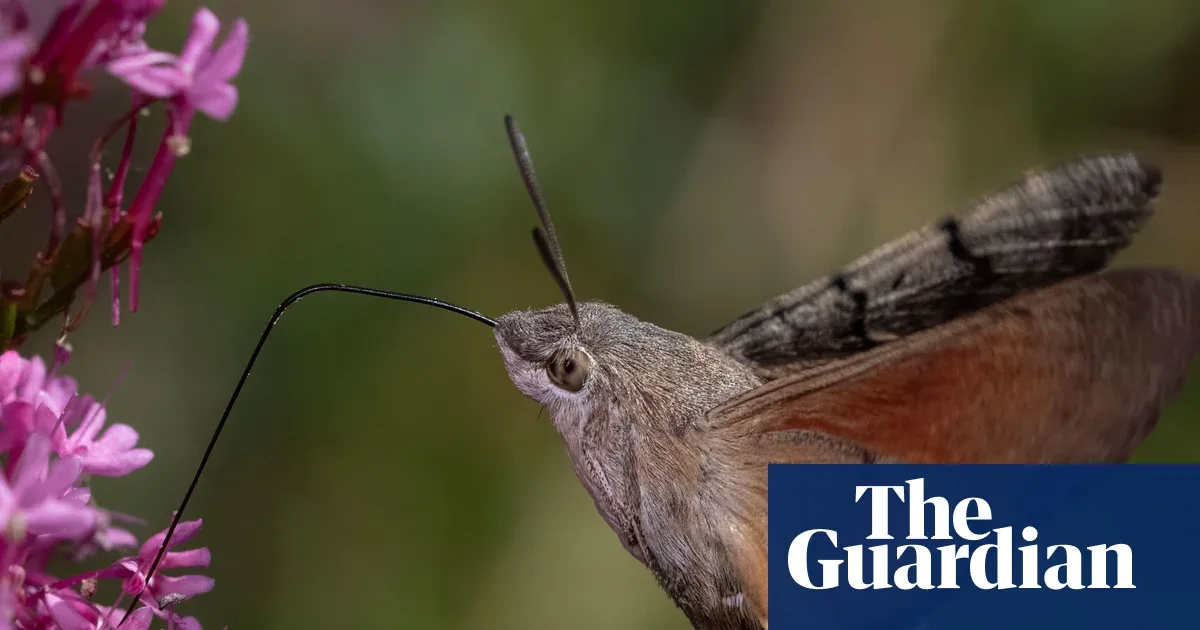
What is more striking, according to Crowley, is the explosion of migration this summer. "Every year there are trillions of insects arriving in Britain, migrating from the continent and even north Africa. They fly high into the air currents and use them as a lift," he explained. With record-breaking temperatures, this year has been a highly fertile season for migrant insects, especially conspicuous species such as the hummingbird hawk moth and hoverfly. Some species are beginning to breed and could potentially survive the winter in southern Britain.
Harry Witts, who found two new species in July, admits to having mixed feelings. The excitement of discovery is tempered by the awareness that "it's only happening because of climate change — a symptom of very damaging forces in our world." Witts, who works at Essex Wildlife Trust, found the blue-winged grasshopper (Sphingonotus caerulans) at Colne Point, Essex, which he believes is the first natural arrival on the mainland, rather than just a stowaway through the Channel Tunnel. A few days later, he and his colleague found the big-eyed bug species (Geocoris megacephalus) at the same location.
"Sometimes you will find something that becomes more problematic because it outcompetes other species. But generally many that arrive on their own don't tend to do that," said Phelps.
According to Crowley, most of these newcomers, if they survive and settle, will find their ecological niche and may even enrich the ecosystem. However, he does not deny the potential for disruption to the existing balance. Phelps added that species arriving naturally rarely cause major problems, though there is still the possibility of competition with local species.
Indonesian Context
The phenomenon of insects shifting northward due to global warming is not just a British story. Indonesia, as a tropical country with the highest biodiversity, faces a similar risk: climate change can alter the migration patterns of agricultural pests, disease vectors, and ecosystem balance. Rising sea and land surface temperatures have already triggered shifts in fishing grounds and the distribution of the Aedes aegypti mosquito that carries dengue fever into areas that were previously not endemic. If the warming trend continues, invasive species from other regions could enter and threaten food production and public health. The government and researchers need to strengthen biodiversity monitoring systems and preparedness for unexpected surges in insect populations.
Going forward, the question is no longer whether insects will continue to move north, but how quickly and to what extent the impact will affect ecosystems and humans. For Indonesia, early vigilance against changes in insect distribution is an inseparable part of climate adaptation and food security strategies.