Why Can Some Fighter Jets Fly Backwards?
Baca dalam 60 detik
- AV-8B Harrier dan F-35B mampu bermanuver mundur berkat sistem pendorong yang dapat diarahkan, bahkan melakukan pendaratan vertikal.
- Kemampuan ini krusial untuk operasi di kapal induk tanpa landasan pacu panjang, serta memberikan opsi pendaratan darurat.
- Teknologi VTOL dan vektor dorong terus berkembang, membuka peluang kerja sama industri pertahanan dengan Indonesia.
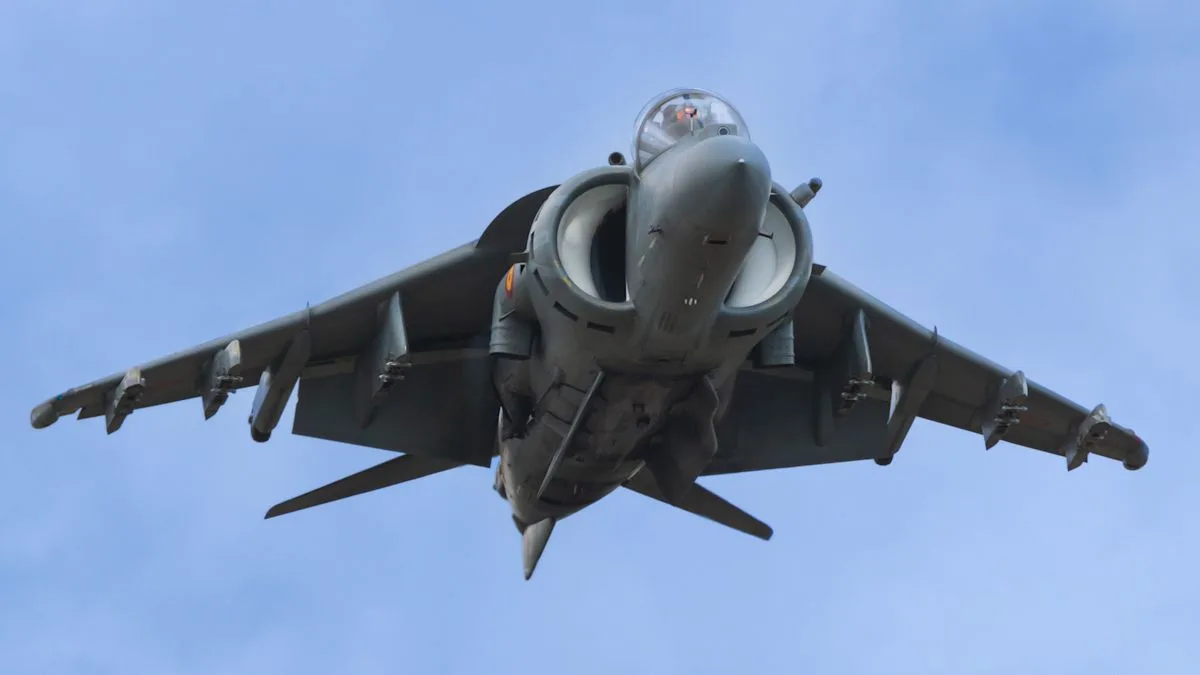
In the world of military aviation, the ability to fly backwards sounds impossible. However, some modern fighter jets can indeed do it. The secret lies in their vectored thrust systems, which allow the aircraft to maneuver backwards and even land vertically.
The legendary AV-8B Harrier is one of the earliest examples. Its engine produces a jet of gas that can be deflected up to 90 degrees, allowing the aircraft to take off and land without a runway. This capability is called Vertical Takeoff and Landing (VTOL). In addition to moving backwards, the Harrier can also hover in place and maneuver like a helicopter, while still maintaining the cruising speed of a fixed-wing aircraft.
The Harrier's successor, the Lockheed Martin F-35B Lightning II, also possesses similar capabilities. In 2018, a Royal Air Force test pilot successfully performed a backward landing with an F-35B on the aircraft carrier HMS Queen Elizabeth. This maneuver demonstrated an alternative landing option in emergency situations. The F-35B can hover thanks to the up to 40,000 pounds of thrust generated by its engine.
Unlike the Harrier and F-35, the F-22 Raptor is not designed for full backward flight. However, during sharp maneuvers, the aircraft can briefly slide backward before resuming forward motion. Its rotating engine nozzles enable vectored thrust to assist in maneuvering when lift is lost.
Besides fighter jets, other fixed-wing aircraft can also move backward, such as the Antonov An-2. This biplane is capable of flying very slowly, almost hovering or even moving backward when facing strong headwinds. This capability is useful for parachute training or operations in confined areas.
For non-fixed-wing aircraft, the CV-22 Osprey with its tiltrotors can also fly backward by tilting its rotors beyond the vertical position. Helicopters have long possessed this capability because their main rotor continuously spins, generating lift independently of forward speed.
“The ability to fly backward and hover provides significant tactical flexibility, especially in operations in confined terrain or aboard ships,” said a defense analyst.
For Indonesia, VTOL and vectored thrust technology offers valuable lessons. With its vast archipelago geography, the ability to take off and land vertically can support operations on remote islands or warships. Although the Indonesian Air Force (TNI AU) currently does not operate jets with such capabilities, defense industry cooperation with producer countries like the United States and the United Kingdom could be a strategic step. Furthermore, the development of VTOL drones for maritime surveillance is also increasingly relevant.
Looking ahead, innovations in propulsion systems will continue to push the boundaries of aircraft maneuverability. Will Indonesia adopt this technology to strengthen its air defense? Time will tell, but the opportunities are wide open.