Defense Ministry Enlists Regional Commands Down to Subdistrict Level in Cadet Corps Extracurricular, Observers Flag Risk of School Militarization
Baca dalam 60 detik
- Kementerian Pertahanan resmi mengintegrasikan jajaran TNI dari Kodam sampai Koramil sebagai pendamping ekstrakurikuler Korps Kadet Republik Indonesia (KKRI) di sekolah menengah.
- Program sukarela ini beroperasi lewat platform digital kkri.id dengan 45 video pembelajaran, tes minat bakat, dan sertifikat elektronik, namun memicu perdebatan soal batas antara pembinaan karakter dan pengaruh militer di ruang pendidikan.
- Ke depan, efektivitas KKRI akan bergantung pada pengawasan kurikulum, transparansi anggaran, serta kemampuan sekolah menjaga netralitas di tengah kuatnya kehadiran aparat wilayah.
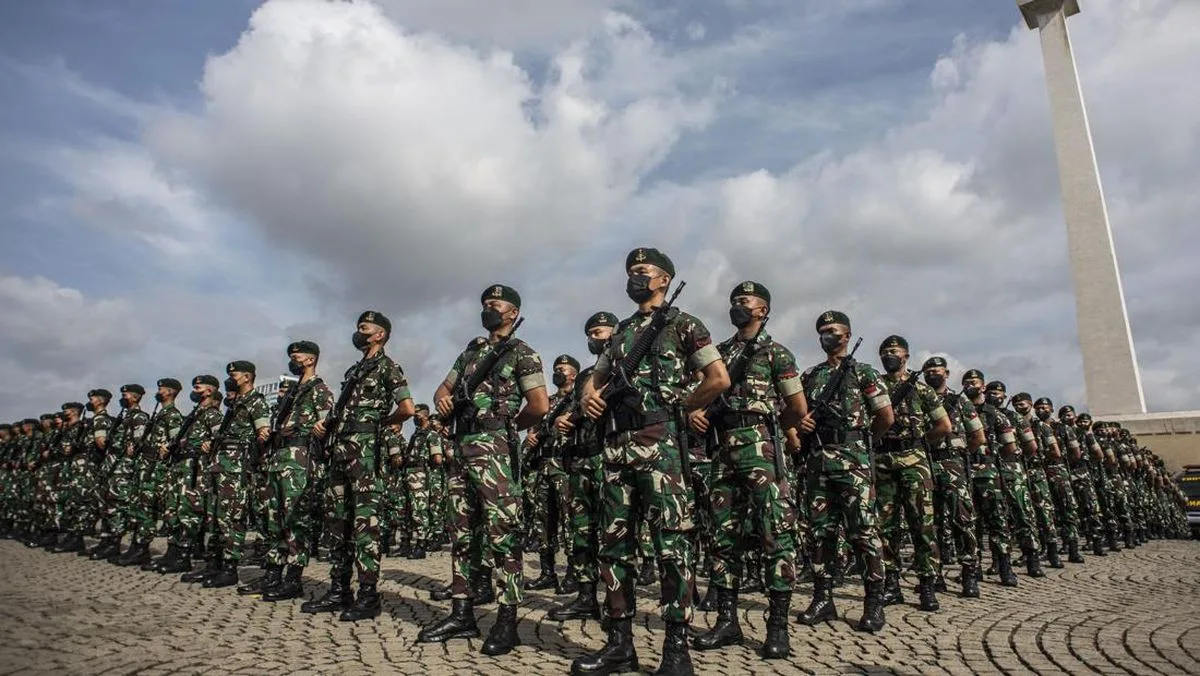
The Ministry of Defense (Kemhan) has confirmed that all TNI territorial commands—from Kodam, Korem, Kodim, down to Koramil—will take part in organizing the extracurricular Korps Kadet Republik Indonesia (KKRI) in secondary schools. The involvement of the regional military structure is stipulated through Ministry of Defense Decree Number 713 of 2026, which serves as the umbrella for establishing the program secretariat from the central level down to regencies and cities.
This step marks a shift in how the state instills national insight. If previously defense education was largely left to schools and youth organizations, now territorial personnel enter directly into the extracurricular space. Head of the Defense Information Bureau of the Kemhan Secretariat General, Brigadier General Rico Ricardo Sirait, emphasized that KKRI is voluntary and refers to Ministry of Primary and Secondary Education Decree Number 136 of 2026. According to him, Kemhan only facilitates, it does not mandate.
The coaching concept is designed as hybrid. In-person sessions at schools are accompanied by teachers who coordinate with regional secretariats at the Kodam to Koramil levels, focusing on strengthening character, ethics, and national insight. Meanwhile, the online track uses the kkri.id platform, which can be accessed by SMA/SMK/MA students using a Google account. It offers 45 learning videos divided into eight classes, covering the State Defense Module, Leadership, Negotiation and Conflict Management, up to Problem Solving and Civic Engagement. Each class is equipped with interactive quizzes and a digital certificate to support non-academic achievements.
The kkri.id platform also offers free potential mapping, including an interest and aptitude test using the 16PF theory approach to identify personality and career direction, as well as a cognitive test developed together with the TNI Psychology Center. For Kemhan, this combination is expected to become a coaching path that is easily accessible and relevant for the younger generation. "Through cross-ministerial collaboration and the support of regional apparatus, we hope KKRI becomes a positive means of coaching," Rico said in a written statement, Thursday (25/9).
However, the presence of territorial personnel in schools raises questions about the boundary between character education and the instilling of military culture. Deputy Minister of Primary and Secondary Education, Atip Latipulhayat, sought to ease those concerns. He emphasized that KKRI participants are not trained to become soldiers, but rather to have their awareness of state defense fostered. "The presence of this extracurricular is very appropriate and not mandatory. When a school organizes state defense awareness coaching, the school is actually fulfilling the student's right," Atip said at the program launch.
"Teachers and mentors are focused on strengthening character, ethics, and national insight materials." — Brig. Gen. Rico Ricardo Sirait, Karo Infohan Setjen Kemhan
On the other hand, education observers argue that a voluntary design does not automatically remove the risk of social pressure. In many regions, the presence of Koramil in the school environment can create unofficial expectations for students and parents to take part. The absence of a clear and independent complaint mechanism is a gap that needs to be anticipated. In addition, the use of psychological tests by a military institution for civilian students requires strict guarantees of personal data protection, especially since the test results concern a child's personality and career potential.
From a governance perspective, this program adds coordination burden between Kemhan, Kemendikdasmen, regional governments, and educational units. Without detailed technical guidelines, schools risk facing confusion in determining who is responsible, the schedule, and assessment. A budget sourced from the state budget (APBN) also demands transparency, given that this program touches thousands of secondary schools across Indonesia. The public has the right to know how much the platform development, mentor fees, and digital system maintenance cost.
Nevertheless, the substance of KKRI is actually in line with the need for character strengthening that has long been a homework for the education world. As long as its curriculum does not get trapped in uniform and marching symbolism, leadership, negotiation, and civic engagement materials can be an added value. The key lies in proportion: how large a share of national insight is given without eroding school autonomy and students' freedom of thought.
Going forward, the real test is not at the launch, but in implementation on the ground. Are schools given room to refuse or modify the program according to local context? How does an independent evaluation mechanism ensure there is no indoctrination? And just as important, can the state guarantee that the classroom remains a place where critical reasoning grows, not merely an arena for instilling barracks-style discipline? The public will judge from practice, not from claims on paper.